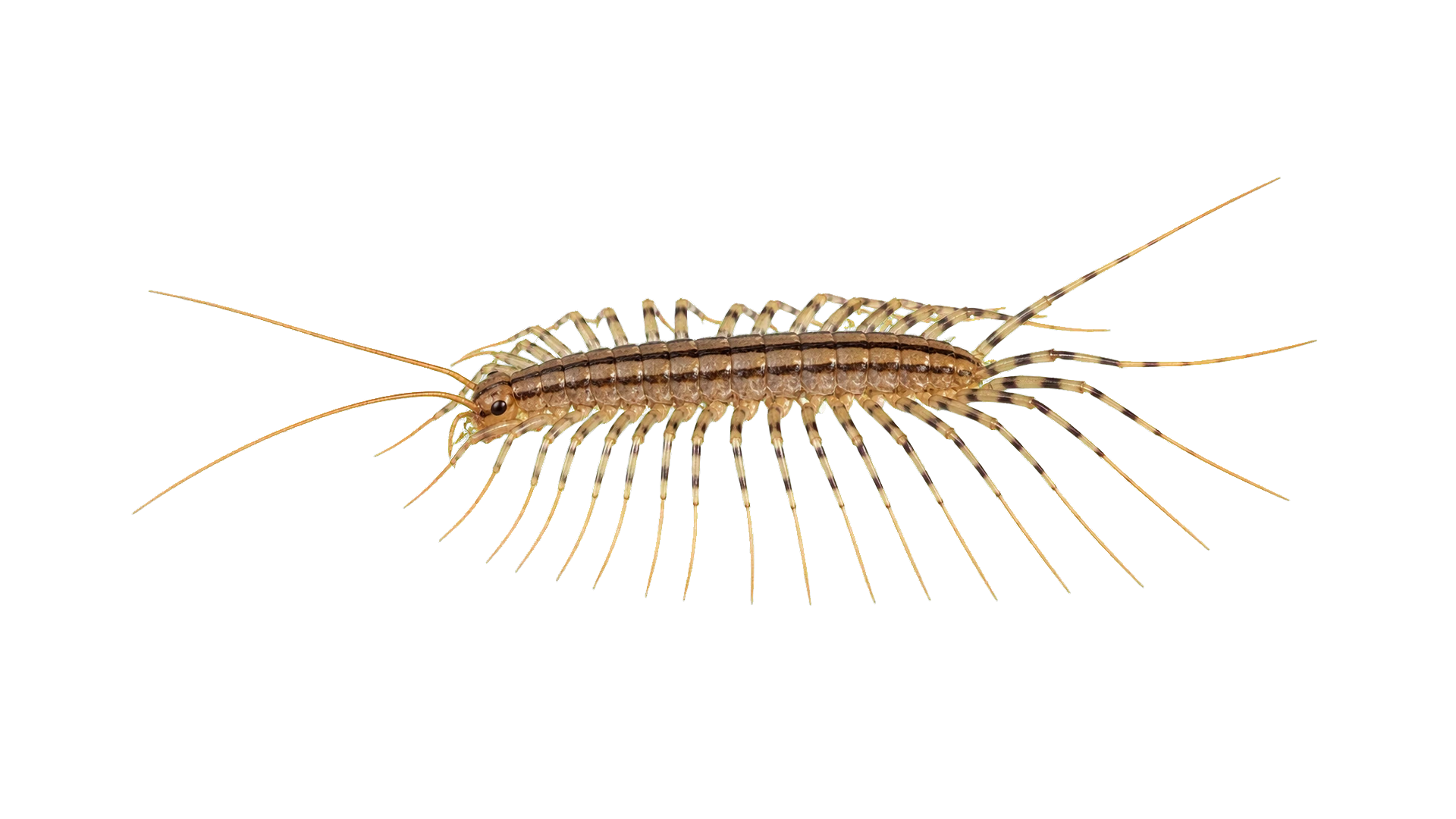
Long flat fast crawler
House centipedes are 1 to 1.5 inches in body length, with leg-to-leg span often closer to 3 inches. The flat profile and fluid running motion across walls or floors is unmistakable once seen.
Local pest control help is one call away.
 Pest Control Services Nationwide Pest Control Services Nationwide
 Centipedes are flat fast-moving predators with one pair of legs per body segment, long sweeping antennae, and venomous front claws (forcipules) used to subdue prey. The house centipede with its dramatic long legs is the species most North American homeowners encounter indoors, but several stout-bodied outdoor species occasionally enter as well. They eat other insects: silverfish, roaches, spiders, ants, and small flies. Their presence indoors is a sign that those prey populations are also present.
Centipedes need humidity. They lose body water rapidly through their cuticle and cannot survive long in dry interior air. Damp basements, bathrooms, crawl spaces, and laundry rooms give them survivable conditions. They also need prey, which is why heavy centipede activity usually means another pest issue is running below the homeowner's radar.
Reduce indoor humidity, address the prey population, and seal foundation entry points, and centipede sightings drop dramatically within weeks. Spray that does not address the prey or the moisture often produces only a brief lull.
Quick reads on centipedes:
House centipedes have 15 pairs of legs as adults and reach roughly 1 to 1.5 inches in body length, with legs extending several times the body width. Larger outdoor species can reach 6 inches or more. Generation time is slow: 1 to 3 years from egg to mature adult depending on species and climate.
Quick checks for distinguishing centipedes from millipedes and from other elongated household insects.
House centipedes are 1 to 1.5 inches in body length, with leg-to-leg span often closer to 3 inches. The flat profile and fluid running motion across walls or floors is unmistakable once seen.

Centipedes have one pair of legs sticking out sideways from each body segment. Millipedes (often confused with centipedes) have two pairs per segment and look more cylindrical. The leg arrangement is the single most reliable visual difference.

House centipedes are pale yellow-tan with three darker stripes running down the back. Outdoor stone centipedes are reddish-brown. The contrast and bold leg pattern make house centipedes look striking under a flashlight.
Centipede activity is mostly visual: homeowners see them rather than the indirect signs they leave. The presence itself is also a useful indicator that prey insects are sharing the home.
How Centipede Activity Develops
Centipedes are predators, not pests in the conventional sense. The reason they take up residence in a basement or bathroom is the presence of other small insects to eat. A home with chronic silverfish, occasional roaches, sowbugs, or pill bugs in the basement is a home with reliable centipede food. Removing the centipedes without addressing the prey usually creates a temporary vacuum: new centipedes find the same prey within months and the cycle repeats. The honest framing is that centipedes are a useful warning sign as much as they are a target.
Bites are uncommon and rarely medically significant. Most bites occur when a homeowner steps on or grabs a centipede that was sheltering in a shoe, towel, or bed. Pain is comparable to a bee sting and resolves within hours. Allergic reactions to centipede venom occur but are rare. The dramatic appearance of house centipedes and the speed at which they move drives most of the homeowner alarm rather than any actual medical risk.
Effective centipede control runs on three tracks. First, lower indoor humidity in basements, bathrooms, and crawl spaces. Centipedes cannot persist in dry interior air. Second, address the prey population: a silverfish or spider issue downstream often resolves the centipede issue upstream. Third, seal foundation entry points and apply pro residual treatment around the perimeter and to crawl space and basement boundaries. With those three pieces in place, centipede sightings decline sharply within weeks.
Six features that confirm a centipede ID and explain how they move, hunt, and survive indoors.
Each segment has a single pair of legs splayed outward. Millipedes have two pairs. The single-pair arrangement also lets centipedes run quickly in a fluid undulating motion.
Two long thread-like antennae sweep ahead of the head and detect prey, moisture, and obstacles. House centipede antennae are nearly as long as the body.
The first pair of legs behind the head is modified into venomous claws called forcipules, used to subdue prey. These are the structures that bite defensively, not walk.
Centipedes are dorsoventrally flat, letting them slip into narrow gaps under doors, behind baseboards, and through foundation cracks. This is why they hide so well by day.
House centipedes have long trailing rear legs (the false head) that sense vibration behind them. The legs detach defensively like a lizard's tail and regrow.
House centipedes have prominent faceted eyes that detect movement and light. Outdoor stone or soil species have limited vision and rely on antennae. All prefer darkness.
Match the centipede situation in your home to the most likely cause and treatment direction.
Centipede urgency is rarely about the centipedes themselves. They are predators feeding on whatever silverfish, roaches, sowbugs, or spiders are already in the home. The real timeline below tracks both the visible centipede activity and the hidden prey population driving it.
A single house centipede spotted in a basement, bathroom, or damp closet. Most are solo hunters. A single sighting often signals a hidden prey population, but the centipede itself isn't an urgent issue yet.
Multiple centipedes in the same area, or recurring sightings in living spaces. Prey base is established, often a hidden silverfish or roach population that DIY inspection hasn't surfaced yet but is doing real work.
Centipedes in multiple rooms (including bedrooms or kitchens), or sightings during daytime. Prey population is significant. The other pests centipedes feed on are likely worse than visible evidence suggests.
Long-term population in living spaces, 3-inch-plus centipedes appearing regularly, or visible roach and silverfish activity. The problem is now layered: centipedes plus their food source, both needing treatment in coordinated visits.
If you have a heavy centipede population, you have a heavy insect population feeding it. Treat the prey species and the centipedes leave on their own within weeks.
Local pros find the prey insects feeding the centipedes, address the moisture conditions keeping them indoors, and treat the harborage that surface spray alone never reaches.
Centipedes need three things indoors to persist: humidity above 60 percent, accessible prey, and dark harborage. Remove any one and the population drops substantially. Remove all three and the issue resolves durably within weeks rather than months.
Different centipede species respond to different conditions. House centipedes (Scutigera coleoptrata, the long-legged species most homeowners encounter) thrive in basement and bathroom moisture and hunt silverfish, small roaches, and sowbugs around baseboards. Stone centipedes and soil centipedes are stockier outdoor species that occasionally wander in through foundation cracks; they rarely establish indoors but bite more painfully if grabbed. Knowing which species is on the wall determines whether the issue is indoor moisture or outdoor exclusion.
Most affected homes have two or three of these conditions running at once. Start with a basement dehumidifier (the single highest-impact change in most homes), then investigate the prey insect picture (silverfish in the laundry, sowbugs in the crawl, small spiders along baseboards). Reducing moisture by itself often shrinks both prey and centipede populations simultaneously, which is part of why moisture work pays double for this category.
The most common indoor centipede habitat. Damp masonry walls, floor drains, and sump pits combine humidity with reliable hunting territory for small prey.
High-humidity rooms with reliable moisture and access to the wall voids beneath. Behind toilets and washing machines are common harborage points.
Crawl spaces with dirt floors and missing vapor barriers offer ideal centipede habitat. Many of the centipedes seen in living spaces above are coming from the crawl below.
Mulch beds, leaf piles, and damp wood piles around the foundation are the source population for outdoor centipedes that occasionally wander in.
Cracks in foundation walls, gaps around utility penetrations, and unsealed crawl space access doors are the primary entry routes from yard to basement.
Slow leaks, condensation on cold pipes, and the warm humid microclimate around water heaters give centipedes a comfortable place to wait between hunts.
Centipedes are slow-developing predators. Populations grow over years rather than months, but they also persist for years once established.
1 to 3 months
Females lay eggs singly or in small groups in damp soil, leaf litter, or indoor harborage. Some species exhibit maternal care of the eggs and early instars.
Several months
Hatchling centipedes have fewer leg pairs than adults and add segments and legs across successive molts. Several molts are required before the adult leg count is reached.
1 to 2 years
Subadult centipedes have the full adult leg count but are not yet sexually mature. They feed actively and represent the bulk of any indoor population at any given time.
Lives 3 to 7 years
Adults reproduce annually under favorable conditions. Long lifespan compared to most household insects means an established population persists for years even with moderate ongoing pressure.
Generation time runs 1 to 3 years depending on species and climate. The slow life cycle means centipede populations build gradually but also that a treated population takes time to fully clear, since long-lived adults remain even after reproduction is suppressed.
Most centipedes are harmless predators of other pests. Match what you're seeing to identify which one.
| Species | Severity | Key Sign | Where You'll Find Them |
|---|---|---|---|
| House Centipedes | Nuisance | Fast-moving on walls and ceilings at night, indicates other pest prey present | basements, bathrooms, crawl spaces |
Severity reflects typical impact, not your specific case. If unsure, treat at the higher tier.
Honest read on the centipede options. The species rewards prey-and-moisture work. It ignores almost every visible-bug spray approach because the population sustains itself off prey insects the spray never touches.

 Address the silverfish, roach, sowbug, or spider issue providing the food Centipede activity often drops sharply within 60 days of resolving the prey issue Comprehensive inspection is the first step in any serious centipede program Dehumidify basements to keep humidity below 50 percent Install a vapor barrier and improve ventilation in crawl spaces with bare soil Repair plumbing leaks and condensation issues at water heaters and HVAC equipment Pro residual treatment along baseboards, behind appliances, in crawl spaces, and at the foundation perimeter Seal foundation cracks, plumbing penetrations, and crawl space access doors Quarterly maintenance visits combined with the homeowner's moisture and prey work
  Removes one individual but leaves the prey insects still in the home New centipedes find the same conditions within weeks Treats symptom rather than cause Kills wandering foragers but does not reach harborage in walls and crawl spaces Does nothing about the prey population sustaining the centipedes Visible improvement is usually short-lived Foggers do not penetrate cracks, voids, or crawl space soil where centipedes shelter Pesticide residue on stored items with limited progress on the actual population Almost never the right tool for centipede pressure
 Six prevention steps sorted by effort. Moisture and prey work first; sealing and treatment amplify those wins.

A dehumidifier set to 45 percent in the basement makes the space inhospitable to centipedes and their prey. The single highest-impact change for most homes.

Walk basement, bathrooms, and crawl spaces with a flashlight monthly. Catching a silverfish or sowbug issue early prevents the centipede issue that usually follows.

Caulk visible cracks in foundation walls, seal around utility penetrations, and replace damaged crawl space access doors. Most outdoor centipedes enter through a few specific gaps.
A continuous plastic vapor barrier across crawl space soil cuts moisture rising into the home and dramatically reduces prey insect and centipede populations beneath.

Pro residual treatment along basement and crawl space boundaries plus the foundation perimeter, repeated quarterly, keeps populations from rebuilding.

Move stored boxes off the floor and away from walls, organize stacks to reduce dark harborage, and clear unused materials. Less clutter means less hiding space for prey and predators.
Indoor centipedes can be active year-round in damp homes; outdoor species follow seasonal patterns more closely.
Outdoor centipede activity resumes as soil warms. Wet springs increase outdoor populations near the foundation. Indoor sightings rise as foragers explore from crawl spaces upward.
Peak outdoor activity. Indoor populations remain steady where humidity supports them. Bathroom and basement encounters peak alongside silverfish and other prey populations.
Outdoor centipedes seek overwintering shelter near foundations; indoor sightings often spike during cool wet fall weeks as more individuals slip in.
Outdoor populations dormant; indoor populations continue in heated humid basements and crawl spaces. Sightings drop in cold-climate homes with dry winter interiors.
Four steps from arrival to a layered plan that addresses prey, moisture, and harborage together. Initial visit runs 60 to 90 minutes and pulls in inspection of every damp space (basement, crawl, bath, laundry) plus the foundation perimeter.
Inspect the food chain, address the moisture, treat the harborage. Centipede control is multi-pest control. Pros look at the whole basement ecosystem, not just the centipedes themselves.
Walk basement, crawl space, bathrooms, and laundry rooms. Identify centipede activity, prey insect activity, moisture sources, and likely entry points and harborage zones.
Identify dehumidifier needs, ventilation improvements, vapor barrier opportunities, and any plumbing leaks contributing to the humidity profile of the home.
Apply residual product along baseboards, in crawl spaces, behind appliances, at foundation perimeters, and at known entry points. Adjust to whichever prey insects are also active.
30-day follow-up assesses progress on both centipede and prey populations. Quarterly maintenance visits combined with the homeowner's moisture work resolve most cases inside 90 days.
Real stories from households that addressed both the centipedes and the prey insects keeping them indoors.

"Indoor centipede sightings dropped sharply."
Finding centipedes in the house was alarming, especially with kids around. The tech treated the perimeter and interior and explained how moisture management reduces their presence. We see them far less often now.
"Indoor centipede sightings dropped sharply."
Finding centipedes in the house was alarming, especially with kids around. The tech treated the perimeter and interior and explained how moisture management reduces their presence. We see them far less often now.

"Shower centipedes sealed out for good."
Large centipedes kept showing up in the bathroom, especially during rainy weather. The provider treated the perimeter and sealed gaps around plumbing penetrations. Reducing moisture and leaf debris near the foundation made a lasting difference.
Direct answers to the questions homeowners ask most about centipedes, bites, and basement encounters.
Centipedes are venomous to their prey insects, but bites on people and pets are uncommon and rarely medically significant. The venom is intended for paralyzing small arthropods, not mammals. Most bites occur when a centipede is handled, stepped on, or rolled onto in bed, and the result is localized pain comparable to a bee or wasp sting that resolves within a few hours to a day. House centipedes (the long-legged species most often seen indoors) are particularly unlikely to bite; their first instinct is to flee. Larger outdoor centipede species are more capable of breaking human skin and can produce more pronounced pain and swelling, but encounters are infrequent. Allergic reactions to centipede venom occur but are rare. Pets that mouth a centipede may experience the same brief sting with no lasting consequence. Severe pain, spreading redness beyond a few inches, signs of infection, or any systemic symptoms warrant medical evaluation, but typical bites need only soap, cool compress, and patience.
Three structural differences are diagnostic. First, leg arrangement: centipedes have one pair of legs per body segment, sticking out sideways, while millipedes have two pairs per segment, tucked under the body. Counting leg pairs on any one segment is the single most reliable test. Second, body shape: centipedes are flat and elongated, while millipedes are cylindrical and worm-like. Third, behavior: centipedes are fast, agile predators that flee or attack when disturbed, while millipedes are slow scavengers that curl into a defensive coil when bothered. Lifestyle is also distinct. Centipedes hunt other insects and need both moisture and prey. Millipedes feed on decaying plant material and need only damp soil and organic matter. The two are sometimes found in the same basement or crawl space, but for very different reasons. Treatment approaches differ accordingly: centipede control runs through prey insects and humidity, while millipede control runs through moisture and outdoor harborage like mulch beds.
The long legs are a hunting and survival adaptation. House centipedes (Scutigera coleoptrata) are visual predators that chase insect prey across walls, ceilings, and floors. Long legs let them cover ground quickly relative to body length and lift the body well off the surface, which protects against the sticky webs of spiders that share the same habitat. The trailing rear legs (which can look like a second set of antennae and lead to the species being called the false head) sense vibration and air movement behind the animal and contribute to its remarkable ability to escape predators. The legs are also detachable as a defense mechanism; a grabbed leg breaks off and the centipede continues running, with regrowth occurring across subsequent molts. The dramatic appearance the legs create also drives most of the alarm homeowners feel on first encounter. The honest framing is that the legs make house centipedes look more menacing than they actually are; the species is essentially harmless and consumes a number of insects most homeowners would rather not have around.
There is a real argument for low-population tolerance. House centipedes consume silverfish, roaches, spiders, ants, small flies, and other small insects, so a single centipede in a basement is doing some unpaid pest control. For homeowners who can tolerate occasional sightings, leaving low-level house centipede populations alone is biologically defensible. The argument breaks down at higher pressures or in certain rooms. Multiple centipedes weekly across living areas is a quality-of-life issue most homeowners do not want to live with. Encounters in bedrooms, nurseries, or on countertops are also generally unacceptable regardless of how harmless the species is. And critically, a heavy centipede population is itself a signal of significant prey insect activity in the home, which usually deserves investigation in its own right. The middle path that works for many households is investigating and addressing the prey, dehumidifying the basement, sealing foundation entry points, and accepting that occasional house centipede sightings in the basement are a fair trade for a generally pest-light home.
Three pieces working together resolve most basement centipede issues within 60 to 90 days. The first is moisture: a dehumidifier in the basement set to 45 percent makes the space far less habitable for centipedes and the prey insects they hunt. The second is prey reduction: identifying and treating the silverfish, sowbug, roach, or spider populations supplying the food. Pro residual treatment along baseboards, behind washing machines and water heaters, and at the foundation interior addresses both the prey and any surface-active centipedes. The third is exclusion: sealing foundation cracks, gaps around plumbing penetrations, and unsealed crawl space access doors so new outdoor centipedes stop replacing the ones being treated. Skipping any one of these steps tends to produce a temporary lull followed by new sightings within a few months. Combining all three reliably resolves the issue, and quarterly preventive visits afterward keep the population from rebuilding. Homeowners with crawl space dirt floors or chronic exterior drainage issues may need additional structural fixes for lasting results.
House centipedes can and do reproduce indoors in homes with suitable humidity, prey, and harborage, particularly in damp basements and crawl spaces. Females lay eggs singly or in small clutches in soil-filled cracks, crawl space substrate, or dark moist harborage along basement walls. Some species exhibit maternal care, with the female remaining with the eggs and early instars. The slow life cycle (1 to 3 years from egg to mature adult) means indoor reproduction does not produce population explosions the way roach or silverfish reproduction does, but it does sustain a long-term indoor population if conditions remain favorable. Larger outdoor centipede species rarely reproduce indoors; their breeding is overwhelmingly tied to outdoor soil and leaf litter, and indoor encounters are usually individuals that wandered in. The practical implication is that house centipede issues are often genuinely indoor populations needing indoor and crawl space treatment, while occasional larger centipede encounters are exterior issues addressed through perimeter and exclusion work.
Yes, professional treatment can substantially reduce or eliminate indoor centipede populations safely when applied as part of a layered plan. Pro residual products labeled for centipedes are applied along baseboards, behind appliances, in crawl spaces, and at foundation perimeters at concentrations and locations that are safe for occupied homes when used per label. Combined with addressing the prey insect populations, dehumidifying the basement, and sealing foundation entry points, professional treatment typically reduces sightings dramatically within the first month and resolves most cases within 90 days. Quarterly maintenance visits afterward keep populations from rebuilding. The honest framing is that centipede elimination, defined as zero sightings ever, is unrealistic in homes with chronic crawl space humidity or persistent yard pressure; substantial reduction to occasional rare sightings is the realistic and achievable target. Homeowners who pair the professional work with their own moisture and storage management routinely report long-term success and a basement they actually want to use.
Address the prey, dry the basement, seal the foundation, and treat the perimeter. Local pros build a centipede plan around all four pieces, not just one.
Click through for species pages on house centipedes and the larger outdoor species occasionally found near foundations.
Long-legged, fast-moving centipedes that hunt insects inside homes.
House centipedes have 15 pairs of legs and move at startling speed across walls, floors, and ceilings, primarily hunting roaches, silverfish, and spiders at night. They prefer damp, dark areas like basements, bathrooms, and crawlspaces. While their bite is harmless to most people, their alarming appearance makes them one of the most feared household arthropods.
Quick ID:
Why it matters: