Notably larger than yellowjackets
Hornets run 20 to 35 mm long, nearly twice the size of a yellowjacket. If a stinging insect looks too big to be a regular yellowjacket, it is almost always a hornet.
Local pest control help is one call away.
 Pest Control Services Nationwide Pest Control Services Nationwide
 Two hornet species cover almost every situation in North America: the bald-faced hornet (technically a large yellowjacket that builds the iconic gray paper aerial nests) and the European hornet (Vespa crabro, the only true Vespa hornet established here). Both build colonies of 400 to 700 workers and defend perimeters 10 to 30 feet wide. Asian giant hornet sightings get headlines, but actual property risk comes from these two.
Hornet colonies are larger and louder than typical wasps. A mature bald-faced hornet nest holds 400 to 700 workers in a basketball-sized gray football hanging from a tree branch, eave, or large shrub. European hornet nests run 300 to 500 workers and hide inside hollow trees, attics, barn lofts, or wall voids. Both deliver smooth stingers that strike repeatedly.
Three property conditions sustain almost every colony you see in mid-August.
What hornet queens are actually after:
A mature bald-faced hornet colony reaches 400 to 700 workers by August. European hornet colonies run 300 to 500 workers and persist into late October in mild climates. Hornet stings deliver 4 to 10 times the venom volume of a typical paper wasp sting, which is why the pain reputation is earned. A single hornet stings repeatedly because the stinger is smooth and does not detach. Defense extends 10 to 30 feet from the nest.
Three checks separate a hornet from a yellowjacket or large paper wasp in 5 seconds.
Hornets run 20 to 35 mm long, nearly twice the size of a yellowjacket. If a stinging insect looks too big to be a regular yellowjacket, it is almost always a hornet.

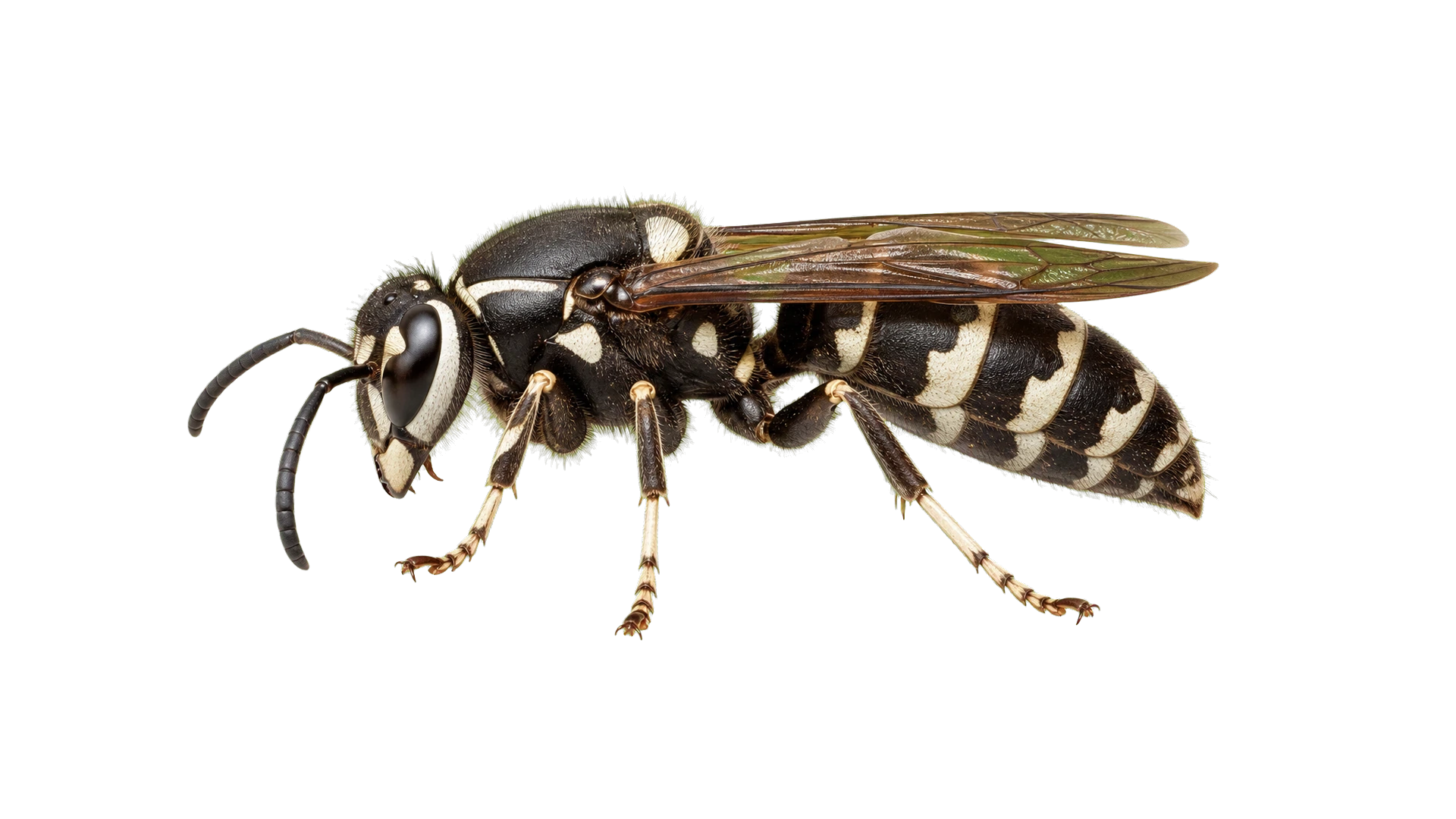
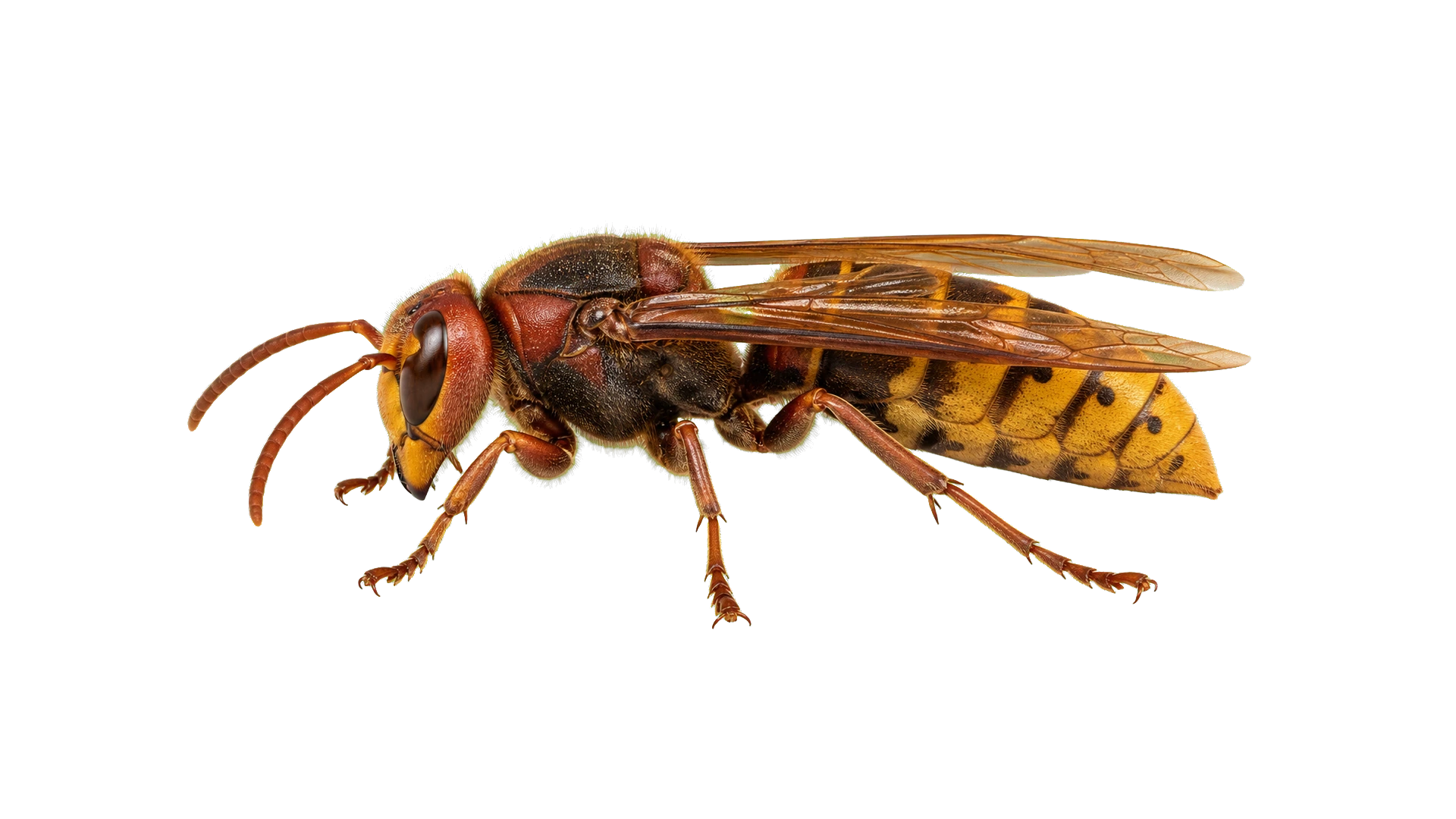
Bald-faced hornets are matte black with white face and tail markings. European hornets are reddish-brown with yellow abdominal bands and a pale face. Either pattern rules out wasps.

Aerial gray paper football on a branch, eave, or shrub equals bald-faced hornet. Wall void or hollow tree entry plus reddish-brown body equals European hornet.
Hornet nests usually announce themselves once foliage thins or colony activity peaks in August. Most homeowners spot the nest itself before they notice individual hornets. A football-sized gray paper sphere above the deck is hard to miss once you know what you are looking at.
European hornets behave differently because they nest in cavities and forage at night. The first clue is often reddish-brown hornets bumping into porch lights and lit windows after dark. The second is sustained day traffic at a hollow tree, gable vent, or attic louver. Indoor buzzing inside walls during summer means the colony is already established.
Late-summer foraging adds a third sign. Workers visit ripe fruit, hummingbird feeders, and outdoor meals as the colony scales toward its 700-worker peak. Solo hornets at flowers without an obvious nest usually come from a colony within 200 to 500 feet, sometimes on a neighbor's property. A perimeter walk identifies the source.
How a Hornet Nest Builds Through the Season
Hornets are predatory wasps that hunt insects to feed larvae. Bald-faced hornets pick spiders, flies, and other wasps off vegetation and carry them back to the aerial nest. European hornets are unusual among stinging insects because they forage actively at night, drawn to porch lights and lit windows where they pick off moths and beetles. Both species visit flowers for nectar to fuel adult activity.
Defense is more aggressive and longer-range than typical wasps. The colony stations sentry hornets at the nest entrance who release alarm pheromones at the first vibration or movement, and a defensive cloud emerges within seconds. The defended perimeter extends 10 to 30 feet, much further than a paper wasp will pursue. Most serious sting incidents on residential property involve hornets or yellowjackets, almost never paper wasps or bees.
Removal is more demanding than paper wasp work. Aerial bald-faced hornet nests above 12 feet require ladder work or extension equipment, full protective gear, and dusk timing. European hornet void colonies require dust formulations injected at the entry plus careful sealing to prevent the colony from chewing through interior drywall into living space. Both situations are pro work for households without bee suits and 20-foot extension poles.
Six features that separate a hornet from a large yellowjacket or paper wasp.
Hornet heads are proportionally wider than wasp heads. Powerful mandibles chew bark for nest fiber and dismember prey. The wide head is the fastest distance-ID for a hornet.
The thorax is noticeably stockier than a yellowjacket or paper wasp, supporting the muscular flight needed to carry larger prey loads back to the nest.
Smooth glossy body with only sparse short bristles. Rules out bee identification immediately, since bees are visibly fuzzy. Smooth plus large equals hornet.
Four wings total, hooked together in flight. Hornet wings handle sustained powered flight better than smaller wasps. Wings fold lengthwise alongside the body at rest.
Smooth straight stinger withdraws cleanly, so a single hornet delivers dozens of stings. Venom volume is 4 to 10 times higher than a paper wasp sting.
Bald-faced hornets are matte black with bright white face and tail markings. European hornets are reddish-brown with yellow abdominal bands and a pale face.
Match the pattern below to identify the hornet species and figure out the right next step.
Hornets are the most aggressive social wasps in North America. Colonies grow faster, stings hurt more, and the defensive zone extends 10 to 30 feet from the nest. The timeline below maps the season.
A solo queen building a golf-ball starter nest under an eave, in a tree branch, or in an attic cavity. Fewer than 10 hornets active. Easiest possible removal: one aerosol shot ends it.
Nest is basketball-sized with 50 to 200 active workers. Defensive zone now extends 20 feet around the nest. Anyone walking past, mowing the lawn, or running yard equipment risks repeated stings.
Full-size nest (basketball or larger) with 300 to 700 hornets. Bald-faced hornets mount sustained group attacks at the slightest disturbance. Anaphylaxis risk is significant for anyone with sting allergy.
Hidden nest in a wall, soffit, or attic with 700 to 1,000+ hornets, or any nest within 30 feet of high-traffic outdoor areas. New queens emerge and aggression peaks. Wall-void hornets chew through drywall.
Hornets are not wasps with bigger stingers. They are a different threat entirely. Treat any nest closer than 30 feet to the house as a priority, regardless of stage.
Local pros bring extension equipment, full protective bee suits, and the right dust formulations to treat aerial and void hornet nests safely.
Hornets do not pick yards at random. They follow signals: a tall shaded shrub that hides an aerial nest, a hollow tree or unscreened gable vent that offers a cavity, a hummingbird feeder that supplies quick sugar to late-season workers. A founding queen scouts a few hundred yards each spring, and once she anchors a nest, the colony scales from 1 to several hundred workers across a single summer.
Different hornet species chase different rewards, which is why ID matters. Bald-faced hornets (Dolichovespula maculata) build large gray paper aerial nests in trees and large shrubs and hunt other insects through the day. European hornets (Vespa crabro) are the only true Vespa in the US, nest in hollow trees, attic voids, and wall cavities, and forage at night on porch lights for moths and beetles. Bald-faced workers max out around 400 per colony; European hornet colonies reach 200 to 400 with much larger individual workers (over 1 inch). Knowing the species tells you whether the nest is in a tree limb or inside a wall.
What you see is roughly 5 percent of an active colony. The other 95 percent (queen, brood, in-nest workers) sits inside the paper envelope or the cavity, which is why hitting the visible workers with a can of spray almost never ends the issue. Start with the highest-leverage source: locate the actual nest by tracing workers at dusk back to the entrance hole. Then schedule treatment after dark when foragers are inside. Even partial wins help: a single confirmed nest treatment can end the season for the property, and screening one open attic vent in May prevents queens from setting up the following year.
Bald-faced hornet nests hang from horizontal branches 10 to 60 feet up. Late-summer leaf drop often reveals nests that were hidden by foliage all season.
Aerial hornet nests sometimes hang from eaves and porch ceilings, especially on second-story sides protected from wind and weather.
European hornet entry points. The vent louvers, ridge vents, and torn screen vents on warmer sides of the house are typical access for cavity-nesting queens in spring.
European hornet colonies can establish behind brick veneer, in chase voids, and around chimney crowns. Indoor buzzing in walls during summer is a classic sign.
Hornet aerial nests inside sheds and barns, hanging from rafters or in upper corners, are common on rural properties. Always look up before entering an open outbuilding in summer.
European hornets favor cavities in dead or dying trees within 50 to 100 feet of structures. Removing dead snags reduces local nesting habitat substantially.
The colony arc explains why a tennis-ball nest in June becomes a basketball nest by September.
5 to 8 days
The overwintered queen lays eggs into hexagonal cells inside the founding envelope. Eggs hatch in under a week in warm summer weather.
12 to 14 days
Larvae are fed chewed insect prey by the queen, then by emerging workers. The first generation of workers emerges 4 to 6 weeks after queen establishment.
12 to 14 days pupa, 3 to 5 week workers
Cells are capped while larvae pupate. Each round produces a new wave of workers. By mid-July the colony holds hundreds of workers and grows weekly.
A founding queen in May produces a nest the size of a tennis ball by mid-June. By August the same colony fills a basketball-sized envelope holding 400 to 700 hornets. The earlier the nest is identified and treated, the smaller the population to handle and the lower the risk during removal.
Hornets sting, defend nests aggressively, and can be dangerous to disturb. Match what you're seeing to identify which one.
| Species | Severity | Key Sign | Where You'll Find Them |
|---|---|---|---|
| Bald-Faced Hornets | Medical | Large gray paper nest hanging from trees or building overhangs | trees, shrubs, under eaves |
| European Hornets | Medical | Large paper nests in hollow trees and wall voids, attracted to lights at night | tree hollows, wall voids, attics |
Severity reflects typical impact, not your specific case. If unsure, treat at the higher tier.
Honest read on common DIY methods and where each helps or backfires with hornets specifically.

 12 to 20 foot extension poles plus dust or aerosol applicators reach above eaves and into trees Full protective bee suit eliminates the multi-sting risk inherent in DIY work Dusk timing means foragers are home and the colony is clustered and treatable in one pass Insecticidal dust injected at the entrance is carried back into the nest by returning foragers Workers track dust onto larvae and other adults, treating the colony from within Avoids the drywall chew-through that always follows daytime sealing Watch overhangs and tree limbs in May for solo founding queens building golf-ball-sized starter nests A solo queen at this stage is the easiest possible removal: a single aerosol shot does the job Catches a colony before it ever has workers to defend it
  Spray range is shorter than the hornet defensive perimeter Single can rarely delivers enough product to penetrate a basketball-sized envelope Most stings happen during exactly this attempt The bag fills with defending hornets and tears at the seam under weight Hornets pour out at face level and pursue the homeowner at speed Among the most common ways multi-sting hospitalizations happen Trapped hornets chew through interior drywall into living space within hours Active foragers returning from outside concentrate at the sealed entry Pushes a serious problem from the wall into the kitchen or bedroom
 Six prevention moves sorted by effort and timing. Most prevention happens in spring or fall, not during the active summer.

Inspect tree branches, eaves, and shed corners for solo founding queens building golf-ball-sized starter nests. A single aerosol shot at this stage handles what would otherwise be 400 hornets in August.

Repair or replace gable, ridge, and soffit vent screens before April. These openings are how European hornet queens reach attic and void cavities for spring nest sites.

European hornets forage on moths and beetles drawn to porch lights. Switching to motion-activated lighting or yellow bug lights reduces nighttime hornet activity around entries by a noticeable margin.

Hollow dead trees within 100 feet of the home are prime European hornet cavity sites. Taking down dead snags reduces local nesting habitat and shifts queens to neighboring properties.

Caulk cracks at fascia trim, around chimney crowns, and at dryer vents. Quarter-inch gaps are sufficient entry points for European hornet queens establishing void colonies in May.

Pro residual application on eaves, soffits, and accessible structural surfaces in April or May discourages founding queens from establishing on the structure. Most cost-effective insurance against a basketball-sized nest in August.
Hornet threat is heavily seasonal. Most stinging incidents occur in a narrow late-summer window when colonies peak.
Founding queens scout and start golf-ball-sized starter nests in trees, attics, and hollow cavities. Spring is the cheapest, safest control window of the year and the only stage a homeowner can reliably address alone.
Workers expand nests through June and July. By late July aerial nests are visible and colonies hold hundreds of hornets. Treatment is feasible but requires extension equipment and protective gear.
Late summer through early fall is peak threat. Colonies are largest, most defensive, and most easily provoked. Most serious sting incidents happen during this window. European hornet colonies persist into October in mild climates.
Workers and males die off; only mated queens overwinter in protected spots like loose bark, mulch piles, and attic insulation. Empty aerial nests become brittle and can be removed safely once temperatures stay below freezing.
Four steps from arrival to confirmed colony shutdown. Most single-nest visits run 45 to 90 minutes including setup and follow-up planning.
Identify, suit up, treat at dusk, verify shutdown. Real hornet work is matched to species, location, and time of day. Daytime spray-and-bag is the most common cause of multi-sting hospitalizations.
Confirm bald-faced hornet vs European hornet vs misidentified yellowjacket. Identify the exact entry point or branch attachment, and assess nest size and approach access.
Full bee suit, extension equipment if needed, and a deliberate retreat path. Treatment is timed 30 to 60 minutes after sunset when foragers have returned and the colony is clustered.
Aerial nests get pole-applied dust or pressurized aerosol soak. Void colonies get insecticidal dust injected at the entry, carried into the nest by returning workers.
Activity ceases within 24 to 72 hours. After confirmed zero traffic, aerial nests can be removed and void entries sealed permanently to prevent drywall chew-through.
Stories from households who connected with pros for aerial bald-faced hornet nests, European hornet wall voids, and other large stinging-insect colonies.

"No pressure, just options."
I appreciated being given eco-friendly options without being pushed. The technician explained tradeoffs honestly and let me decide based on my priorities. They were transparent about what each approach involves. The no-pressure approach and honest information helped me make a confident decision.
"No pressure, just options."
I appreciated being given eco-friendly options without being pushed. The technician explained tradeoffs honestly and let me decide based on my priorities. They were transparent about what each approach involves. The no-pressure approach and honest information helped me make a confident decision.

"The inspection caught what we missed."
I didn't realize how much damage raccoons can cause once they get inside. The wildlife specialist explained what areas they inspect first and why raccoon issues are handled more carefully than regular pests. They showed me the damage and explained removal and exclusion strategies. Understanding the potential for damage made me glad I called professionals.

"The problem finally stayed gone."
Ants kept returning no matter what we did. The tech treated the trail areas and explained how to handle food storage and moisture so the ants don't keep coming back. It's been months and we haven't seen them again. I appreciated that it wasn't just a one-and-done spray.

"Clear expectations and a real plan."
I was overwhelmed and didn't know what was realistic to fix quickly. The inspector explained what results to expect and how long it typically takes depending on the ant species. They treated the right places and gave simple prevention tips. Everything felt structured and easy to follow.

"They found the entry points fast."
Ants were showing up in the kitchen and we couldn't figure out where they were coming from. The tech tracked the activity and pointed out two entry points we never would've noticed. After treating and sealing those areas, the ants disappeared. It was quick and surprisingly thorough.

"No pressure, just helpful info."
I mainly wanted to understand what was happening before committing to anything. The inspector walked me through the likely cause and the differences between treatment approaches. They answered questions without rushing me. The plan we chose worked and the ants were gone within days.

"The tech helped me stop wasting time."
I kept trying different products and nothing was sticking. The tech explained why some solutions don't work for certain ant problems and focused the treatment where it would actually matter. They also gave prevention tips that were easy to implement. The difference was obvious within the first week.

"We finally understood what to do next."
We felt stuck because nothing we tried lasted. The tech explained how to find the source of the problem, treated both indoor and outdoor areas, and helped us build a prevention routine. It wasn't complicated. Just the right steps in the right order. We've had a huge improvement since.

"They fixed what was actually causing it."
Ants kept showing up in the same spot. The pro explained that the visible ants weren't the real issue and focused the treatment on where they were coming from. They identified the entry path and treated it properly. The problem stopped and hasn't returned.

"It felt like a real inspection, not a quick spray."
The tech spent time figuring out where the ants were entering instead of just spraying around. They walked me through the likely reasons and what to watch for over time. After treatment, ant activity dropped fast and stayed low. The detailed approach gave me confidence.

"Small changes made a big difference."
We didn't realize how much our routine was attracting ants. The inspector explained simple prevention steps and treated the areas where activity was highest. Once those changes were in place, we stopped seeing ants inside. It was a practical approach that actually worked.

"The explanation alone was worth it."
I'd been doing random treatments without understanding what I was dealing with. The tech explained how ants behave and why certain approaches work better. They treated strategically instead of just spraying. It made the whole thing feel manageable.

"We stopped chasing the problem and solved it."
We kept wiping down counters and the ants would be back the next day. The pro identified the entry areas and explained the treatment plan clearly. Once they treated and targeted the colony, the ants disappeared quickly. It felt like we finally got ahead of it.

"They didn't oversell. Just solved it."
The tech explained what treatment was necessary and what wasn't. They focused on the entry points and corrected the conditions that were attracting ants. The work felt honest and effective. I liked having clear expectations and seeing results quickly.

"It wasn't just 'spray and go.'"
I appreciated the step-by-step explanation and the focus on prevention. The inspector treated the areas where ants were getting in and helped me understand what to change at home. The ants stopped showing up and it's been consistent. The approach felt thoughtful and sustainable.

"It finally made sense why they kept coming back."
I had ants showing up every few months and never understood why. The tech explained how outdoor nests and weather changes affect indoor activity. They treated the perimeter and entry points instead of just the inside. Since then, we haven't had recurring issues.

"Targeted instead of overdone."
I was worried about over-treating the house. The pro focused on specific problem areas and explained why blanket spraying wasn't necessary. The ants stopped appearing, and we didn't feel like chemicals were used unnecessarily. That balance mattered to us.

"Clear answers without jargon."
The tech explained everything in plain language and answered questions without rushing. They identified the type of ant we had and adjusted the treatment accordingly. Knowing why the approach worked gave me confidence it would last.

"They focused on prevention, not just treatment."
I liked that the tech talked through how to keep ants from returning after the treatment. They addressed moisture issues and entry points around the home. The treatment worked, and the prevention tips helped us stay ahead of future problems.

"No guessing, just a plan."
I was tired of guessing what would work. The inspector explained the cause of the issue and outlined a clear plan of action. After treatment, the ants disappeared and we haven't had to revisit the problem. It felt efficient and well thought out.

"They explained what to expect upfront."
The tech set expectations about timing and results before starting. They explained that some activity might happen initially and why. Everything played out exactly as described, and the ants were gone shortly after. That transparency made a big difference.

"Helpful without being overwhelming."
I didn't realize there were different types of ants or that it mattered. The inspector walked me through what they were seeing and explained how ant behavior affects treatment. It made it easier to ask the right questions and understand the solution.

"Saved me a lot of guessing."
I was close to trying random sprays for the ants. Talking with the tech helped me understand what was realistic to address and what usually doesn't work. The targeted treatment solved the issue quickly and saved time and frustration.

"It felt tailored to our home."
The tech didn't just apply a standard treatment. He looked at where we were seeing activity and adjusted the approach to our layout and yard. The ants stopped showing up and we understood how to keep it that way.

"Straightforward and effective."
I appreciated how straightforward everything was. The pro explained the issue, treated the problem areas, and gave us a few simple steps to prevent future issues. The ants were gone and it didn't feel complicated.

"They explained how the weather played a role."
I didn't realize seasonal changes could affect ant activity so much. The tech explained how heat and rain push ants indoors and what to do about it. They treated the problem areas and gave tips to prevent future issues. The explanation helped everything click.

"It wasn't as complicated as I expected."
I assumed pest control would be disruptive or complicated. The technician explained the steps clearly and focused on targeted treatment. The ants stopped appearing quickly and the process was smoother than expected.

"They helped me understand the bigger picture."
Instead of just treating the ants I saw, the tech explained what was happening around the house that made it attractive to pests. Once those factors were addressed, the problem resolved quickly. It felt educational as well as effective.

"Clear communication from start to finish."
I appreciated how clearly everything was explained before treatment began. The inspector walked through the process and answered all my questions. The ants were gone shortly after and we felt confident about prevention going forward.

"They addressed what we were missing."
We kept focusing on cleaning, but the tech showed us where ants were actually entering. Once those points were treated and sealed, the issue resolved. It was reassuring to finally understand the root cause.

"A methodical approach that worked."
The pro explained how they identify ant trails and colonies before treating. They took a methodical approach instead of rushing through. The ants stopped appearing and the fix has held up well.

"They understood desert pest behavior."
Living in Phoenix, pests behave differently than other places. The tech explained how heat drives ants indoors and what treatments work best here. The solution was effective and tailored to our environment.

"They took the time to do it right."
I appreciated that the tech didn't rush. He inspected the problem areas carefully and explained what they were seeing. The treatment worked quickly and the ants haven't returned.

"They understood the local pest issues."
The tech explained how the humidity here contributes to ant problems and why certain treatments work better in this climate. They focused on outdoor entry points and moisture-prone areas. The ants cleared up quickly and haven't come back.

"Finally something that lasted."
We'd dealt with recurring ants for years. The pro explained why flooding and moisture play such a big role here and adjusted the treatment accordingly. It's been months without seeing ants, which is a big win for us.

"They knew exactly what works in Arizona."
The tech explained how desert conditions affect ant behavior and which treatments are most effective here. They targeted the right areas and avoided unnecessary spraying. The ants disappeared quickly.

"Clear, calm, and professional."
I appreciated how calmly everything was explained. The inspector identified the ant problem, explained the treatment, and answered my questions without rushing. The solution worked and gave me peace of mind.

"They handled it efficiently."
The tech inspected the problem areas, explained the plan, and got to work quickly. The ants were gone within days and the process felt efficient without being rushed.

"Simple explanations, solid results."
I liked how simply everything was explained. The pro didn't overcomplicate things and focused on what mattered. The ants stopped appearing and we haven't needed follow-up treatments.

"They showed me what to watch for."
Beyond treating the ants, the tech explained what signs to watch for if activity starts again. That knowledge made me feel more in control. So far, everything has stayed clear.
Direct answers to questions homeowners ask before deciding how to handle a hornet nest.
Size and nest style separate them. Hornets are typically 20 to 35 mm long; yellowjackets are 10 to 16 mm. The bald-faced hornet, despite the name, is technically a large yellowjacket but builds aerial gray paper nests the size of footballs or basketballs that hang from tree branches and eaves. True yellowjackets nest in the ground, in wall voids, or in other cavities, never as a free-hanging aerial nest. The European hornet (the only true Vespa hornet established in much of the eastern US) is reddish-brown with yellow bands and nests in hollow trees, attics, or wall voids. If you see a softball-sized or larger gray paper nest hanging in the open, that is a hornet. If you see steady wasp traffic in and out of a small ground hole or wall crack, that is almost certainly yellowjackets.
Bald-faced hornet nests typically reach the size of a basketball at full maturity in late August and September, with the largest measured nests roughly the size of a beach ball. A mature aerial nest holds 400 to 700 hornets at peak. European hornet nests are usually inside cavities (hollow trees, attics, wall voids) and the visible part is just the entry point, but the colony inside reaches 300 to 500 workers. The growth rate is striking: a tennis-ball-sized nest in mid-June becomes a basketball-sized nest by August. This is why early-season identification matters. A solo founding queen in May is a 30-second job; the same colony in September is a multi-thousand-dollar mistake waiting to happen.
Yes, in two specific ways. First, hornets deliver several times the venom volume of a paper wasp or yellowjacket per sting (the venom sac is proportionally larger), which makes each sting more painful and produces a larger local reaction. Second, hornets are more likely to deliver multiple stings because the colony is larger, more aggressive, and defends a wider perimeter. A single bald-faced hornet encounter can produce 5 to 15 stings before the homeowner gets clear; comparable yellowjacket and paper wasp encounters typically produce 1 to 3. The medical risk from a multi-sting hornet event is genuinely higher than the equivalent encounter with smaller wasps, especially for children, elderly adults, and people on blood thinners. Anyone with a known wasp allergy should treat hornet encounters as a medical emergency at the first sting.
Strongly not recommended for any aerial nest you cannot reach with confidence. Even at night the colony is alive and reactive; vibration from a pole or knock will provoke immediate defensive emergence. A bag pulled over a basketball-sized nest fills with hundreds of defending hornets that find the seam and pour out at face level. Falls from ladders during this exact attempt are common emergency-room visits in late summer. The only reasonable DIY scenario is a small starter nest the size of a golf ball or smaller, in May or early June, on a single founding queen. Beyond that, the math heavily favors a pro visit. Pros wear sealed bee suits, use pole-mounted applicators that deliver enough product to penetrate the nest envelope, and time the work for 30 to 60 minutes after sunset when the colony is clustered. The cost of a single visit is a small fraction of the cost of a multi-sting hospitalization.
Almost certainly European hornets. They are unusual among stinging insects in that they actively forage at night, drawn to porch lights, lit windows, and outdoor floodlights where they pick off moths and beetles. The behavior surprises homeowners because no other large North American wasp or hornet does this. The fact that you are seeing them around lights at night strongly suggests a European hornet colony nesting within a few hundred feet, likely in a hollow tree, attic, or wall void. Observation: walk the property at dusk and watch where the hornets are returning to as the sun sets. The entry point is usually obvious within 15 minutes of focused watching. To reduce the night activity in the meantime, switch to motion-activated outdoor lights or yellow bug lights, which are less attractive to the moths and beetles the hornets are hunting.
No. Like all temperate-climate social wasps, hornet colonies are annual. Workers and males die off in fall when temperatures drop, and only mated queens survive the winter, hidden in protected spots like loose bark, leaf litter, mulch piles, or attic insulation. In spring each surviving queen builds a brand new nest from scratch, never reusing the previous year's structure. However, the same property is more likely to host a new nest in subsequent years if the structural and habitat conditions are right. An attic vent that gave a queen access this year can give a different queen access next spring. Removing empty aerial nests in fall or winter is mostly cosmetic; the real prevention is sealing entry points, removing dead snags within 100 feet, and inspecting for new starter nests in May.
Almost certainly not, unless you live in a small confirmed area of northwestern Washington state or southern British Columbia. Asian giant hornet (Vespa mandarinia, sometimes called northern giant hornet) was detected in that limited region starting in 2019, and aggressive state and federal eradication efforts have kept the population from spreading. Outside that confirmed area, Asian giant hornet sightings reported by homeowners are essentially always misidentified bald-faced hornets, European hornets, or cicada killers. State agriculture departments take confirmation seriously and accept photo submissions; they do not need media-driven public reports without evidence. If you are genuinely worried, photograph the insect from a safe distance and send to your state extension office. The hornet you actually have on your property is almost certainly something else, and that something else is itself worth treating, just not as an exotic species emergency.
Reach the nest, treat at dusk, seal the entry. Local pros bring the equipment and protective gear hornet work demands.
Click through to species pages for bald-faced hornets, European hornets, and other large stinging insects.
Large black-and-white wasps that build paper nests in trees and on structures.
Bald-faced hornets build large, enclosed paper nests, sometimes exceeding the size of a basketball, in trees, under eaves, and on building exteriors. They are extremely aggressive when their nest is threatened and can sting repeatedly. Nests should only be removed by professionals using protective equipment, as disturbing a colony can provoke a coordinated defensive attack.
Quick ID:
Why it matters:
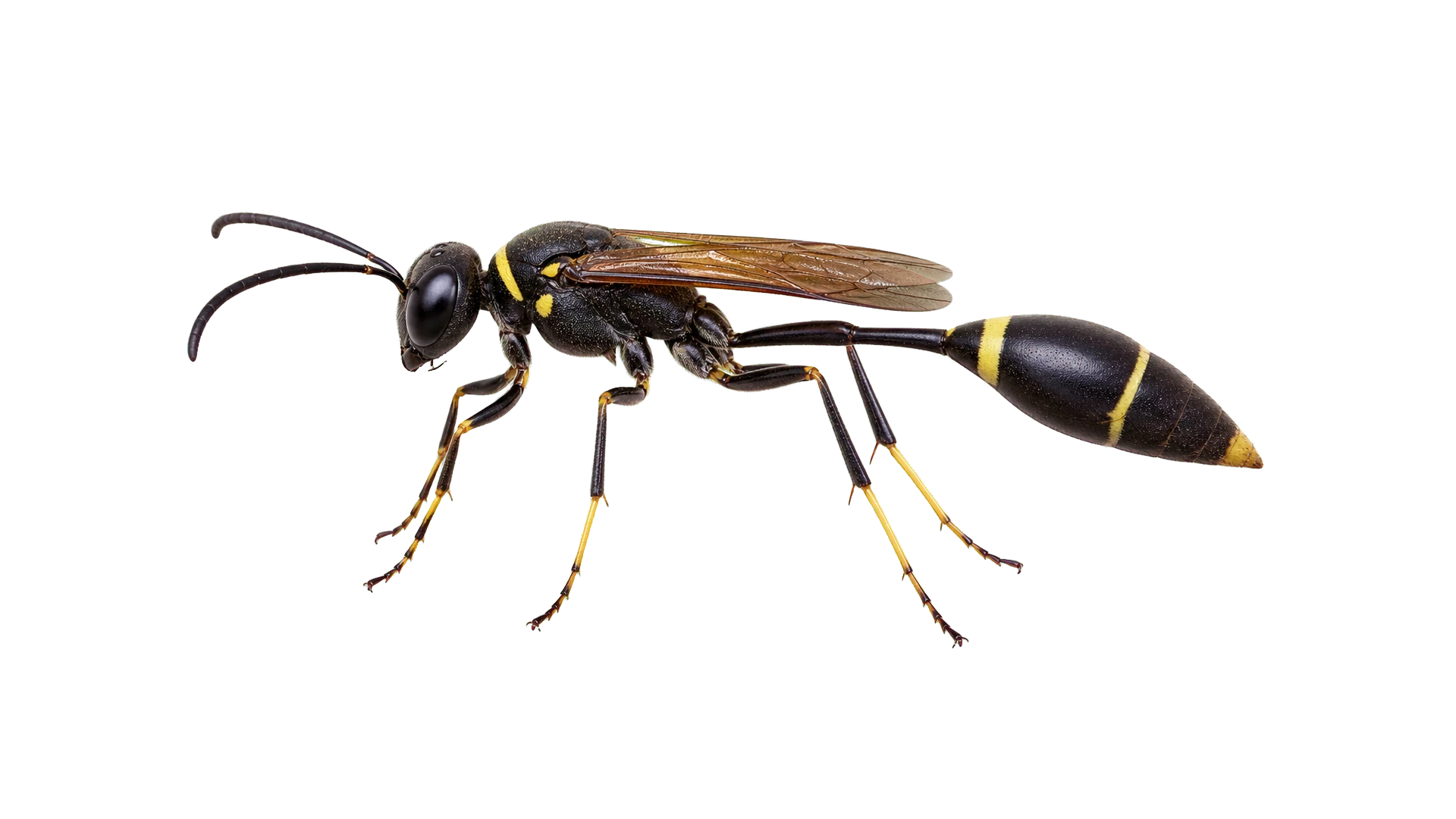
Solitary wasps that build small mud tubes on walls, ceilings, and under eaves.
Mud daubers are non-aggressive, solitary wasps that construct tube-shaped mud nests in sheltered areas like garages, attics, barns, and porch ceilings. They provision each tube with paralyzed spiders as food for their larvae. While they rarely sting, their abandoned nests can attract other insects and become an unsightly accumulation on building surfaces.
Quick ID:
Why it matters:
Large, nocturnal hornets attracted to light that strip bark from trees.
European hornets are the only true hornet species established in North America. They are active at night and are strongly attracted to porch lights and illuminated windows, often alarming homeowners with their large size and loud buzzing. They strip bark from lilac, birch, and other ornamental trees for nest material, and their nests inside wall voids and attics can contain several hundred workers by late summer.
Quick ID:
Why it matters: