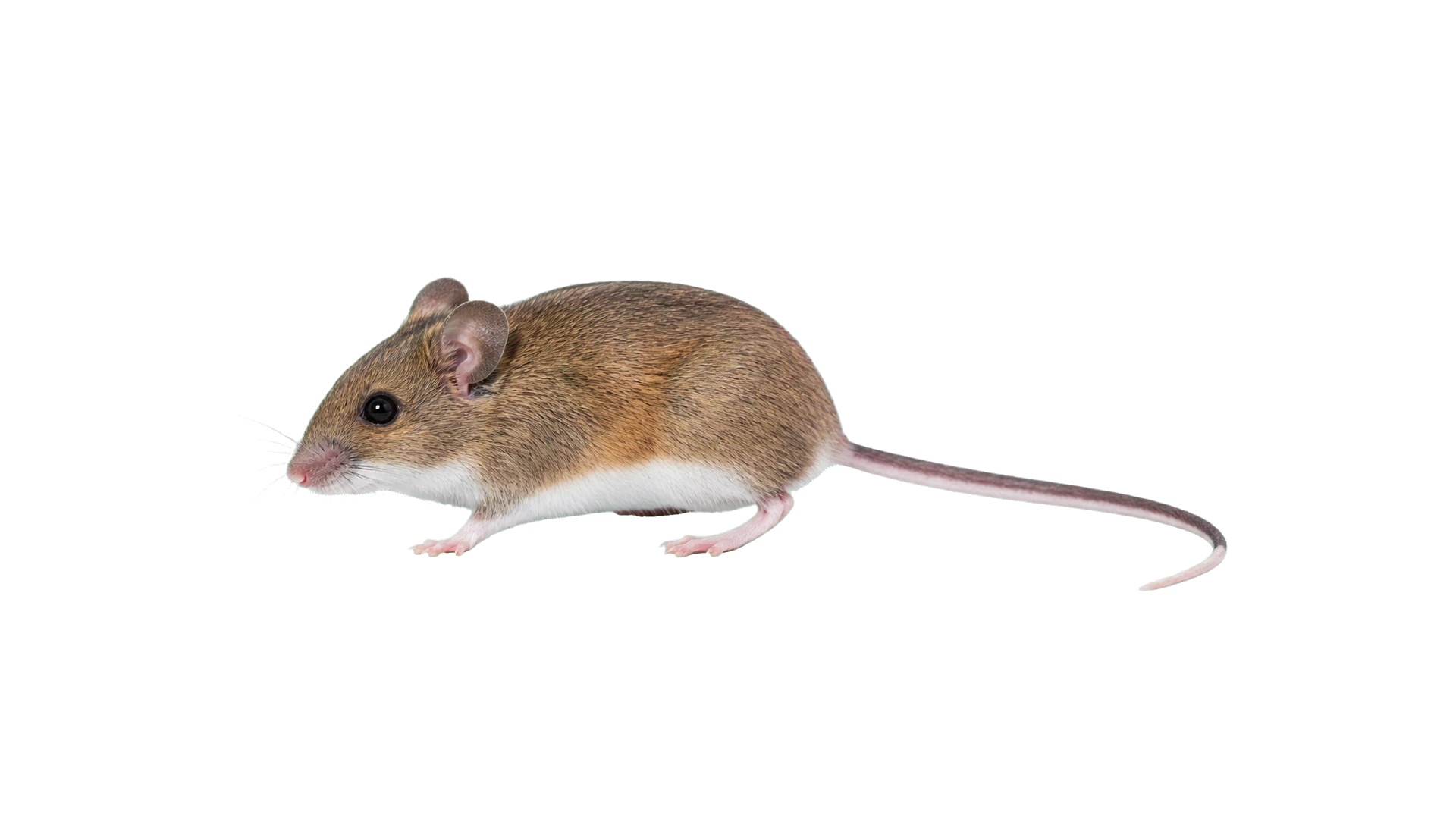
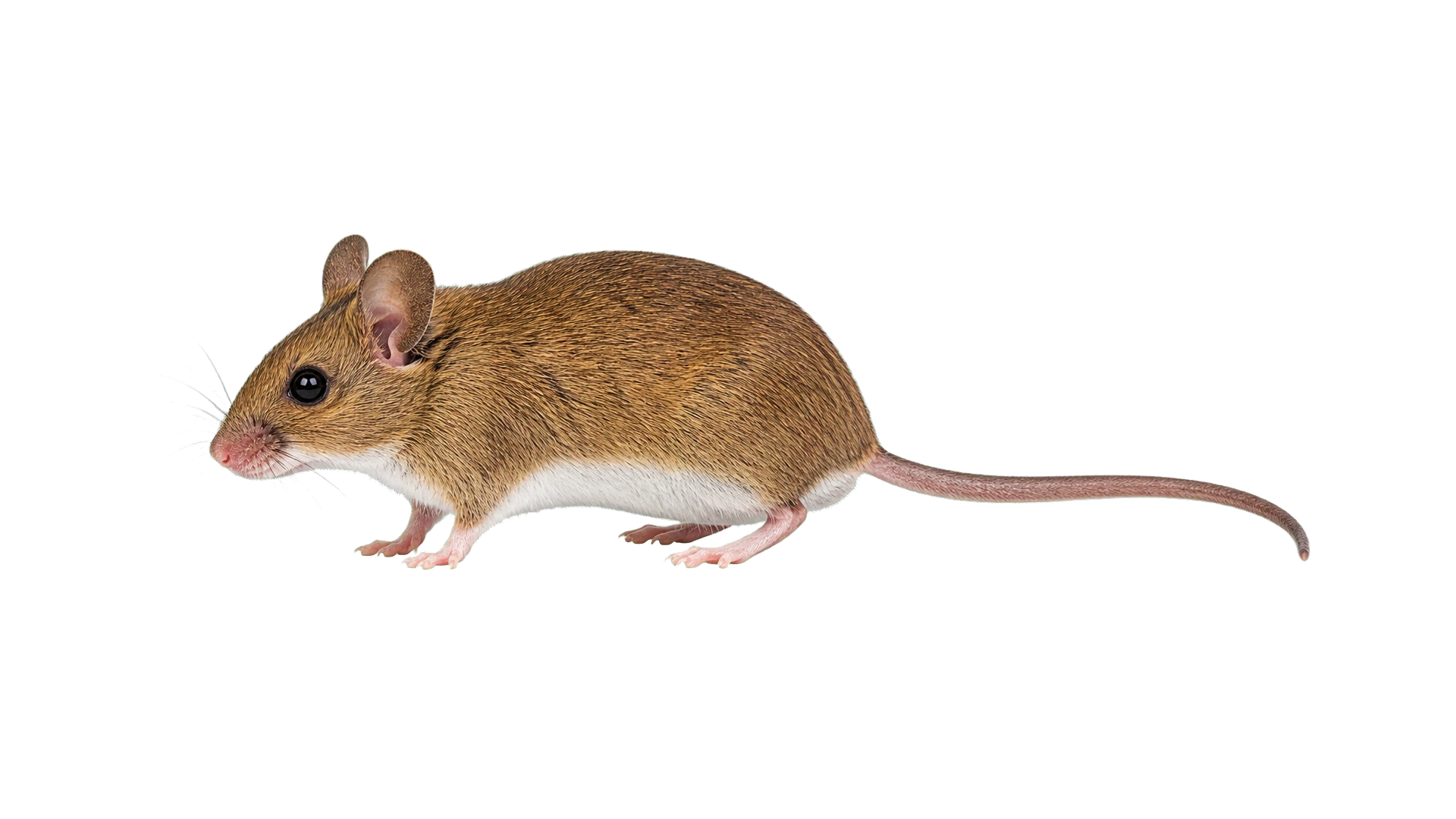
Adult body 2 to 4 inches
House mice top out around 4 inches body length, with a tail roughly equal to body length. A 6-inch rodent is almost certainly a juvenile rat, not an adult mouse. Get the size right before you buy traps.
Local pest control help is one call away.
 Pest Control Services Nationwide Pest Control Services Nationwide
 One mouse in daylight is rarely one mouse. By the time you see a house mouse or deer mouse crossing the kitchen floor at noon, the colony is usually two to three generations deep, nesting in a wall void, attic insulation, or behind the fridge. Identify the species, read the droppings, and act before the next 5 to 12 pups arrive.
Mice squeeze through gaps you would not call a hole. A house mouse fits through a quarter-inch opening, the diameter of a pencil. Deer mice need even less. Most homes have dozens of these gaps around utility penetrations, dryer vents, and aging weatherstripping.
Three things every mouse colony commits to before nesting indoors.
What mice are actually after:
A house mouse reaches breeding age at 6 weeks. A single female produces 5 to 10 litters per year, each with 5 to 12 pups. Half the pups are female, breeding before they hit 2 months old. Indoor populations face no predators and an adult lives 9 to 12 months. The math is why mouse problems compound so fast, and why early action saves a season of damage.
Three checks that distinguish a mouse from a young rat or other small rodent.
House mice top out around 4 inches body length, with a tail roughly equal to body length. A 6-inch rodent is almost certainly a juvenile rat, not an adult mouse. Get the size right before you buy traps.

House mice have a sharply pointed snout and ears that look too large for the head. Deer mice have a similar shape with a clean white belly and white feet. Rat snouts are blunt, ears smaller relative to head.

Mouse droppings are 3 to 6 millimeters long with pointed ends, the size of a long grain of rice. Rat droppings are 12 to 18 millimeters and blunt-ended. The droppings tell you which animal you're dealing with before you ever see it.
A daytime sighting in the kitchen is a late-stage signal. Long before you saw the mouse, the colony was leaving evidence in places homeowners rarely check: behind the stove, inside cabinets along the back wall, in pantry corners, in attic insulation, and in dropped ceilings of finished basements. Catch the early signs and you spare yourself a multi-month removal.
Droppings are the most reliable early signal. House mouse droppings are 3 to 6 millimeters with pointed ends, scattered along travel routes at 50 to 75 per day per mouse. Fresh ones are dark and shiny. Older ones are gray and crumbly. A pile in one corner usually means a feeding station, while scattered droppings along a wall mark a regular run.
Sounds and smells round it out. Faint scratching or scampering 30 minutes after dark, mostly in walls or above ceilings, points to active routes. A sweet ammonia-tinged smell from accumulated urine in hidden runs confirms longer-term occupation. The deer mouse adds health stakes because the species drives most US hantavirus cases, so attic and basement droppings get extra caution.
How a Mouse Problem Snowballs
House mice live in small social groups: typically a dominant male, a few females, and their offspring. They establish a fixed nest area within 10 to 30 feet of a reliable food source, then travel along the same routes every night. The dominant male defends the territory; the females raise overlapping litters. Total colony size in a single home commonly runs 5 to 25 mice once it's established.
Deer mice and field mice prefer outdoor nesting (sheds, woodpiles, vehicles parked long-term) and move indoors as outdoor temperatures drop. They are the species responsible for most hantavirus cases in the United States, which is why droppings in attics, garages, and basements are treated with more caution than droppings in a kitchen.
What makes mice different from most pests is their reproductive math. Killing the mice you can see does almost nothing if the nesting area still has food and water access; the hidden females replace the lost workers within a few weeks. Lasting control is always two-step: trap aggressively while sealing every entry point you can find. One without the other fails.
Six features that separate a mouse from a young rat, and why each one matters for identification.
Mouse ears look oversized for the head, often as wide as the snout is long. Rat ears are smaller in proportion, set lower, and folded against the head.
House and deer mice have a sharp triangular snout. Rats have a blunter, broader nose. The snout test is the fastest visual ID at running distance.
Whiskers (vibrissae) extend wider than the body and let mice navigate dark wall voids by touch. Damaged or singed whiskers near a heat source mean an active travel route.
Two pairs of front teeth grow throughout the mouse's life. They must gnaw constantly to wear them down, which is why drywall, electrical insulation, and food packaging are constantly damaged.
Tail length is roughly equal to body length on house mice. The tail is nearly hairless and shows fine ring scales. Used for balance on narrow runs along beams and pipes.
Front paws have four functional toes; hind paws have five. Tracks in dust show four-toe front prints behind five-toe hind prints, often in straight lines along walls.
Pick the sign that matches what you've noticed. Each one points to a different stage of the colony or a different room they're nesting in.
House mice reproduce up to 10 litters per year with 5 to 12 pups each. The timeline below maps how fast a single intruder becomes a colony, and what to do at each step.
Droppings in one location (often under the sink or behind the stove), or a single rustling at night. A scout has likely entered through a gap and may not have established a nest yet.
Droppings in 2+ rooms, gnaw marks on packaging, or smudges along baseboards. Mice are using the home as both food and harborage. A small colony of 2 to 6 mice is likely active.
Multiple sightings (especially during day), nightly noises in walls or attic, or chewed wires. Population now likely 10 to 20+ breeding inside. DIY rarely closes this out without pro exclusion work.
Mice visible during day, urine smell in walls, or nests in stored items. Risks include electrical fires from chewed wiring, pantry contamination, and disease exposure (hantavirus, salmonella).
Cold weather compresses this timeline. Every fall, the next stage arrives faster as house mice and deer mice push indoors for warmth and stored food. October entries become winter colonies on the same calendar most years.
Local rodent specialists trap aggressively, seal entry points, and verify the colony is gone before they leave. One call gets you matched.
Mice do not pick houses at random. They follow signals: pet food left in a bowl overnight, cereal stored in cardboard, a 1/4 inch gap around a dryer vent. A scout finds reliable calories, drops a scent trail, and within 10 to 14 days the colony commits because a female house mouse produces 5 to 10 litters per year of 5 to 6 pups each, so a starter pair becomes 30 plus animals by season end.
Different mouse species chase different rewards, which is why ID matters. House mice (Mus musculus) dominate kitchens, pantries, and garages year-round and rarely leave the structure once established. Deer mice (Peromyscus maniculatus) work garages, sheds, and crawl spaces seasonally and carry hantavirus in dried urine and droppings. Field mice (white-footed and meadow varieties) overwinter indoors in fall, then return to outdoor habitat in spring. Knowing the species changes whether the response is permanent indoor exclusion or seasonal late-fall sealing.
Sealing entries beats trapping every time. A young mouse can pass through a hole the diameter of a dime (about 1/4 inch), so any gap that size or larger is an open door. Start with the highest-leverage source: walk the foundation, garage door, utility penetrations, and dryer vents at dusk and seal every gap with 1/4 inch hardware cloth, steel wool, and exterior caulk. Then store pantry grains in airtight glass or hard plastic, pull pet bowls in at night, and fix leaks. Even partial wins help: sealing a single 1/2 inch gap around a kitchen pipe penetration and stripping a pantry to airtight containers often cuts mouse droppings in a 24-hour sticky-monitor sweep to zero within 10 to 14 days because the colony shifts to easier targets.
Stove, fridge, dishwasher backs are warm, dark, and within feet of food. The single most common indoor nesting site. Pull each appliance once a year and inspect.
Hollow walls connected by stud bays let mice travel the entire house unseen. Look for entry points around plumbing, outlets, and where two walls meet at the floor.
Pink fiberglass batt is preferred nesting material for deer mice and house mice. Look for shredded clumps, droppings on the vapor barrier, and stained insulation along eaves.
Cardboard boxes, stored holiday decorations, dog food bags, and bird seed are mouse highways. Garages are the most common entry point for outdoor mouse populations.
Plumbing penetrations bring water lines and drain lines through the wall, leaving gaps. Mice climb the lines and exit into the cabinet, then range outward through the kitchen.
Outdoor nesting hubs that supply the indoor population. A pile of stored wood within 30 feet of the house is a deer mouse staging ground for fall move-ins.
Why a mouse problem doubles in 60 days if it is not actively managed.
0 to 3 weeks
Born blind, hairless, and helpless. Mother nurses in a hidden nest of shredded paper or insulation. A litter contains 5 to 12 pups.
3 to 6 weeks
Eyes open at day 12. By week 4 pups eat solid food and range further. Females can become pregnant at 6 weeks. Gestation runs 19 to 21 days.
Lives 9 to 12 months indoors
Adult house mouse weighs about an ounce. Indoor populations face no predators and can produce 50+ offspring per female across their lifespan.
House mice and deer mice both reach reproductive maturity in 6 weeks, which is why a single autumn entry point becomes a winter colony. The deer mouse drives most US hantavirus cases and prefers attics, garages, and basements. Droppings in those spaces are a health-risk priority, not just a nuisance.
Mouse species behave and nest differently. Match what you're seeing to identify which one.
| Species | Severity | Key Sign | Where You'll Find Them |
|---|---|---|---|
| Deer Mice | Medical | Droppings and nesting material in sheds and cabins, hantavirus risk in enclosed spaces | rural areas, cabins, sheds |
| Field Mice | Persistent | Small droppings along walls, gnaw marks on food packaging and wires | fields, gardens, sheds |
| House Mice | Persistent | Rice-grain-sized droppings, gnaw marks on food packaging | kitchens, wall voids, attics |
Severity reflects typical impact, not your specific case. If unsure, treat at the higher tier.
Honest read on the most common DIY methods: which ones reduce the colony and which ones just thin it temporarily.

 8 to 12 traps placed perpendicular to walls (mice run along edges) catches most colonies in 7 to 10 days Bait with peanut butter, hazelnut spread, or a small piece of bacon, secured so the mouse has to work for it Reset and re-bait every 24 hours; replace traps every 3 to 4 days even if untriggered Steel wool stuffed into gaps, then sealed with silicone caulk over top Hardware cloth (1/4 inch mesh) over dryer vents, soffit gaps, and foundation cracks Door sweeps on garage and exterior doors close the most common entry route in older homes All food in glass or hard plastic containers with tight lids; pet food bowls picked up overnight Crumbs behind appliances cleaned weekly, not seasonally Cluttered storage areas (garage, basement, attic) decluttered and reorganized so movement is visible
  Almost no peer-reviewed evidence they work beyond the first 24 to 48 hours Mice habituate to the noise within days and resume normal activity Don't address food, water, or entry points, the actual root drivers Strong scents may briefly displace mice from a specific spot, not from the structure Reapplication fades within a week as the oil dissipates Useful as a deterrent at known entry points, not as a primary control method Catches the visible mice but does nothing about the entry routes the colony uses Within 2 weeks the gaps that let in the first wave let in the next wave Always pair traps with steel wool, hardware cloth, and silicone caulk in the gaps you find
 Six prevention actions sorted by effort. Mouse control is mostly about closing entry points and removing food access. Chasing mice indoors is the failure mode.

Cereal, rice, flour, sugar, pet food, and bird seed into airtight containers. House mice chew through cardboard and thin plastic in minutes. A 10-minute pantry overhaul cuts the strongest indoor attractant for the colony.

Cats and dogs do not need food sitting out at 2 am. Closing this single source eliminates the most reliable nighttime draw in most homes. A teaspoon a day per mouse keeps a colony fed.

Walk the exterior with a flashlight at dusk. Look for gaps wider than a pencil around utility lines, dryer vents, foundation cracks, and garage door corners. Seal with steel wool plus silicone caulk.

Stored cardboard, fabric, and paper goods are mouse nesting material. Move important items into hard plastic totes off the floor. House mice and deer mice both prefer undisturbed corners for litters.

Repair leaky pipes, dry up condensation lines, and empty pet bowls overnight. Mice leave a house with food but no water faster than one with water but no food. Most homes have at least 2 moisture sources running.

Hardware cloth (1/4 inch mesh) on every soffit, gable, and foundation vent. Door sweeps on garage and exterior doors. Mesh over dryer vents. Done correctly, this is one-time work that holds for years.
Mouse populations cycle hard with the seasons. Time your inspections and exclusion work to the months that matter.
Outdoor populations explode as winter mortality stops and breeding accelerates. Indoor activity drops slightly as some mice return to outdoor nesting. Spring is the easiest exclusion window because outdoor populations haven't peaked yet.
Outdoor populations continue building. Indoor activity is at its lowest, mostly contained to kitchens and basements. The good time to do exterior exclusion work because gaps are easy to find and the season for sealing them is generous.
Peak indoor invasion season. As nighttime temperatures drop below 50 degrees, outdoor populations move toward warm structures. Most homeowners notice mice in October or November because that is when invasion happens.
Established indoor colonies breed continuously through winter. New invasions slow but don't stop. This is the hardest season for control because gaps are harder to inspect under snow and outdoor exclusion work pauses. Trapping and bait stations carry the load.
Four steps from front door to a house with no mice and no entry points. Most mouse jobs run 60 to 90 minutes for the initial visit, plus follow-ups.
Trap aggressively, then seal the holes. Half-jobs fail. Pros who solve mouse problems do both at once and verify with a follow-up before they call it done.
Walk interior and exterior. Map droppings, gnaw marks, rub marks, and audible activity. Identify species (house mouse vs deer mouse) before placing anything.
Snap traps perpendicular to walls along active routes. Bait stations sealed in tamper-resistant boxes where pets and kids cannot reach. 8 to 14 placements is typical.
Every gap larger than 1/4 inch sealed with steel wool, hardware cloth, or silicone caulk. Door sweeps installed where missing. Dryer vents and exterior penetrations protected.
Return visit at 7 to 14 days to check trap counts and look for new sign. Colony is gone when traps are empty for 2 consecutive visits and no new droppings appear.
Real stories from households who connected with rodent control pros to clear out the colony and seal the gaps.

"No pressure, just options."
I appreciated being given eco-friendly options without being pushed. The technician explained tradeoffs honestly and let me decide based on my priorities. They were transparent about what each approach involves. The no-pressure approach and honest information helped me make a confident decision.
"No pressure, just options."
I appreciated being given eco-friendly options without being pushed. The technician explained tradeoffs honestly and let me decide based on my priorities. They were transparent about what each approach involves. The no-pressure approach and honest information helped me make a confident decision.

"The inspection caught what we missed."
I didn't realize how much damage raccoons can cause once they get inside. The wildlife specialist explained what areas they inspect first and why raccoon issues are handled more carefully than regular pests. They showed me the damage and explained removal and exclusion strategies. Understanding the potential for damage made me glad I called professionals.

"The problem finally stayed gone."
Ants kept returning no matter what we did. The tech treated the trail areas and explained how to handle food storage and moisture so the ants don't keep coming back. It's been months and we haven't seen them again. I appreciated that it wasn't just a one-and-done spray.

"Clear expectations and a real plan."
I was overwhelmed and didn't know what was realistic to fix quickly. The inspector explained what results to expect and how long it typically takes depending on the ant species. They treated the right places and gave simple prevention tips. Everything felt structured and easy to follow.

"They found the entry points fast."
Ants were showing up in the kitchen and we couldn't figure out where they were coming from. The tech tracked the activity and pointed out two entry points we never would've noticed. After treating and sealing those areas, the ants disappeared. It was quick and surprisingly thorough.

"No pressure, just helpful info."
I mainly wanted to understand what was happening before committing to anything. The inspector walked me through the likely cause and the differences between treatment approaches. They answered questions without rushing me. The plan we chose worked and the ants were gone within days.

"The tech helped me stop wasting time."
I kept trying different products and nothing was sticking. The tech explained why some solutions don't work for certain ant problems and focused the treatment where it would actually matter. They also gave prevention tips that were easy to implement. The difference was obvious within the first week.

"We finally understood what to do next."
We felt stuck because nothing we tried lasted. The tech explained how to find the source of the problem, treated both indoor and outdoor areas, and helped us build a prevention routine. It wasn't complicated. Just the right steps in the right order. We've had a huge improvement since.

"They fixed what was actually causing it."
Ants kept showing up in the same spot. The pro explained that the visible ants weren't the real issue and focused the treatment on where they were coming from. They identified the entry path and treated it properly. The problem stopped and hasn't returned.

"It felt like a real inspection, not a quick spray."
The tech spent time figuring out where the ants were entering instead of just spraying around. They walked me through the likely reasons and what to watch for over time. After treatment, ant activity dropped fast and stayed low. The detailed approach gave me confidence.

"Small changes made a big difference."
We didn't realize how much our routine was attracting ants. The inspector explained simple prevention steps and treated the areas where activity was highest. Once those changes were in place, we stopped seeing ants inside. It was a practical approach that actually worked.

"The explanation alone was worth it."
I'd been doing random treatments without understanding what I was dealing with. The tech explained how ants behave and why certain approaches work better. They treated strategically instead of just spraying. It made the whole thing feel manageable.

"We stopped chasing the problem and solved it."
We kept wiping down counters and the ants would be back the next day. The pro identified the entry areas and explained the treatment plan clearly. Once they treated and targeted the colony, the ants disappeared quickly. It felt like we finally got ahead of it.

"They didn't oversell. Just solved it."
The tech explained what treatment was necessary and what wasn't. They focused on the entry points and corrected the conditions that were attracting ants. The work felt honest and effective. I liked having clear expectations and seeing results quickly.

"It wasn't just 'spray and go.'"
I appreciated the step-by-step explanation and the focus on prevention. The inspector treated the areas where ants were getting in and helped me understand what to change at home. The ants stopped showing up and it's been consistent. The approach felt thoughtful and sustainable.

"It finally made sense why they kept coming back."
I had ants showing up every few months and never understood why. The tech explained how outdoor nests and weather changes affect indoor activity. They treated the perimeter and entry points instead of just the inside. Since then, we haven't had recurring issues.

"Targeted instead of overdone."
I was worried about over-treating the house. The pro focused on specific problem areas and explained why blanket spraying wasn't necessary. The ants stopped appearing, and we didn't feel like chemicals were used unnecessarily. That balance mattered to us.

"Clear answers without jargon."
The tech explained everything in plain language and answered questions without rushing. They identified the type of ant we had and adjusted the treatment accordingly. Knowing why the approach worked gave me confidence it would last.

"They focused on prevention, not just treatment."
I liked that the tech talked through how to keep ants from returning after the treatment. They addressed moisture issues and entry points around the home. The treatment worked, and the prevention tips helped us stay ahead of future problems.

"No guessing, just a plan."
I was tired of guessing what would work. The inspector explained the cause of the issue and outlined a clear plan of action. After treatment, the ants disappeared and we haven't had to revisit the problem. It felt efficient and well thought out.

"They explained what to expect upfront."
The tech set expectations about timing and results before starting. They explained that some activity might happen initially and why. Everything played out exactly as described, and the ants were gone shortly after. That transparency made a big difference.

"Helpful without being overwhelming."
I didn't realize there were different types of ants or that it mattered. The inspector walked me through what they were seeing and explained how ant behavior affects treatment. It made it easier to ask the right questions and understand the solution.

"Saved me a lot of guessing."
I was close to trying random sprays for the ants. Talking with the tech helped me understand what was realistic to address and what usually doesn't work. The targeted treatment solved the issue quickly and saved time and frustration.

"It felt tailored to our home."
The tech didn't just apply a standard treatment. He looked at where we were seeing activity and adjusted the approach to our layout and yard. The ants stopped showing up and we understood how to keep it that way.

"Straightforward and effective."
I appreciated how straightforward everything was. The pro explained the issue, treated the problem areas, and gave us a few simple steps to prevent future issues. The ants were gone and it didn't feel complicated.

"They explained how the weather played a role."
I didn't realize seasonal changes could affect ant activity so much. The tech explained how heat and rain push ants indoors and what to do about it. They treated the problem areas and gave tips to prevent future issues. The explanation helped everything click.

"It wasn't as complicated as I expected."
I assumed pest control would be disruptive or complicated. The technician explained the steps clearly and focused on targeted treatment. The ants stopped appearing quickly and the process was smoother than expected.

"They helped me understand the bigger picture."
Instead of just treating the ants I saw, the tech explained what was happening around the house that made it attractive to pests. Once those factors were addressed, the problem resolved quickly. It felt educational as well as effective.

"Clear communication from start to finish."
I appreciated how clearly everything was explained before treatment began. The inspector walked through the process and answered all my questions. The ants were gone shortly after and we felt confident about prevention going forward.

"They addressed what we were missing."
We kept focusing on cleaning, but the tech showed us where ants were actually entering. Once those points were treated and sealed, the issue resolved. It was reassuring to finally understand the root cause.

"A methodical approach that worked."
The pro explained how they identify ant trails and colonies before treating. They took a methodical approach instead of rushing through. The ants stopped appearing and the fix has held up well.

"They understood desert pest behavior."
Living in Phoenix, pests behave differently than other places. The tech explained how heat drives ants indoors and what treatments work best here. The solution was effective and tailored to our environment.

"They took the time to do it right."
I appreciated that the tech didn't rush. He inspected the problem areas carefully and explained what they were seeing. The treatment worked quickly and the ants haven't returned.

"They understood the local pest issues."
The tech explained how the humidity here contributes to ant problems and why certain treatments work better in this climate. They focused on outdoor entry points and moisture-prone areas. The ants cleared up quickly and haven't come back.

"Finally something that lasted."
We'd dealt with recurring ants for years. The pro explained why flooding and moisture play such a big role here and adjusted the treatment accordingly. It's been months without seeing ants, which is a big win for us.

"They knew exactly what works in Arizona."
The tech explained how desert conditions affect ant behavior and which treatments are most effective here. They targeted the right areas and avoided unnecessary spraying. The ants disappeared quickly.

"Clear, calm, and professional."
I appreciated how calmly everything was explained. The inspector identified the ant problem, explained the treatment, and answered my questions without rushing. The solution worked and gave me peace of mind.

"They handled it efficiently."
The tech inspected the problem areas, explained the plan, and got to work quickly. The ants were gone within days and the process felt efficient without being rushed.

"Simple explanations, solid results."
I liked how simply everything was explained. The pro didn't overcomplicate things and focused on what mattered. The ants stopped appearing and we haven't needed follow-up treatments.

"They showed me what to watch for."
Beyond treating the ants, the tech explained what signs to watch for if activity starts again. That knowledge made me feel more in control. So far, everything has stayed clear.
Direct answers to what homeowners ask most when mouse signs first show up.
Almost always yes. By the time a homeowner sees a mouse in daylight or catches one in a trap, the colony has usually been there for several weeks and includes at least one breeding female plus subadults. Mice are nocturnal and risk-averse; visible activity means the population has grown enough that some individuals are forced into riskier feeding patterns. Plan on trapping aggressively for two to three weeks while sealing entry points. If the original mouse was the only one, traps will go quiet within a week. If there are more (the common case), you'll keep catching for two to three weeks before activity drops.
Size and shape. Mouse droppings are 3 to 6 millimeters long with pointed ends, roughly the size of a long grain of rice. Rat droppings are 12 to 18 millimeters long, much thicker, with blunt ends. Norway rat droppings tend to be uniformly thick; roof rat droppings are slightly more pointed but still much larger than mouse droppings. Identification matters because traps, bait, and exclusion approaches differ between species: mouse traps under-trigger for rats, and rat-sized exclusion gaps will not stop a mouse. If you can photograph a sample next to a coin for scale, a pest pro can confirm the species in seconds.
Independent research generally finds ultrasonic repellers ineffective for sustained mouse control. Mice may avoid the noise initially but habituate within a few days and resume normal activity. The devices also fail to address the actual root drivers of a mouse problem: food access, water access, and entry points. They can be a low-priority supplemental tool in a kitchen or pantry, but they should never be the primary method. Aggressive snap-trap placement combined with exclusion sealing remains the proven approach.
A house mouse fits through a quarter-inch opening, about the diameter of a pencil. Deer mice fit through openings even smaller, closer to 3/16 of an inch. The general rule for inspection: if a pencil eraser fits through the gap, a mouse fits too. Common entry points are gaps around utility line penetrations, dryer vent openings, garage door corners, threshold gaps under exterior doors, foundation cracks at grade level, and worn weatherstripping around basement windows. A flashlight inspection at dusk along the exterior of the foundation will surface most of these in 30 to 45 minutes.
Mice carry several pathogens that can transfer to humans through contaminated food or aerosolized urine and droppings. Salmonella and leptospirosis are the most common; hantavirus is the most serious and is associated primarily with deer mice in the western United States. The cleanup recommendation is to wear an N95 mask and disposable gloves, ventilate the area, and dampen droppings with a bleach-water solution before wiping (never sweep or vacuum dry, which aerosolizes pathogens). Pet food, dishes, and food-contact surfaces with droppings on them should be washed and sanitized thoroughly. If you find heavy droppings in attics, basements, or HVAC areas, professional cleanup is worth the cost.
Peanut butter and hazelnut spread are the two most consistently effective baits because mice are drawn to the high-fat, high-calorie scent and have to work to extract the sticky bait, which triggers the snap. A small piece of bacon, a chunk of chocolate, or a thumbnail-sized smear of cream cheese also work well. Cheese is iconic but performs worse than peanut butter in side-by-side trials. Bait must be small (a pea-sized portion is plenty), pressed firmly onto the trigger, and reset every 24 to 48 hours so it stays scented. Place traps perpendicular to walls with the trigger end against the wall, since mice run along edges, not across open floor.
For a moderate mouse problem (5 to 15 mice), a serious trap-and-seal effort typically clears the active colony in 2 to 3 weeks. Larger or longer-established infestations can take 4 to 6 weeks. The timeline depends much more on how aggressively the trapping is done and how completely the entry points are sealed than on the size of the colony. Half-measures (a few traps, no exclusion) extend the process indefinitely because outdoor mice keep replacing the trapped ones. The cleanest measure of success is two consecutive weekly checks with no trap activity and no new droppings, at which point the colony is considered eliminated and exclusion measures are doing the long-term work.
Trap, seal, verify. Local rodent specialists handle all three on the same call.
Click through to the species page for behavior, regional patterns, and treatment specific to that mouse.
Rodents commonly found in garages, sheds, and rural homes.
Deer mice resemble house mice but are more common in rural areas and are associated with disease risks when infestations go unnoticed. They carry hantavirus, which can be transmitted through contact with contaminated droppings, urine, or nesting material. Careful cleanup using protective equipment is essential, and professional remediation is recommended for heavy infestations.
Quick ID:
Why it matters:
The most common household rodent, nesting in walls, cabinets, and storage areas.
House mice can squeeze through gaps as small as a quarter inch, making almost any home vulnerable to entry. They nest in insulation, drawer spaces, and behind appliances, reproducing year-round with litters of five to seven pups every three weeks. Their droppings contaminate food surfaces and their constant gnawing can damage wiring, insulation, and plumbing.
Quick ID:
Why it matters:
Outdoor rodents that invade homes and garages when temperatures drop.
Field mice live in grasslands, meadows, and agricultural areas during warm months but migrate into homes, garages, and outbuildings seeking warmth and food as fall arrives. They contaminate stored goods with droppings and urine, gnaw on wiring and insulation, and reproduce quickly once established indoors. Sealing entry points before fall is the most effective prevention.
Quick ID:
Why it matters: