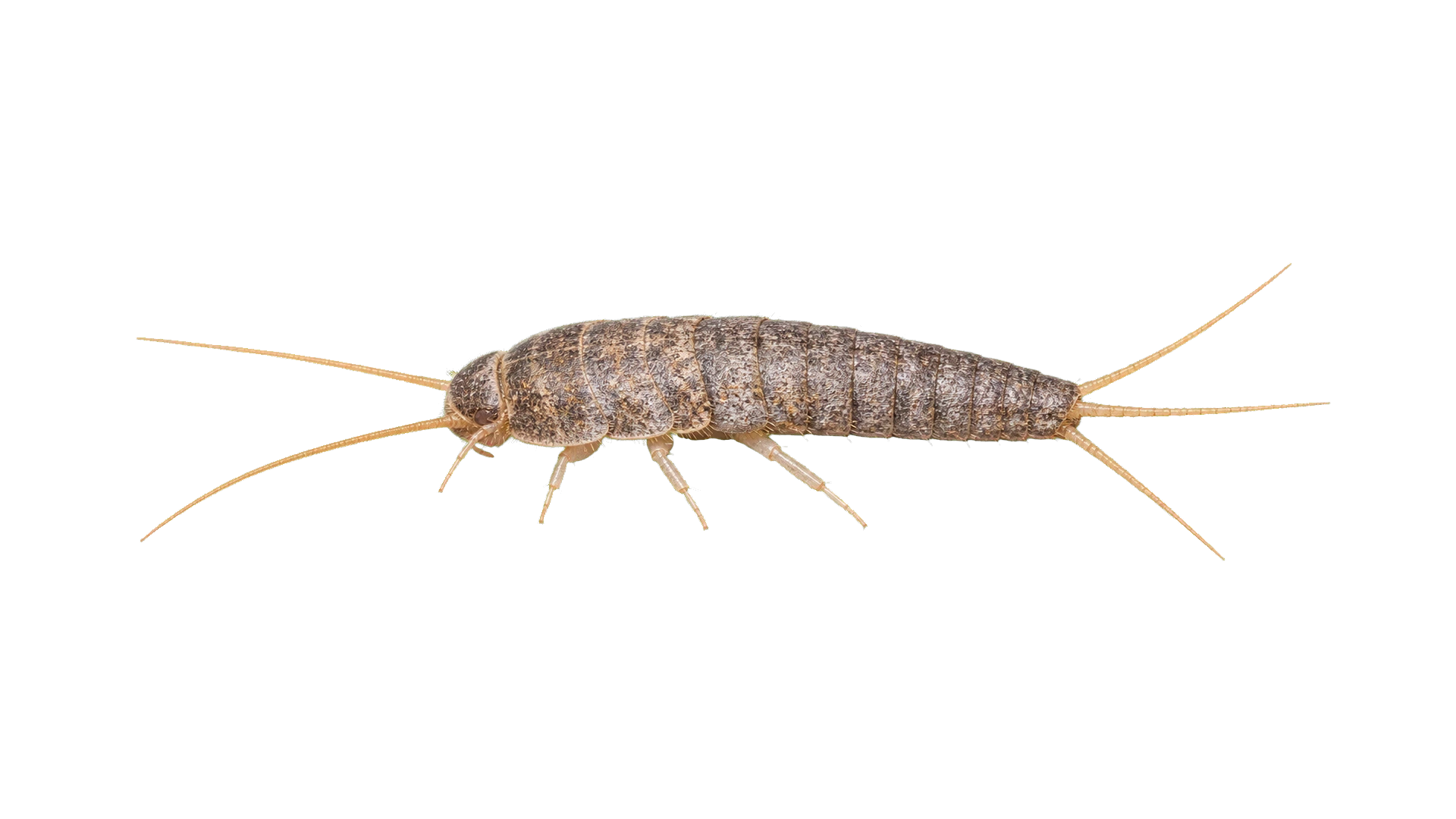
Half-inch silver wriggler
Roughly 1/2 to 3/4 inch long as an adult. The metallic silver-gray sheen reflects light when the insect is in motion, and the body narrows toward the rear into three thin tail filaments.
Local pest control help is one call away.
 Pest Control Services Nationwide Pest Control Services Nationwide
 Silverfish are slender, silver-scaled wingless insects that wriggle across bathroom floors and basement walls at night. They feed on starches, paper, glue, wallpaper paste, and stored cotton or linen, and they survive over 12 months between meals. Most homeowners discover them by sighting rather than damage, but the damage is what makes them worth addressing.
Silverfish need moisture plus a starchy food source. Indoor humidity above 75 percent in basements, attics, and bathrooms creates ideal living conditions. Stored cardboard, books, photo albums, wallpaper, and starched fabrics give them food. Many homes provide both without the homeowner thinking about it.
Drop humidity below 50 percent and seal stored paper into airtight bins, and silverfish populations decline within months. Skip those steps and the same boxes feed new generations year after year as adults live 2 to 8 years apiece.
What sets silverfish apart from other indoor insects:
A single female silverfish lays 1 to 3 eggs at a time but continues laying for years. Adults survive up to 12 months without food when water is available. Populations expand slowly: it takes 3 to 4 months for a nymph to reach adulthood under typical home conditions, longer in cooler basements.
Quick visual checks for confirming a silverfish sighting versus a firebrat, earwig, or centipede.
Roughly 1/2 to 3/4 inch long as an adult. The metallic silver-gray sheen reflects light when the insect is in motion, and the body narrows toward the rear into three thin tail filaments.

Tear-drop or carrot-shaped body, widest just behind the head and tapering to a narrow point. Three thread-like appendages at the rear (two cerci flanking a longer median caudal filament) confirm the ID instantly.

Body covered in soft scales that flake off when touched, leaving a fine silver dust on fingers or surfaces. Older adults appear duller gray; nymphs are nearly white before scales fully develop.
Most silverfish issues are confirmed by a combination of nocturnal sightings and slow accumulating damage to stored items. A single sighting in a humid bathroom may not warrant treatment; a recurring pattern across multiple rooms with damaged paper does.
How a Silverfish Population Builds
Silverfish damage is not dramatic in the way termite damage is, but it is permanent and almost always discovered too late. A box of family photos stored in a humid basement closet for ten years can come out with chewed edges and yellow staining that no restoration will reverse. Antique books and document collections suffer in the same quiet way. The insect feeds at night, hides during the day, and lives long enough to feed on the same item for years before the homeowner inspects it.
The structural risk is small. Silverfish do not damage wood, drywall, or wiring. The risk is to anything starchy, paper-based, or fabric-based that sits in storage. Wallpaper paste is a favorite food, which puts older homes with original wall coverings at higher risk than newer construction. Boxed cotton or linen with starch finishes is also vulnerable.
Real silverfish control combines moisture reduction, food protection, and targeted residual treatment. Lowering basement humidity below 50 percent removes their preferred environment. Sealing books, photos, and fabrics into airtight bins removes the food. Pro residual treatment in wall voids, behind baseboards, and in attic insulation reaches the harborages homeowners cannot. All three together solve the problem; any one alone usually does not.
Six features that confirm a silverfish ID and explain how they move, feed, and survive in human homes.
The body widens behind the head and tapers to the rear, giving the carrot or fish-like silhouette. The shape lets silverfish slip into narrow gaps along baseboards and shelving.
Fine scales give the metallic sheen and the silver dust on storage surfaces. Scales also slough off when grabbed, helping silverfish escape predators like a fish losing scales.
Two outer cerci flank a longer median caudal filament at the rear. The three-tail signature separates silverfish (and the related firebrat) from every other indoor insect of similar size.
Two thread-like antennae as long as the body extend forward, feeling ahead in dark voids and locating moisture. Antennae plus filaments produce a symmetrical front-to-back outline.
Six legs splayed beneath a flat body keep silverfish low to the surface. Legs and a wriggling abdomen produce the fish-like motion. Quick on flats, poor climbers on vertical walls.
Small compound eyes sense light changes more than detail. Silverfish are strongly negatively phototactic, freezing or fleeing the moment a room lights up. Most encounters happen at night.
Match the pattern of evidence in your home to the most likely silverfish situation.
Silverfish are slow-moving but persistent. They live for up to 3 years, breed quietly in humid voids, and damage paper, books, wallpaper, and natural fabrics. They're a humidity problem before they're a pest problem. The timeline below tracks both clocks.
A single silverfish in a basement, bathroom, or storage area. Likely tied to a humid harborage zone with stored paper or cardboard nearby. No damage yet, but the population is already established somewhere on the property.
Multiple silverfish in the same area, or visible damage to books, papers, wallpaper, or natural fabrics (small irregular holes, yellow stains). The colony is breeding and population is growing slowly but steadily over weeks now.
Activity in multiple rooms, damage to wallpaper or framed art, or recurring sightings during the day. Population is established in inaccessible voids (under sinks, attic insulation, behind walls). DIY rarely closes this out without addressing the moisture source.
Established population across the home, significant damage to documents or framed materials, or persistent activity despite cleanup. Moisture remediation is essential. Treatment without it sees the population return within months as adults wait it out.
Silverfish are humidity indicators. If you have an ongoing silverfish problem, you almost certainly have a hidden moisture problem, and treatment that ignores the moisture won't hold past the next humid season.
Local pros pair residual treatment in wall voids and attic spaces with practical moisture and storage advice that keeps silverfish from coming back to the same boxes year after year.
Silverfish do not pick basements at random. They follow signals: humidity above 75 percent in a laundry room, a stack of cardboard boxes holding old paperbacks, paste-backed wallpaper lifting at a seam. Once any one of those signals exists, silverfish can stay hidden for months because they feed at night and freeze when lights come on, so a population is usually 6 to 12 months ahead of the first sighting.
Common silverfish (Lepisma saccharina), four-lined silverfish (Ctenolepisma lineata), and gray silverfish (Ctenolepisma longicaudata) all behave similarly indoors, but firebrats (Thermobia domestica) are a separate problem in the same family. Silverfish prefer cool damp zones at 70 to 80 degrees Fahrenheit and 75 percent humidity (basements, attics, bathroom voids). Firebrats prefer hot zones at 90 plus degrees Fahrenheit (boiler rooms, behind water heaters, attic insulation near chimneys). Knowing which one you have changes where to look first.
Most affected homes have two or three of these conditions running at once, and moisture-fix beats spray every time. Start with the highest-leverage humidity source: a basement at 80 percent humidity, a bathroom fan vented into the attic, a slow leak under the laundry sink. Drop interior humidity below 50 percent and silverfish populations collapse within 30 to 60 days because eggs fail to hatch. Even partial wins help: tossing 6 to 8 cardboard boxes of stored paper from a damp basement removes the food and harborage in one afternoon.
High humidity plus tile and grout offer perfect harborage. Inspect under sinks, behind toilets, and along baseboards near tubs and washers.
Stacked cardboard boxes against damp masonry walls are the textbook silverfish habitat. Check the lower corners of boxes that have sat for months or years.
Cellulose insulation, packed photo boxes, and old wallpaper rolls in attics give silverfish food and shelter. Roof leaks compound the issue.
Older books with starchy bindings and paper jackets are particularly vulnerable. Damage on the lower shelves usually shows first.
Older paper-backed wallpaper provides paste, paper, and a hidden harborage all in one. Damage along seams is a strong indicator of a wall-void population.
Stored linens, packing materials, and high-shelf cardboard in closets and pantries see less inspection and provide quiet feeding sites for years.
Silverfish are slow developers, which is why infestations build over years rather than weeks.
2 to 8 weeks
Females lay eggs singly or in small clutches into cracks, behind baseboards, or inside cardboard. Eggs blend with dust and rarely get noticed.
3 to 4 months
Nymphs hatch nearly white and gradually develop scales over several molts. They feed on the same foods as adults and hide in the same crevices.
4 to 6 months
Sexually immature subadults look like small adults but are still developing. This stage feeds heavily on stored paper and starchy materials.
Lives 2 to 8 years
Adults keep molting through life (the only insect that does) and lay eggs in small batches. Continual reproduction explains gradual damage buildup.
Generation time runs roughly 4 to 6 months indoors. Populations grow slowly compared to roaches or flies, but they persist. A box stored for ten years has cycled through twenty or more generations of silverfish if conditions are favorable.
Honest assessment of common DIY tactics. The right combination depends on how established the population is.

 Run a dehumidifier in basements, attics, and crawl spaces to keep humidity below 50 percent Repair plumbing leaks and improve bathroom and laundry ventilation Single highest-impact change for chronic silverfish issues Move books, photos, and fabrics from cardboard into airtight plastic bins with tight lids Add silica gel packs inside bins for stored paper or photographs Dispose of long-stored cardboard packing materials that you no longer need Residual product applied along baseboards, behind appliances, and in pantries reaches active foraging zones Diatomaceous earth or boric-acid dusts injected into wall voids and behind baseboards reach harborage Combined with moisture and storage fixes, this typically resolves long-term issues within 60 to 90 days
  Marketed as silverfish repellents but research support is weak Pleasant scent does not address moisture or harborage Provides a sense of action without actually reducing the population Catch occasional wanderers but miss the wall-void population Useful as a monitoring tool, not as a control method Empty traps do not mean an empty home; silverfish hide more than they roam Foggers do not penetrate cardboard boxes, wall voids, or insulation where silverfish live Pesticide residue on stored paper and fabric is undesirable Almost never the right tool for a long-term silverfish issue
 Six prevention actions sorted by effort. Start with moisture and storage; the rest amplify those wins.

A basement dehumidifier with a humidistat set at 45 percent is the single biggest lever for silverfish prevention. Empty the reservoir or plumb in a drain so it runs unattended.

Move books, photos, holiday decorations, and stored fabrics from cardboard into clear airtight totes. Cardboard is itself silverfish food; the bin is both barrier and inventory tool.

Walk basement, attic, and closet storage with a flashlight once a month. Catching damage to one box early protects the next twenty.

Caulk gaps where pipes enter walls in bathrooms, kitchens, and laundry rooms. Silverfish travel through these voids; sealing the entry slows wall-to-wall spread.

Pro treatment along baseboards, behind appliances, and in storage rooms maintains a hostile surface for silverfish even after population is suppressed.

For homes with wallpaper damage or recurring sightings despite surface treatment, professional injection of dust into wall voids reaches the actual harborage population.
Silverfish are active year-round indoors, but seasonal humidity and homeowner habits create predictable peaks.
Rising humidity and recently activated AC condensation lines bring moisture back into basements and crawl spaces. Spring is also when homeowners open long-stored boxes and discover damage from the previous year.
Highest population growth, especially in unconditioned attics where heat and humidity peak. Bathroom sightings increase as nightly humidity climbs.
Activity remains high in attics and basements; outdoor populations near foundations move inward as temperatures drop. Storage rooms see the most concentrated feeding.
Indoor heating drops humidity and slows population growth, but well-fed populations in basements and attics persist year-round. Bathroom sightings can drop noticeably during dry winters.
Four steps from arrival to a layered control plan. Initial visit typically runs 60 to 90 minutes for a thorough inspection.
Inspection, harborage treatment, moisture coaching. Real silverfish control is rarely a single visit. Pros explain what changes the homeowner needs to make in storage and humidity to prevent the population from rebuilding.
Walk basement, attic, bathrooms, and storage rooms with a flashlight. Identify damaged stored items, humidity hotspots, and likely wall-void harborage zones.
Apply residual product along baseboards, behind appliances, and in storage rooms. Spot-treat under sinks and around plumbing penetrations where moisture is highest.
Where activity warrants, inject dust into wall voids near plumbing chases and behind baseboards. Treat attic perimeter and around insulation seams if active.
Walk the homeowner through specific changes that will keep silverfish out: dehumidifier setpoint, storage bin upgrades, ventilation fixes, and what to inspect at each follow-up.
Real stories from households that combined pro treatment with humidity and storage changes to get long-term results.

"Bathroom silverfish handled with moisture control."
Silverfish kept appearing in the bathroom and closets. The pro explained how humidity drives silverfish indoors and treated the moisture-prone areas. They also suggested a dehumidifier for the basement which helped reduce the overall activity.
"Bathroom silverfish handled with moisture control."
Silverfish kept appearing in the bathroom and closets. The pro explained how humidity drives silverfish indoors and treated the moisture-prone areas. They also suggested a dehumidifier for the basement which helped reduce the overall activity.

"Stored papers safe from silverfish."
Important documents stored in the closet were being damaged by silverfish. The provider treated the closets and storage areas and explained how humidity control prevents silverfish. A dehumidifier made a significant difference.
Direct answers to the questions homeowners ask most after spotting silverfish or finding paper damage.
Silverfish are not dangerous to humans or pets in any direct medical sense. They do not bite, they do not sting, they are not venomous, and they do not vector disease. The risk they pose is to property: they damage paper, books, photographs, wallpaper, and starched fabrics. Some homeowners with severe dust allergies report flare-ups in rooms with heavy silverfish populations because the shed scales and droppings contribute to indoor allergen load, but this is uncommon. The honest framing is that silverfish are a property-protection and quality-of-life concern, not a health emergency. Children and pets that encounter silverfish are not at risk; the insect's defensive response is to flee and freeze, not to attack. Stories about silverfish biting are essentially always misidentifications of other insects (carpet beetle larvae, bed bugs, or fleas) seen in the same room.
The bathtub is a one-way trap for silverfish. Bathrooms attract them with high humidity, and the smooth porcelain or fiberglass walls of a tub are too slick to climb. A silverfish that wanders into the tub at night looking for moisture cannot get back out, so the homeowner finds it there in the morning. The tub itself is not the source; it is the exit-only chamber for foragers. The actual harborage is usually in the wall void around the tub, behind the toilet, under the sink, or in the attic insulation directly above the bathroom. Improving exhaust ventilation, repairing slow leaks, and treating the wall voids around plumbing penetrations addresses the source. If tub sightings recur weekly across multiple bathrooms, the population is well-established and pro residual treatment is generally needed to clear the harborage.
No. Silverfish do not chew wood, drywall, electrical wiring, or insulation in ways that compromise structural integrity. They feed on starches, paper, glue, and the cellulose in wallpaper and book bindings. The damage they cause is to contents, not to the building itself. That said, the moisture conditions silverfish prefer often correlate with conditions that do cause structural damage: chronic basement humidity, attic condensation from poor venting, slow plumbing leaks, and inadequate exterior drainage. A heavy silverfish population is a useful warning sign that the home has a moisture issue worth investigating. Fixing the moisture protects both the contents (paper, photos, fabrics) and the structure (framing, sheathing, insulation). The pest is the visible symptom; the underlying conditions are the actual repair priority for many homes.
Silverfish are unusually long-lived for an indoor insect. Adults commonly live 2 to 5 years and can reach 8 years under favorable conditions. They are also unique in that they continue to molt throughout their adult life rather than stopping at maturity. Reproduction is slow compared to roaches or flies: females lay 1 to 3 eggs at a time and produce roughly 50 to 100 eggs over a lifetime. Generation time runs 3 to 6 months indoors. The combination of long lifespan and slow reproduction is why silverfish issues build gradually over years rather than blowing up overnight. It also means that successful control is measured over months, not days. A treatment program that suppresses the visible foragers within 2 weeks but does not address the wall-void population will see new adults appearing 3 to 4 months later as the next wave of nymphs matures.
By itself, lowering humidity will not eliminate an established silverfish population, but it is the single highest-impact change a homeowner can make and is the foundation of any effective long-term plan. Silverfish need ambient humidity in the 70 to 90 percent range to thrive. Holding indoor humidity below 50 percent for sustained periods stresses the population, slows reproduction, and dramatically reduces nymph survival. Combined with food protection (sealing stored paper and fabric into airtight bins) and harborage treatment (residual along baseboards plus wall-void dust), dehumidification turns silverfish from a chronic problem into a managed one. Homeowners who try to skip the humidity step and rely on spray alone almost always see the issue come back within 6 to 12 months. Homeowners who dehumidify but skip treatment see the existing population persist for years before naturally fading. The combination resolves most cases inside 90 days.
Silverfish and firebrats are close cousins in the same insect order (Zygentoma) and share the tear-drop body, three tail filaments, and long antennae. The differences are color and habitat preference. Silverfish are uniformly metallic silver to gray with smooth scales, and they prefer cool damp environments: basements, bathrooms, and attics in the 70 to 80 degree Fahrenheit range. Firebrats are mottled brown and tan, often with darker markings, and they prefer hot environments above 90 degrees: boiler rooms, areas near ovens and fireplaces, and around hot water pipes. The damage and feeding habits are similar (both eat starches, paper, glue, and fabrics), so identification matters less for treatment than for predicting where the harborage actually is. A homeowner finding three-tailed insects near a furnace or fireplace is probably looking at firebrats; the same insect in a damp basement is probably silverfish. The control approach for both is essentially identical.
A typical pro silverfish program runs across two to three visits over 60 to 90 days. The initial visit is a thorough inspection of basements, attics, bathrooms, and storage rooms to identify damaged items, humidity hotspots, and likely harborage zones. Residual product is applied along baseboards, behind appliances, under sinks, and in storage rooms. Where activity warrants, dust formulations (boric acid or amorphous silica) are injected into wall voids near plumbing penetrations and behind baseboards in storage rooms; this reaches the wall-void population that surface spray cannot. Attic perimeter treatment may be added when the attic is contributing. The follow-up visit roughly 30 days later assesses progress, retreats hotspots, and reinforces moisture and storage recommendations to the homeowner. A third visit may be needed for severe long-standing cases or homes with structural moisture issues. Quarterly preventive visits afterward keep the surface treatment current while the homeowner manages humidity and storage.
Treat the harborage, drop the humidity, and protect what is in storage. Local pros bring the equipment and the plan that turns short-term sightings into a home where silverfish stay gone.
Click through for species details on silverfish and the firebrats often confused with them.
Heat-loving relatives of silverfish found near furnaces and ovens.
Firebrats closely resemble silverfish but prefer hot, dry environments like furnace rooms, boiler areas, and spaces around ovens and water heaters. They feed on the same materials, paper, glue, starches, and textiles, but can tolerate much higher temperatures. Addressing heat-source environments and sealing access points to heated mechanical spaces are the primary control strategies.
Quick ID:
Why it matters: