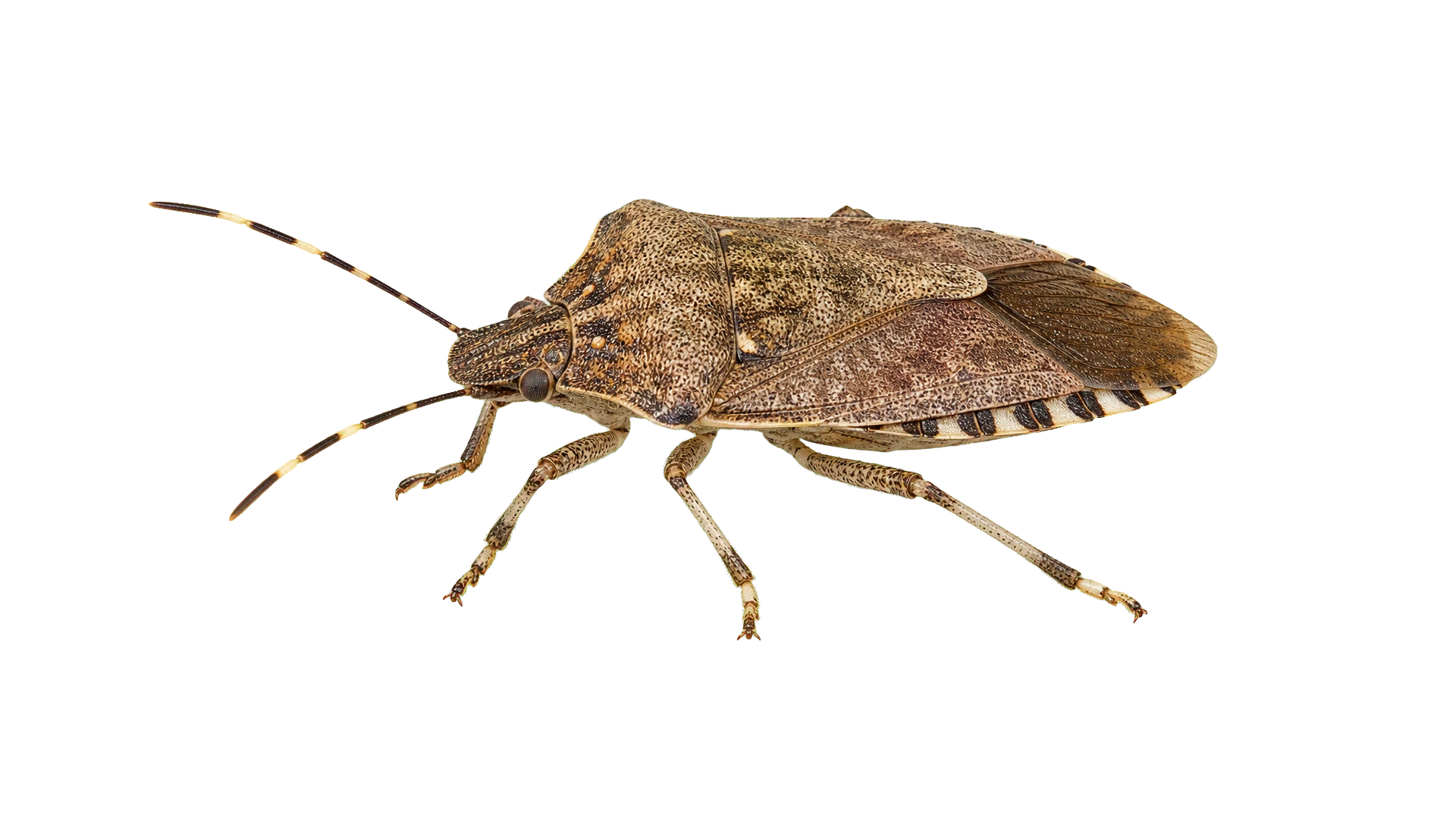
Shield-shaped body
The defining trait. Five-sided outline broader at the shoulders, tapered toward the rear, with a large triangular plate (scutellum) running down the back. Beetles look round or oval. Stink bugs look like a miniature shield.
Local pest control help is one call away.
 Pest Control Services Nationwide Pest Control Services Nationwide
 Stink bugs are shield-shaped insects with two signature behaviors. They release a cilantro-soap odor when threatened. They march up sunny walls by the hundreds each fall, hunting overwintering shelter. By the time you notice indoor activity, the migration finished weeks earlier through soffits, attic vents, and siding gaps.
Brown marmorated stink bugs (BMSB) drive nearly every serious home invasion. The species arrived in Pennsylvania in 1998 and now occupies 47 states. Native species (green stink bug, brown stink bug, southern green stink bug) stay in fields and rarely cross into living space. Marbled brown shield with banded antennae means BMSB.
Your window to stop an indoor invasion runs late August through mid-October. Populations gather on exterior walls during this stretch, then squeeze inside. After they reach the wall void, indoor treatment fails and you spend the next six months managing emergences instead of preventing them.
What separates a passing visit from a real problem:
One home can shelter 4,000 BMSB across wall voids and attic insulation by January. Females lay 200 to 400 eggs per season in barrel-shaped clusters of 28 on leaf undersides. Mid-Atlantic apple growers lost $37 million to BMSB feeding in 2010 alone. The fall flight covers up to three miles per individual, enough to reach every home within line of sight of a host orchard or soybean field.
Three checks separate stink bugs from boxelder bugs, beetles, and other fall invaders. The shield silhouette is usually enough on its own.
The defining trait. Five-sided outline broader at the shoulders, tapered toward the rear, with a large triangular plate (scutellum) running down the back. Beetles look round or oval. Stink bugs look like a miniature shield.

Adults match a thumbnail. BMSB is mottled brown with subtle white bands on antennae and along the abdomen edge. Native species range from bright green to gray-brown but share the same silhouette and size class.

BMSB shows alternating light and dark bands on the last two antenna segments, plus white-and-dark banding along the abdomen edge. Solid-color antennae point to a native species rather than the invasive home invader.
Stink bugs make themselves known. The combination of clustered fall sightings on siding and indoor emergence in winter is hard to confuse with any other pest. The cilantro smell after one is disturbed is its own diagnostic, and BMSB is the species behind 95 percent of indoor reports. Sort the situation against the five field signs below.
Each sign corresponds to a different stage of the invasion cycle. The fall wall aggregation is a warning for next winter. Indoor emergence in January confirms a wall void already holds the population. The smell after vacuum or crush is unrelated to severity but tells you to switch tools. Garden scars on tomatoes mean the summer feeding stage is producing the population that will arrive at your siding in October.
The fastest diagnostic for separating BMSB from native stink bugs is the banded antennae plus banded abdomen edge. Native species (green stink bug, brown stink bug, southern green stink bug) lack both features and almost never overwinter in homes. If the bug on your windowsill shows the bands, you have BMSB and the indoor emergence will repeat across the rest of winter.
How a Stink Bug Issue Builds
Stink bugs do not bite, do not sting, do not transmit disease, and do not damage building structure. The cost they impose on homes is overwhelmingly nuisance and aesthetic: hundreds of overwintering individuals appearing in living spaces over the course of winter and spring, the smell when they are mishandled, and the staining some species can produce on light-colored fabrics and walls. None of that is trivial, but the threat profile is genuinely lower than the volume of bugs suggests.
The harder cost is on gardens and orchards. BMSB feeds on a wide range of fruit and vegetable crops by inserting a needle-like rostrum and withdrawing fluid, leaving scarred or pitted produce that is often unmarketable and unpleasant for home consumption. Tomatoes, peppers, apples, peaches, and beans are the most commonly hit. Homeowners with vegetable gardens or fruit trees often notice the garden damage first and the indoor invasion second, late in the same season.
Effective management runs through fall exterior treatment timed before the migration to overwintering sites begins, plus exclusion work around siding edges, soffits, vents, window frames, and attic access points. Once stink bugs are inside the wall voids, indoor sprays are largely a waste of effort because the bugs are not feeding or moving and indoor product cannot reach where they are sheltering. Vacuuming with a designated vacuum (canister easily emptied, no smell transfer) is the practical winter response.
Six features that define the shield-shaped fall invader. The silhouette alone is usually enough for identification.
Five-sided outline broader at the shoulders, tapered toward the rear. Defining silhouette across the entire Pentatomidae family. Runs 1/2 to 5/8 inch in home-invading species.
Large triangular plate running from the thorax down the back. Covers roughly a third of the abdomen, visible as a clear triangle from arm's length.
Three pairs of walking legs spaced along the body. Stink bugs walk slowly and pause often on warm walls. Loud, clumsy fliers when disturbed.
Five segments held forward of the head. BMSB shows alternating light-and-dark bands on the last two segments, the most reliable mark separating invasive BMSB from native stink bugs.
Needle-like rostrum tucked under the body when not feeding. Pierces plant tissue and extracts fluids, producing cat-facing scars on fruit. Cannot puncture human skin.
Paired thorax glands release the cilantro-soap compounds when the insect is threatened or crushed. Crushing indoors broadcasts the smell across the room and onto fabrics.
Match your situation to one of the four common patterns. The right response depends entirely on which one you are dealing with.
Brown marmorated stink bugs (BMSB) are an invasive pest established across 47 states. They feed on garden plants and orchards through summer, then push indoors in massive fall aggregations. The timeline below tracks the seasonal cycle.
Adults and nymphs feed on garden vegetables, fruit trees, and soybean fields. Cat-facing scars appear on tomatoes and peppers by August. Summer presence directly predicts fall aggregation pressure on your siding.
Mass aggregations on south- and west-facing walls, often hundreds to thousands at peak. Bugs enter through gaps as small as 1/8 inch and accumulate in attics, window frames, and soffit voids. Crushing stains surfaces.
Bugs overwintering in attics, wall voids, and behind siding. They emerge on warm winter days into bedrooms, bathrooms, and living spaces. Indoor sightings continue across 6 to 8 weeks of warm spells.
Surviving bugs leave overwintering sites and return to host plants. Some get trapped in living spaces during the exit. Spring sealing of entry points (after bugs leave) is the most effective long-term fix.
Stink bugs are managed, not exterminated. Indoor cleanup never fully ends until the building envelope tightens. Combine fall exterior treatment with spring sealing for the cleanest long-term result.
Local pros time fall exterior treatment ahead of the overwintering flight and combine it with the exclusion work that keeps next year's bugs in the wall instead of inside.
Stink bugs do not pick houses at random. They follow signals: a south- or west-facing wall warmed by October afternoon sun, a soybean field or orchard within a mile that produces the summer breeding population, an aggregation pheromone trail from prior-year overwintering populations marking the structure as a known winter shelter. Once a single fall return-flight tags the house, 500 to 2,000 plus bugs deposit on sunlit walls across a 3 to 5 day October window.
Different stink bug species behave differently indoors, which is why ID matters. Brown marmorated stink bugs (Halyomorpha halys, BMSB) drive nearly every serious home invasion: marbled brown shield, banded antennae, banded abdomen edge, and active overwintering in attic and wall voids across 47 states. Native green stink bugs, brown stink bugs, and southern green stink bugs stay in fields and rarely cross into living space. Harlequin bugs damage cole crops but skip homes. Knowing the species tells you whether the indoor emergence repeats across winter or ends at first frost.
Most affected homes have two or three of these conditions running at once, and exclusion in late September beats interior spray every time. Start with the highest-leverage entry point: install or repair screens on every gable, ridge, and soffit vent before October 1, then seal gaps larger than 1/16 inch around exterior trim, vinyl siding edges, and worn weather stripping. Even partial wins help: screening one open gable vent on a south-facing wall can cut attic aggregations by 60 to 80 percent the following winter, and a shop vacuum (not a crush) handles any indoor stragglers without releasing defensive odor.
South and west-facing siding is where the fall flight aggregates. Surface populations during warm afternoons in September and October are the lead indicator for indoor invasion later.
The single largest indoor overwintering site. Bugs enter through soffit vents, gable vents, ridge vents, and gaps where soffit meets siding, then settle into insulation for the winter.
Gaps around exterior trim, weep holes in vinyl frames, and worn weather stripping are common entry points and the spot where indoor emergence is first noticed in winter.
Vinyl siding edges, gaps under wood siding, and chimney flashing all funnel bugs into wall voids. Once they are there, indoor emergence on warm days is essentially unavoidable for the rest of the season.
Detached garages and storage sheds absorb significant overwintering pressure when the main home is well sealed. Stored items, especially cardboard boxes, become indoor harborage.
Tomatoes, peppers, beans, soybeans, and ornamental fruiting trees feed the summer population that becomes the fall flight. Garden density is a leading indicator of nearby home pressure.
Why fall is the make-or-break window. The annual cycle determines exactly when exterior treatment matters and when it is too late.
4 to 7 days
Females deposit barrel-shaped eggs in clusters of 28 on host plant leaf undersides. Eggs darken from pale green before hatching.
5 instars over 5 weeks
Nymphs hatch red and black, darkening through five molts toward adult coloring. They feed on plant tissue throughout development.
Spring to late summer
Adults exit overwintering in spring, feed and reproduce across fields and gardens. Southern climates produce two generations per year, northern climates one.
Fall through spring
Late August through October, adults seek warm structures for diapause. They cluster on sunny walls, enter wall voids, and remain dormant until spring.
Exterior treatment and exclusion windows close mid-September across most climates. After mid-October, most BMSB that will invade have already entered wall voids, and indoor product cannot reach them.
Stink bugs invade homes in fall to overwinter. Match what you're seeing to identify which one.
| Species | Severity | Key Sign | Where You'll Find Them |
|---|---|---|---|
| Brown Marmorated Stink Bugs | Nuisance | Mass invasions in fall, pungent cilantro-like smell, damage to fruit crops | homes (fall), orchards, gardens |
Severity reflects typical impact, not your specific case. If unsure, treat at the higher tier.
Honest read on the approaches homeowners try. Timing matters more than product choice in nearly every case.

 Pyrethroid or similar pro-grade product applied to siding, soffits, and around vents in late August through mid-September Timing is essential; same product applied in November is largely wasted Combined with exclusion, dramatically reduces indoor invasion the following winter Caulk gaps where soffit meets siding, around window and door trim, around utility penetrations Replace or repair soffit, gable, and ridge vent screens (1/8-inch hardware cloth) Address worn weather stripping around exterior doors before fall Wet/dry vacuum or dedicated canister vacuum kept for stink bug duty only Empty the canister immediately into a sealed outdoor bag Adding a small amount of soapy water to the canister kills bugs and reduces smell transfer
  Bugs sheltering in wall voids and attic insulation are not exposed to interior product Indoor chemical exposure with no progress on the actual source Emergence continues through spring regardless of indoor application Releases defensive scent compounds across the room Stains light-colored fabrics, walls, and window sills Pheromones in the released compounds can actually attract more bugs Smell concentrates in the bag or canister and recirculates through exhaust Vacuum becomes unusable for routine household cleaning Bugs sometimes survive the suction and crawl back out of the canister
 Six steps, sorted by effort. The best work for indoor pressure happens outside in late summer.

Wet/dry shop vacuum kept for stink bug duty only, with a quart of soapy water in the canister. Empty into a sealed outdoor bag after every session to prevent smell transfer.

Walk the perimeter in early September. Caulk every gap around exterior trim, vinyl-frame weep holes, and utility line penetrations. Replace worn weather stripping before the first cool night triggers migration.

Soffit, gable, and ridge vents funnel 70 percent of arriving BMSB straight into attic insulation. Replace damaged screens with 1/8-inch hardware cloth before late August.

Late August through mid-September. Pro-grade pyrethroid applied to walls, soffits, and vent surrounds before migration starts. Single most impactful intervention against a property with chronic BMSB pressure.

Vinyl siding edges, material transitions, and chimney flashing all funnel BMSB into wall voids. Sealing these takes a weekend but pays off across 5 to 10 fall seasons.

Relocate vulnerable hosts (tomatoes, peppers, beans, soybeans) at least 30 feet from the home perimeter. Reduces the local summer population that builds the fall flight on your siding.
Stink bug pressure follows a predictable annual rhythm. Knowing the calendar tells you exactly when each intervention belongs.
Overwintered adults exit walls and attics on warm days, sometimes producing alarming indoor sightings. Outdoor egg-laying begins on host plants. Indoor emergence tapers by late May.
Nymphs develop on garden and crop plants. Garden damage to tomatoes, peppers, and beans is most apparent in late summer. Population is building toward the fall flight.
The defining season. Late August through October is when adults aggregate on sunny walls and enter homes for overwintering. Exterior treatment and exclusion windows belong here.
Bugs are dormant in wall voids and attics. Warm interior days trigger limited emergence into living spaces. Indoor sprays do not reach the source; vacuuming is the practical response.
Four steps from arrival to a fall-timed plan that matches the actual pressure pattern. Initial visit runs 60 to 90 minutes.
Timing beats product choice. The right work in the wrong week is often the wrong work. A pro plan locks in the late-summer treatment window and pairs it with the exclusion work that keeps the next migration outside the structure.
Discuss prior winters' indoor sighting intensity, garden proximity, and which walls and rooms have been affected. Confirm BMSB versus native species and severity tier.
Walk siding, soffits, vents, window frames, and utility line penetrations. Identify the exact entry points funneling bugs into wall voids and attic insulation.
Pro-grade pyrethroid applied to walls, soffits, vent surrounds, and known entry points. Timed for late August through mid-September across most climates.
Caulk and re-screen the entry points logged during inspection. Schedule a follow-up exterior visit if pressure warrants. Plan vacuum-based winter response.
Real stories from households who connected with pros to handle aggressive fall invasions and stop the next overwintering cycle before it started.

"Fall stink bug invasions dropped sharply."
Stink bugs would cover our south-facing walls and find their way inside. The provider treated the exterior and sealed entry points around windows. The number that got inside dropped dramatically.
"Fall stink bug invasions dropped sharply."
Stink bugs would cover our south-facing walls and find their way inside. The provider treated the exterior and sealed entry points around windows. The number that got inside dropped dramatically.

"Stink bug migration cut off at the exterior."
In the fall, stink bugs would cluster on the sunny side of the house and work their way inside. The provider treated the exterior before the migration and sealed the most common entry points. The difference was significant.

"Sunny-side stink bug entries sealed."
Stink bugs would cover our sunny-side walls and get inside through tiny gaps. The provider treated the exterior in late summer and sealed around windows and doors. The number that got inside dropped to almost zero.

"South wall sealed against stink bugs."
Stink bugs would swarm our south-facing walls and find their way inside through every crack. The pro treated the exterior and sealed around windows. The number getting inside dropped to almost none.

"October stink bug entries sealed up."
Every October, stink bugs would cluster on the sunny side of the house and squeeze inside. The tech sealed window and door frames and treated the exterior. The number of bugs getting inside dropped to nearly zero.

"Indoor stink bug numbers fell to nearly none."
Dozens of stink bugs would gather on the windows every fall and find their way inside. The inspector sealed gaps around window frames and treated the exterior. The following fall, the number getting inside was negligible.

"Window screen stink bugs cleared yearly."
Brown marmorated stink bugs covered our screens each fall. The provider treated the exterior walls and sealed gaps around utility penetrations. They explained the annual cycle so we could start prevention earlier each year.

"Fall stink bug entries cut down to nearly zero."
Stink bugs gathered on the south-facing walls every autumn and made their way inside. The provider sealed window and door frames and treated the exterior. The following fall, the number getting inside dropped to almost zero.

"Stink bug invasion cut from dozens to a few."
Each autumn, stink bugs would congregate on the south wall and enter through gaps around the windows. The provider sealed the entry points and treated the exterior. The annual invasion dropped from dozens to just a handful.

"Window tracks sealed against stink bugs."
Stink bugs collected in the window tracks and behind curtains every fall. The provider sealed the windows and treated the exterior with a barrier. The improvement was noticeable the very next season.

"Stink bug entries cut by over ninety percent."
Every autumn, stink bugs found their way inside despite our efforts. The provider sealed dozens of tiny gaps around windows, doors, and utility lines. The comprehensive sealing job cut the number getting inside by over ninety percent.

"South-side stink bug entries sealed up."
Every fall, stink bugs would cover the south-facing wall and find their way inside through window gaps. The provider sealed the exterior and treated the wall. The number getting inside dropped dramatically.

"South wall sealed and stink bugs cut dramatically."
Stink bugs gathered on the south wall and squeezed through window gaps each fall. The provider sealed the exterior and treated the siding. The following autumn saw a dramatic drop in the number getting inside.

"October stink bug invasion sharply reduced."
Stink bugs covered the south side of the house each fall. The provider treated the exterior and sealed around window frames and vents. The following fall, the number getting inside was reduced dramatically.

"Indoor stink bugs cut to just a few."
Brown marmorated stink bugs covered the windows every October. The provider sealed exterior gaps and treated the siding. The number finding their way indoors dropped to just a few.

"South wall stink bug entries closed up."
Stink bugs gathered on the south wall and found their way inside through window gaps. The provider sealed the windows and treated the exterior. The number getting inside dropped to almost zero the following year.

"Window frames sealed and stink bugs cut."
Every October the south-facing windows looked like they had a polka dot pattern from the outside, and inside I was vacuuming up dozens daily. The crew caulked the trim, treated the siding, and replaced the worst weatherstripping. This past fall I counted maybe four indoors total. My husband, who hated these the most, is finally happy.

"Exterior sealed and stink bugs cut dramatically."
Stink bugs covered the south wall and entered through window gaps each autumn. The provider sealed the exterior and treated the siding. The improvement was dramatic the following season.

"Window gaps sealed and stink bugs out."
Late September the south wall would look like a polka dot pattern and the kids found one in the cereal one morning. That was the last straw. The crew caulked around every window on the warm side, treated the siding, and walked me through what to watch for. This past fall I think I saw three indoors total instead of dozens.

"Indoor stink bug numbers cut dramatically."
Vacuumed up about fifteen of them off the bedroom curtains one Sunday morning in October. My wife was beyond done with the cilantro smell. The crew caulked around every window on the south side, treated the exterior, and replaced two pieces of weatherstripping. This year I counted about five total indoors.

"Indoor stink bugs cut down to nearly zero."
Brown marmorated stink bugs gathered on the windows each autumn. The provider sealed exterior gaps and treated the siding. The number getting inside dropped to nearly zero.

"Exterior sealed and stink bug invasion minimal."
Every year around the second week of October the lampshade in the living room would have stink bugs clinging to it. My daughter is terrified of them. The crew caulked around every window and trim piece on the south side, treated the siding, and replaced two failing pieces of weatherstripping. This past October my count was three indoors total.

"Indoor stink bugs cut significantly."
We have a sunny south wall and every October it became a stink bug magnet. Found one in the dog's water bowl one morning and that was it. The tech caulked every gap around the windows, treated the siding, and showed me where they were squeezing in behind the vinyl trim. This past fall the indoor count was maybe four total. The dog approves.

"Stink bug entries cut from dozens to a few."
Brown marmorated stink bugs invaded every fall. The provider sealed around windows and treated the exterior. The number entering dropped from dozens daily to just a few.

"Sunny window stink bug entries sealed."
Every October the sunny windows would have a polka dot pattern of stink bugs from the outside in. The tech sealed gaps around the trim and treated the exterior in early September. The following fall the indoor count was a fraction of what we used to see. The cilantro smell is gone too.

"Exterior sealed and stink bug entries dropped."
Stink bugs gathered on the south wall and entered through window gaps. The provider sealed the exterior and treated. The following fall saw a significant drop in indoor activity.

"South wall stink bug entries sealed up."
Late September would roll around and the south wall would be polka-dotted with stink bugs from the outside. Inside, I was vacuuming up dozens daily off the windowsills. The tech caulked every gap around the trim and treated the siding. This past fall I think I saw four inside the whole month. Big improvement.

"Indoor stink bug numbers dropped sharply."
October would roll around and I would find stink bugs everywhere: lampshades, the bathroom mirror, the cat's food bowl. The tech caulked every gap around the south-facing windows and treated the siding in early September. Made a huge difference this past fall. The cat is happier and so am I.

"Windows sealed and stink bugs cut sharply."
First frost is when we noticed them every year, dozens on the south-facing windows and a handful indoors. Vacuumed them up and felt the smell on my hands for hours. The tech caulked the trim around every window on that side, treated the siding, and replaced the worst weatherstripping. Last fall I think I saw four inside the whole month of October.

"Exterior sealed and stink bugs reduced."
Stink bugs gathered on the warm side of the house each fall. The provider sealed gaps and treated the exterior. The following autumn showed dramatic improvement.

"Sunny window gaps sealed against stink bugs."
Vacuumed up a small army of stink bugs off the dining room curtains the second week of October every year. The smell when you crush one is something else. The tech caulked every window on the warm south side, treated the siding in late summer, and swapped two failing strips of weatherstripping. The number indoors this past fall was a fraction of what we used to see.

"South wall sealed and stink bugs cut."
Late September the warm side of the house turned into a stink bug billboard. I would vacuum dozens off the screen door every morning before the kids went to school. The tech caulked the trim around every window on that side, treated the siding in early September, and made me a believer in late-summer timing. This past fall, indoor count was way down.
Direct answers to what homeowners ask most about identification, fall invasions, and what actually works for indoor and outdoor pressure.
No. Stink bugs do not have biting jaws capable of breaking human skin and do not have a stinger. The needle-like rostrum they use to feed is built for piercing plant tissue, not animal hosts, and it stays tucked under the body when not in use. They also do not transmit any human disease. Pets that mouth one usually drop it immediately because of the smell rather than because of any defensive injury. The actual costs stink bugs impose on a household are nuisance, smell, and aesthetic: dozens or hundreds of overwintering bugs appearing inside through fall and spring, the cilantro-soap odor when one is mishandled, and occasional staining of light-colored fabrics or window sills from the defensive secretion. Garden damage to tomatoes, peppers, beans, and tree fruit is a separate and often larger cost outdoors, particularly with brown marmorated stink bugs. None of those concerns rise to a medical risk for typical residential exposure.
That is the annual fall flight to overwintering sites, the single most visible event in the stink bug calendar. As outdoor temperatures cool in late August through October, adults that have been feeding all summer in fields, gardens, and orchards begin searching for warm structures where they can shelter in diapause through winter. South- and west-facing walls absorb afternoon sun and stay warm into evening, so they show up first on the bug's solar-tracking radar. Light-colored siding amplifies the effect. Aggregation pheromones from previous arrivals mark a specific home as a known overwintering site, which is why some homes get hit year after year while neighbors are barely affected. The clusters on the wall surface are the visible part of a larger event: many bugs continue past the surface into siding gaps, soffits, vents, and wall voids to settle in for the winter. The window for stopping the indoor side of the invasion runs out in mid-October in most climates.
Vacuum, not crush, but use the right vacuum. Crushing releases the defensive scent compounds in concentrated form across whatever surface the bug was on, and the chemicals are oily and persistent enough to bind to drywall, fabric, and wood for hours or days. The smell can also include aggregation pheromone components that signal other stink bugs to gather, which is the opposite of what you want. A standard household vacuum is the next-worst option because the smell concentrates inside the bag or canister and recirculates through exhaust, often making the vacuum unusable for routine cleaning. The right tool is a designated stink bug vacuum, ideally a wet/dry shop vacuum or a canister vacuum kept for stink bug duty only. Adding a small amount of soapy water to the canister kills bugs on contact and reduces smell transfer. Empty the canister immediately into a sealed outdoor bag after each use. This approach handles the visible bugs without spreading the chemicals or attracting more.
Almost never, and reaching for indoor spray is the most common wasted effort in stink bug response. By the time bugs are emerging from light fixtures, attic hatches, and window frames in winter or early spring, the source population is already deep in the wall voids and attic insulation where indoor product cannot reach. Surface sprays applied along baseboards or window sills target a tiny fraction of what is actually present, expose the household to chemicals without addressing the driver, and do nothing to stop continued emergence as warmth cycles through the structure. The work that actually reduces stink bug pressure is exterior, applied in late August through mid-September before the migration begins, and combined with exclusion at soffits, siding edges, vents, and window frames. Once the calendar passes mid-October most of the year's invasion is decided. Plan for next fall rather than fighting the current winter with indoor product.
Two reliable field marks. First, the antennae. Brown marmorated stink bugs (BMSB) have alternating light and dark bands on the last two antenna segments, the single most diagnostic feature for separating the invasive species from native stink bugs. Native species typically have solid-colored antennae. Second, the abdomen edge. BMSB has alternating light and dark banding along the outer edge of the abdomen, visible from above as a striped fringe. Native species usually have a solid colored or subtly speckled edge. Color alone is not reliable because BMSB ranges from gray-brown to mottled brown and several native species are similar. The species behind nearly all serious indoor invasions is BMSB; native species (green stink bug, brown stink bug, southern green stink bug) tend to remain agricultural pests and rarely overwinter inside homes in significant numbers. Confirming BMSB is helpful for setting realistic expectations about indoor pressure and orchard or garden damage.
No. Stink bugs that enter homes for overwintering are in diapause, a hormonally suppressed state in which they do not feed, do not mate, and do not lay eggs. The interior environment lacks the host plants nymphs require to develop, so even if a small amount of accidental mating occurred no successful offspring would result. The hundreds of bugs a homeowner finds emerging through fall and spring are the same hundreds that entered the previous fall, dwindling as some die during winter. The practical implication is that stink bug issues are imported issues with no indoor reproduction component. Treating only the indoor space (surface sprays, foggers, baseboard product) tends to fail because the source is the previous fall flight that is now sheltered behind drywall. Treating the outdoor source (late-summer perimeter treatment, exclusion at soffits and vents and siding edges) consistently reduces next year's intake. Homes that finally invest in the exterior work typically see indoor pressure drop substantially within one or two annual cycles rather than continuing to rebuild every winter.
Pro treatment can dramatically reduce indoor invasion when timed correctly and paired with exclusion, but the honest framing is reduction rather than elimination for homes with significant local pressure. A well-run pro program for stink bugs centers on a late-summer exterior visit (late August through mid-September in most climates) applying pro-grade pyrethroid or similar product to siding, soffits, around vents, and at known entry points before the fall flight starts. That single visit alone often cuts indoor pressure by 60 to 80 percent the following winter. Pairing the treatment with exclusion (1/8-inch screen on soffit, gable, and ridge vents; caulk around window and door trim; sealing siding edges) reduces it further. Properties with nearby orchards, soybean fields, or large gardens will still see some indoor activity because the regional population is large enough to overwhelm any one home's defenses, but the volume and frequency drop substantially. Homeowners who commit to the fall calendar consistently report the difference between hundreds and dozens, which is usually enough to make the issue manageable rather than overwhelming.
Get on a fall calendar. Local pros time the late-summer perimeter visit to your climate and pair it with the exclusion that keeps the wall voids empty.
Click through to species pages for specific identification, behavior, and treatment for each stink bug type.
An invasive stink bug species that causes widespread agricultural and home invasion problems.
The brown marmorated stink bug is an invasive species from Asia that has become one of the most problematic fall home invaders in the eastern and midwestern United States. In addition to being a household nuisance, they damage fruit orchards, vegetable crops, and ornamental plantings. Early-season exterior treatment and thorough sealing of the building envelope are the most effective residential strategies.
Quick ID:
Why it matters: