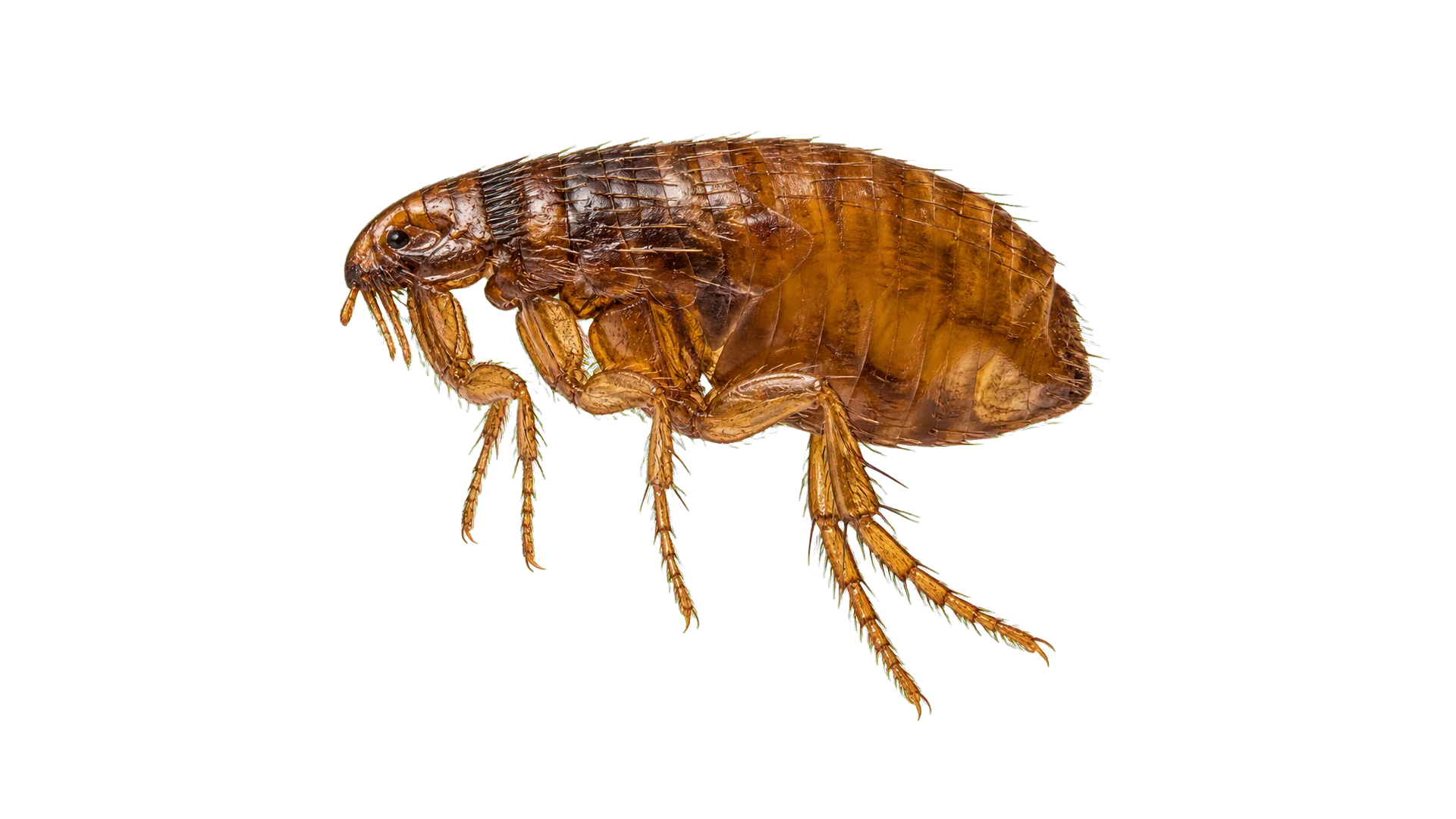
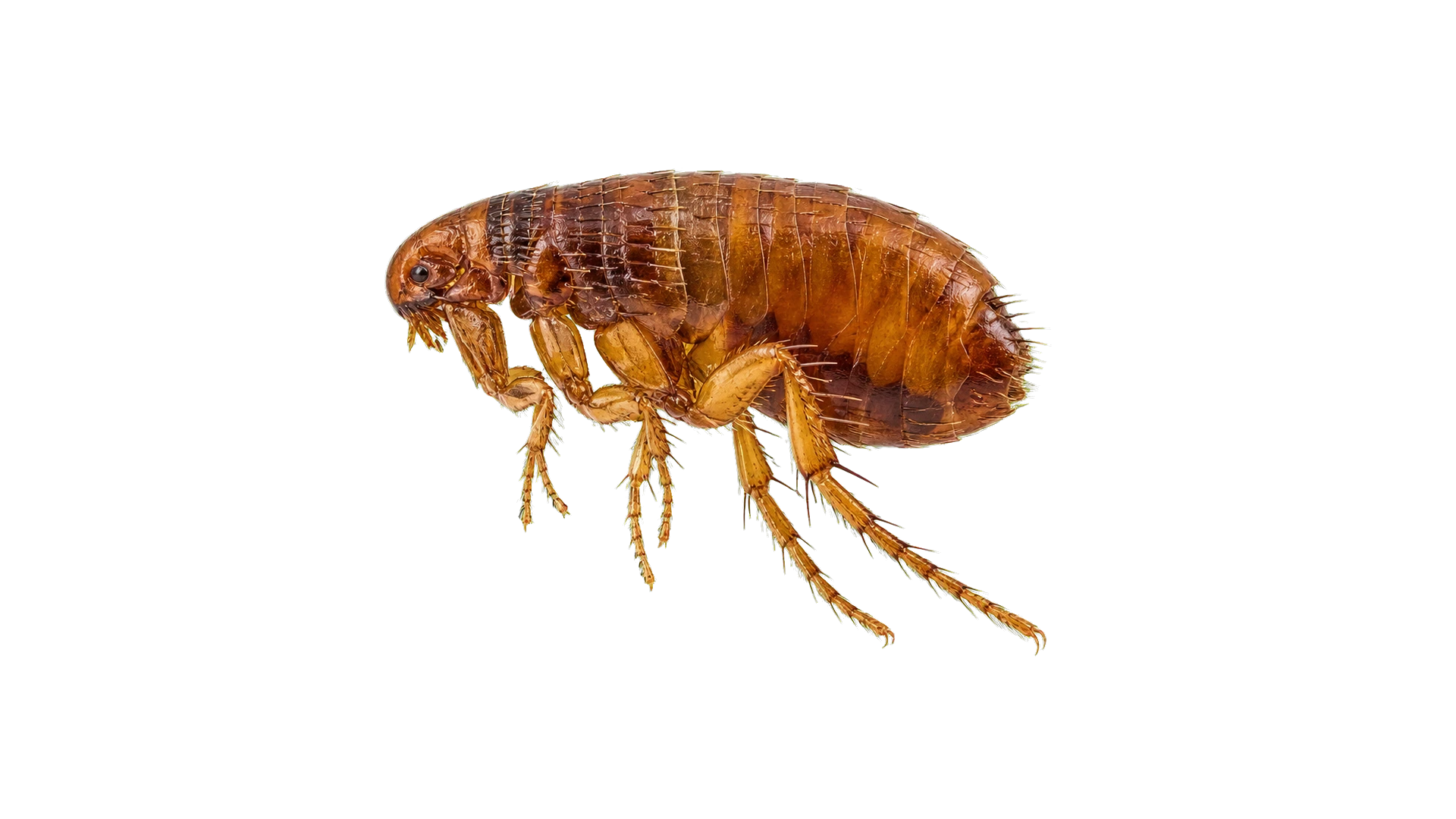
1 to 3 mm reddish-brown
Adult fleas are tiny, dark, and laterally compressed (tall and thin from the side). Coloring is reddish-brown to dark brown. Anything larger than 4 mm is not a flea.
Local pest control help is one call away.
 Pest Control Services Nationwide Pest Control Services Nationwide
 Fleas almost never stay outdoor-only. The pet picks them up in the yard, the eggs roll off in the house, and within 3 to 4 weeks an indoor population is reproducing in the carpets. Treating just the pet, just the house, or just the yard always leaves part of the cycle alive.
Fleas need a warm-blooded host to feed on, then a soft humid environment for eggs and larvae to develop. Pets are the host; pet bedding, carpets, upholstered furniture, and shaded yard spots are the development environment. Both have to be treated.
Cut the host access (effective pet flea protection) and the cycle breaks at adult stage. Treat the indoor environment and you eliminate the developing generations. Skip either step and the population recovers within weeks.
Three things every flea population requires:
A single female flea lays 20 to 50 eggs per day for most of her adult life. The visible adults represent only about 5 percent of the total population; the other 95 percent are eggs, larvae, and pupae developing in carpets, bedding, and floor cracks. Pupae can stay dormant in their cocoons for months waiting for vibration cues that signal a host is nearby.
Three checks that distinguish fleas from gnats, mites, or biting flies.
Adult fleas are tiny, dark, and laterally compressed (tall and thin from the side). Coloring is reddish-brown to dark brown. Anything larger than 4 mm is not a flea.

Fleas are flat side-to-side (the opposite of bed bugs and cockroaches, which are flat top-to-bottom). The shape lets them slip through fur and feathers.
If it disappears when you reach for it and reappears 6 to 12 inches away, it's a flea. Adult fleas can jump roughly 100 times their body length using muscular hind legs.
By the time you see fleas jumping on your ankles, the population has been developing in your carpets and pet bedding for weeks. The visible adults are roughly 5 percent of what's there; the rest are eggs, larvae, and pupae waiting to emerge. Catching the early signs lets you intervene before the indoor cycle is fully established.
How a Flea Problem Establishes
Adult fleas spend most of their lives on the host: a cat, dog, or wildlife. They feed on blood, mate on the host, and the female lays eggs that fall off into the environment. Eggs hatch into worm-like larvae that crawl deep into carpet pile, pet bedding, or floor cracks. Larvae feed on flea dirt (digested blood from adults) and develop for 5 to 11 days before spinning a cocoon and pupating.
The pupal stage is the reason flea infestations are so durable. Pupae can wait inside their silk cocoons for weeks to months, emerging only when they detect vibration cues (footsteps, vacuuming, heat) that signal a host is nearby. This is why empty homes can sit dormant for months and then explode with adult fleas the day a new resident moves in. Vacuuming actually triggers emergence, which is part of why it's so useful as a treatment step.
Effective flea control treats all four life stages simultaneously: adults on the pet (with veterinary-grade flea medication), eggs and larvae in carpets and bedding (with insect growth regulator and aggressive vacuuming), pupae through environmental disruption (vacuum-induced emergence followed by treatment), and outdoor populations in shaded yard spots if pets are outdoor-active. Single-stage treatments fail predictably.
Six features that define a flea, with the cat flea pictured (the species responsible for most US infestations).
Fleas are flat side-to-side, the opposite of the top-to-bottom flatness of bed bugs and cockroaches. The shape lets them slip through fur or feathers as they move along a host.
The third leg pair is dramatically larger, packed with muscle that powers jumps 100+ times the body length. Takeoff acceleration is among the highest in the animal kingdom.
Cat fleas have two rows of dark spines: a genal comb under the head and a pronotal comb behind it. Both anchor the flea against host fur during feeding.
The proboscis points downward; three stylets pierce skin and draw blood. Bites take under a minute, and the flea hops back into fur or environment immediately after.
Body hairs angle backward, letting the flea move forward through fur without catching. The same hairs work against finger pinches, which is why fleas are so hard to grab.
Fleas have six legs total like all insects, but the disproportionate hind pair makes them look like jumpers from any angle. The first two pairs are used for grip on host hair.
Choose the symptom that matches what you're observing. Each one indicates a different point in the flea life cycle.
Fleas multiply in waves because of how their lifecycle works. A single pregnant female lays 20 to 50 eggs a day, but eggs, larvae, and pupae are nearly invisible. The timeline below maps the visible adult population, not the 95 percent hiding in carpets.
Pet scratching more than usual, or one or two bites on ankles after walking on carpet. The flea is likely hitchhiking on a pet or a wildlife visitor. Egg-laying is just starting now.
Visible adult cat fleas on pets, multiple bite clusters on human ankles, or flea dirt (small black specks) in pet bedding. The egg cycle is in full swing and the larval population is much larger.
Heavy bite activity, visible fleas jumping in carpet, or pets with skin irritation. The population includes thousands of pupae that DIY products miss, and most homeowners need pro treatment at this stage now.
Fleas in multiple rooms, on furniture, and on humans regardless of pet location. Pupal dormancy means the cycle restarts every time you vacuum the room. Multi-visit pro treatment across 30 to 60 days is required.
Pupae can stay dormant in carpet for 5+ months waiting for vibration and warmth. Even after a successful treatment, a sudden re-emergence 30 to 60 days later usually means the pupa stage finally hatched.
Treat the pet, treat the carpets, treat the yard. Local pros coordinate the integrated plan that actually clears flea populations in 4 to 8 weeks.
Fleas don't drift into homes randomly. They arrive on a host (your pet, a visiting pet, wildlife under the deck) or on shoes that walked through an active outdoor population. Identifying the introduction route lets you close it before treating the indoor population.
The two species in most US homes split the host preference more than their names suggest. Cat fleas (Ctenocephalides felis) actually account for over 90 percent of indoor infestations on both cats and dogs in the United States, despite the species name. Dog fleas (Ctenocephalides canis) are rarer here and look nearly identical to cat fleas in the field. The distinction matters less than the introduction route, because the treatment plan is the same: address the pet host, treat the indoor environment, and break the outdoor reinvasion source.
Most flea problems trace back to two or three overlapping conditions. Year-round pet protection that lapsed for a single month is the most common single cause. Wildlife harborage under decks, crawl spaces, and outbuildings (raccoons, opossums, feral cats) is the second. Used furniture or carpets from infested homes is the third. Even partial wins help: restarting consistent monthly pet medication alone often eliminates 70+ percent of indoor flea populations within 6 weeks.
Ground zero for flea development. Wherever the pet sleeps, eggs and flea dirt accumulate. Wash bedding weekly at high heat during treatment.
Larvae crawl deep into carpet fibers to develop away from light. Vacuum daily during treatment, paying attention to edges and corners where larvae concentrate.
Couches, recliners, and chairs where pets nap host significant developing populations. Treat with steam, vacuum thoroughly, or apply IGR-rated upholstery spray.
Larvae avoid light and crawl into baseboards, floor cracks, and the edges of area rugs. These crevices are where most adults emerge after pupal development.
Outdoor flea development happens in shaded, humid spots: under decks, dense ground cover, leaf litter accumulations, and along the foundation perimeter.
Wildlife (raccoons, opossums, feral cats) nesting in crawl spaces or under decks bring flea populations to the property. Address the wildlife and the flea source dries up.
Why a single pregnant flea on the pet becomes a full-house infestation in 3 to 4 weeks.
2 to 5 days
Females lay 20 to 50 eggs per day on the host; eggs roll off into pet bedding, carpets, and floor cracks. They hatch within a week under typical indoor temperatures and humidity.
5 to 11 days
Worm-like larvae crawl deep into carpet fibers, bedding, and floor cracks to avoid light. They feed on flea dirt (digested blood excreted by adults) and shed skin debris. Larvae are vulnerable to insect growth regulators.
1 week to 1 year
Larvae spin silk cocoons that camouflage with environmental debris. Pupae wait inside the cocoon for vibration or heat cues from a passing host. They can wait for weeks to over a year before emerging, which is why empty homes can produce flea outbreaks when re-occupied.
Lives 2 to 3 months on host
Adults emerge when triggered by vibration, heat, or CO2 (signs of a passing host). They jump onto the host, feed within minutes, and start producing eggs within 24 to 48 hours.
Egg-to-adult takes 3 to 4 weeks at typical indoor conditions. The pupal stage is the durable hidden generation that sustains infestations even after adult treatment. This is why effective flea control runs 4 to 8 weeks: the timeline includes one full pupal-emergence cycle to confirm the developing population is being suppressed.
Flea species look nearly identical, but their preferred hosts differ. Match what you're seeing to identify which one.
| Species | Severity | Key Sign | Where You'll Find Them |
|---|---|---|---|
| Cat Fleas | Persistent | Flea dirt on pet bedding, bites around ankles, infests both cats and dogs despite name | pet bedding, carpets, upholstery |
| Dog Fleas | Persistent | Flea dirt on dog bedding, most common in kennels and rural areas | dog bedding, kennels, carpets |
Severity reflects typical impact, not your specific case. If unsure, treat at the higher tier.
Straight read on common DIY methods. Effective flea control is always integrated across pet, environment, and yard because the visible adults are only 5 percent of the population. Single-tactic plans fail predictably within 4 weeks.

 Modern oral medications kill adults within hours of biting and prevent egg production Topical (back-of-neck) products provide 30 days of adult protection per dose Talk to your vet for the right product for your pet's weight, age, and species Insect growth regulator (methoprene or pyriproxyfen) prevents larvae and eggs from maturing Adulticide (etofenprox, permethrin, or pyrethrins) kills the visible adults Apply to carpets, upholstery, pet bedding, and floor edges; let dry before re-entering Daily vacuuming during treatment removes eggs, larvae, and adults; also triggers pupal emergence (which then encounters treated surfaces) Empty the vacuum bag/canister immediately after each session into a sealed outdoor trash bag Maintain daily vacuuming for 2 to 4 weeks even after visible activity stops
  Provide some protection against adult fleas on the pet Do nothing about the 95 percent of the population developing in the home environment Useful as supplemental layer with veterinary-grade oral or topical medication, not as the primary control Kill adults that contact the spray; do not penetrate carpets where larvae and pupae develop Pupae are protected inside their cocoons and emerge unaffected days later Often advertised as one-and-done treatments; almost always require follow-up applications Kills adults currently on the pet but provides no residual protection New adults emerge from indoor pupae and reinfest the pet within hours Useful as immediate-relief layer during heavy infestations, not as a control method
 Six prevention actions, sorted by effort. Most flea problems start outdoors and arrive on the pet; preventing them upstream is dramatically cheaper than treating an established indoor population.

Modern monthly oral or topical flea medications are dramatically more effective than older approaches. Maintain protection through winter, not just summer; indoor flea populations don't go dormant.
Hot wash and high-heat dry of pet bedding once a week kills any eggs and larvae. The single highest-impact regular maintenance for flea prevention.

Trim back dense ground cover, clear leaf litter from shaded spots, eliminate brush piles. Outdoor flea populations need humidity and shade; reduce both.

Skirt under-deck spaces, seal crawl space access, install hardware cloth where wildlife is nesting. Raccoons, opossums, and feral cats bring flea populations onto the property.

Pro-grade yard flea treatment focused on shaded zones (where outdoor flea development happens) provides 30 to 60 days of suppression. Worth it for properties with significant outdoor pet time.
Annual professional carpet cleaning (steam or hot-water extraction) removes accumulated eggs, larvae, and flea dirt that vacuuming cannot reach. Preventive layer for households with pets.
Outdoor populations peak in summer; indoor populations run year-round once established.
Outdoor populations begin building as temperatures rise. Pets returning from winter break (kennels, travel) often pick up new infestations. Spring is the right window to verify pet flea protection is current and start year-round if it lapsed.
Peak outdoor flea pressure. Yard populations multiply rapidly in shaded humid spots. Indoor populations from spring introductions reach maturity. Most homeowner flea calls cluster in July and August.
Outdoor populations decline but indoor populations persist. Wildlife seeking warm overwintering harborage often brings fleas into crawl spaces, sheds, and under-deck areas adjacent to structures.
Outdoor populations crash; indoor populations breed continuously in heated structures. Maintain pet flea protection through winter; lapsed protection in winter is one of the most common causes of spring flare-ups.
Four steps from arrival to a household no longer hosting fleas. Initial visit runs 60 to 120 minutes; full elimination spans 4 to 8 weeks.
Pet, environment, yard. Real flea control treats all three at once. Plans that focus on only one usually fail in 2 to 4 weeks when the untreated stage repopulates the others.
Inspect indoor pet zones, identify pet bedding hot spots, assess yard for outdoor breeding sites, check for wildlife harborage. Plan adjusts to the actual sources found.
Adulticide plus insect growth regulator applied to carpets, upholstery, pet bedding zones, and floor edges. Combined treatment addresses adults plus the developing 95 percent of the population.
Targeted yard treatment in outdoor flea development zones: under decks, dense ground cover, foundation perimeter shade. Lasts 30 to 60 days.
Second application at 14 days addresses pupae that emerged after the initial treatment. The full cycle takes 4 to 8 weeks; verification is two consecutive weekly checks with no adult activity.
Real stories from households who connected with flea control pros to clear the colony from pets, carpets, and yard simultaneously.

"The tech solved our recurring flea issue."
We treated our dog for fleas but the house was still infested. The tech explained that flea eggs live in carpets and furniture and treated the interior with targeted products. Within two weeks the flea cycle was broken.
"The tech solved our recurring flea issue."
We treated our dog for fleas but the house was still infested. The tech explained that flea eggs live in carpets and furniture and treated the interior with targeted products. Within two weeks the flea cycle was broken.

"Quick flea treatment after adopting a cat."
Our new rescue cat brought fleas into the house and they spread fast. The tech treated carpets, furniture, and baseboards while we got the cat treated by the vet. Breaking the flea life cycle in the house was key to solving it.

"Indoor flea cycle broken after stray visit."
A stray cat rested on our porch and left fleas that migrated inside. The provider treated the porch, entryway, and living room carpets. They explained how outdoor-to-indoor transmission works and recommended preventive treatments for pet-owning homes.

"Indoor flea cycle broken after park visit."
Our dog picked up fleas at the park and the house was infested within a week. The provider treated the carpets and upholstered furniture while the vet treated the dog. They explained the four-stage flea lifecycle and why indoor treatment is necessary even after treating pets.

"Indoor flea cycle broken throughout the house."
Our cats were treated for fleas but the carpets were still infested. The provider explained the flea life cycle in carpets and treated the floors and furniture. Breaking the indoor cycle was essential to ending the problem.

"Move-in flea problem cleared within two weeks."
We moved into a house where the previous owner had pets and fleas were already established. The provider treated every room and explained the life cycle stages hiding in carpets. The problem was cleared within two weeks.
Direct answers to what homeowners ask most when fleas show up on the pet or in the carpets.
Adult fleas on the pet represent only about 5 percent of the total flea population. The other 95 percent are eggs, larvae, and pupae developing in carpets, pet bedding, upholstered furniture, and floor cracks. Pet medication kills the adults as they bite the pet, but new adults emerge daily from the indoor pupal pool. Effective flea control always treats the indoor environment alongside the pet: insect growth regulator (IGR) plus adulticide on carpets and bedding, plus aggressive daily vacuuming for 2 weeks. Plan on 4 to 8 weeks for full elimination because pupae continue emerging on schedule. Visible adults appearing 2 to 4 weeks after starting treatment is normal, not a treatment failure.
Wipe the suspected specks with a damp white paper towel or cotton ball. Flea dirt (digested blood excreted by adult fleas) turns reddish-brown when moistened because it contains undigested blood pigments. Regular dirt or dust stays gray or brown without color change. The wet-paper-towel test is the standard diagnostic and confirms an active flea population on the pet. Concentration of flea dirt maps where the pet spends time: heaviest in pet bedding, secondary in carpet near sleeping spots, lighter on upholstered furniture. The amount of flea dirt also gives a rough population estimate; a substantial accumulation usually means dozens to hundreds of adult fleas active on the pet.
No, and this is a common surprise. The indoor flea population (eggs, larvae, pupae) develops independently of the pet for weeks to months. Pupae can wait inside their cocoons for over a year before emerging when triggered by vibration or heat from a passing host. Removing the pet eliminates the source of new eggs but does not address the developing population already in the carpets and bedding. The remaining adults will feed on humans (focusing on lower legs and ankles) when pet hosts are unavailable. Effective control always requires treating the indoor environment regardless of pet status. If the pet is being rehomed for an unrelated reason, complete the indoor flea treatment before the new home decision is finalized so the pet doesn't carry the infestation forward.
Cat fleas and dog fleas (the species responsible for most US flea infestations) do not live and breed on humans. Their lifecycle requires a furred host. They will bite humans opportunistically, especially when pet hosts are unavailable, but they do not establish long-term human-host populations. Bites concentrate on lower legs and ankles because of fleas' limited jump height (about 8 inches vertical). True human-host fleas exist (Pulex irritans, the human flea) but are rare in modern US homes; they were historically associated with poor sanitation conditions. If you have flea bites and no pets in the household, the population is almost certainly cat or dog fleas left over from previous residents or wildlife (raccoons, opossums, feral cats) on the property. The treatment approach is the same: indoor environmental treatment plus elimination of the wildlife source.
The most effective consumer approach combines four elements. First, an indoor spray containing both an insect growth regulator (IGR like methoprene or pyriproxyfen) and an adulticide (etofenprox, permethrin, or pyrethrins). Apply to carpets, upholstery, pet bedding, and floor edges; let dry before re-entering. Second, daily vacuuming for 14 days to remove eggs and larvae and to trigger pupal emergence. Third, weekly hot-wash of all pet bedding. Fourth, vet-prescribed flea medication on every pet in the household. Re-treat at 14 days because pupae continue emerging. Plan on 4 to 8 weeks for full clearance. If activity persists past 8 weeks, the source (wildlife, untreated yard, lapsed pet medication) is sustaining it; address that source rather than retreating.
Fleas can transmit several diseases of varying significance. Murine typhus, plague (rare in the US but documented in some western states), and bartonellosis (cat scratch fever, transmitted to humans through cat scratches with flea-contaminated saliva on the cat's claws) are all flea-vectored. Fleas are also intermediate hosts for tapeworms; pets can develop tapeworm infections by accidentally ingesting fleas during grooming, and humans can be infected by ingesting an infected flea (rare). Severe infestations can cause anemia in young, old, or weakened pets through cumulative blood loss. Most household flea infestations cause itchy bites and pet discomfort rather than serious illness, but the risk is not zero and warrants prompt treatment.
Year-round pet flea protection is the primary defense; modern monthly oral or topical medications are dramatically more effective than older approaches. Maintain protection through winter, not just summer; indoor flea populations don't go dormant. Wash pet bedding weekly at high heat. Vacuum carpets and upholstered furniture weekly, paying attention to edges and corners. Outdoors, trim back dense ground cover, clear leaf litter from shaded spots, and address wildlife harborage under decks and crawl spaces. For households with significant outdoor pet time in regions with high flea pressure, quarterly professional yard treatment in shaded zones provides another layer. Sustained over a season, these habits keep flea populations near baseline and prevent reinfestation cycles.
Treat the pet, the carpets, and the yard. Local flea specialists handle the integrated plan, not a single fogger event.
Click through to species pages for behavior and treatment specific to that flea type.
The most common flea species found on both cats and dogs.
Despite the name, cat fleas are the dominant flea species on dogs, cats, and wild mammals across North America. They reproduce rapidly indoors, with larvae developing deep in carpet fibers and upholstery where they are difficult to reach with surface treatments. Heavy infestations cause flea allergy dermatitis in pets and itchy bites on human ankles and lower legs.
Quick ID:
Why it matters:
Blood-feeding fleas that target dogs and occasionally bite humans.
Dog fleas are less common than cat fleas but are still found on domestic dogs, particularly in rural and kennel environments. They transmit the double-pored dog tapeworm and can cause intense itching and hair loss in infested animals. Eggs fall off the host into bedding, kennels, and carpet where larvae develop, making environmental treatment essential alongside pet treatment.
Quick ID:
Why it matters: