Local pest control help is one call away.

Scorpions in and Around the Home

Bark scorpions inside the home? (888) 495-1510

US scorpions range from medically dangerous to genuinely harmless. The Arizona bark scorpion is the only species capable of serious envenomation in healthy adults. Most homeowners across the Southwest see striped tail, hairy desert, or bark scorpions. Pseudoscorpions show up in basements and bookcases nationwide and are not real scorpions at all. Species ID drives the response.

Why Scorpions Are Different From Insects

Scorpions are arachnids (eight legs, two body segments, no antennae) and gap-exploitation specialists. They squeeze through 1/16-inch openings, which means typical foundation crack sealing has to be much more aggressive than wasp or rodent exclusion. They are nocturnal, hide all day in dark crevices, and stay invisible until a sting.

Scorpion control is exterior-focused. Address harborage (woodpiles, rock landscaping, leaf litter), seal the structural envelope to 1/16 inch, and apply residual treatments scorpions cross while crawling. Indoor sprays do little because scorpions hide in voids the spray cannot reach.

Four scorpion situations most homes encounter:

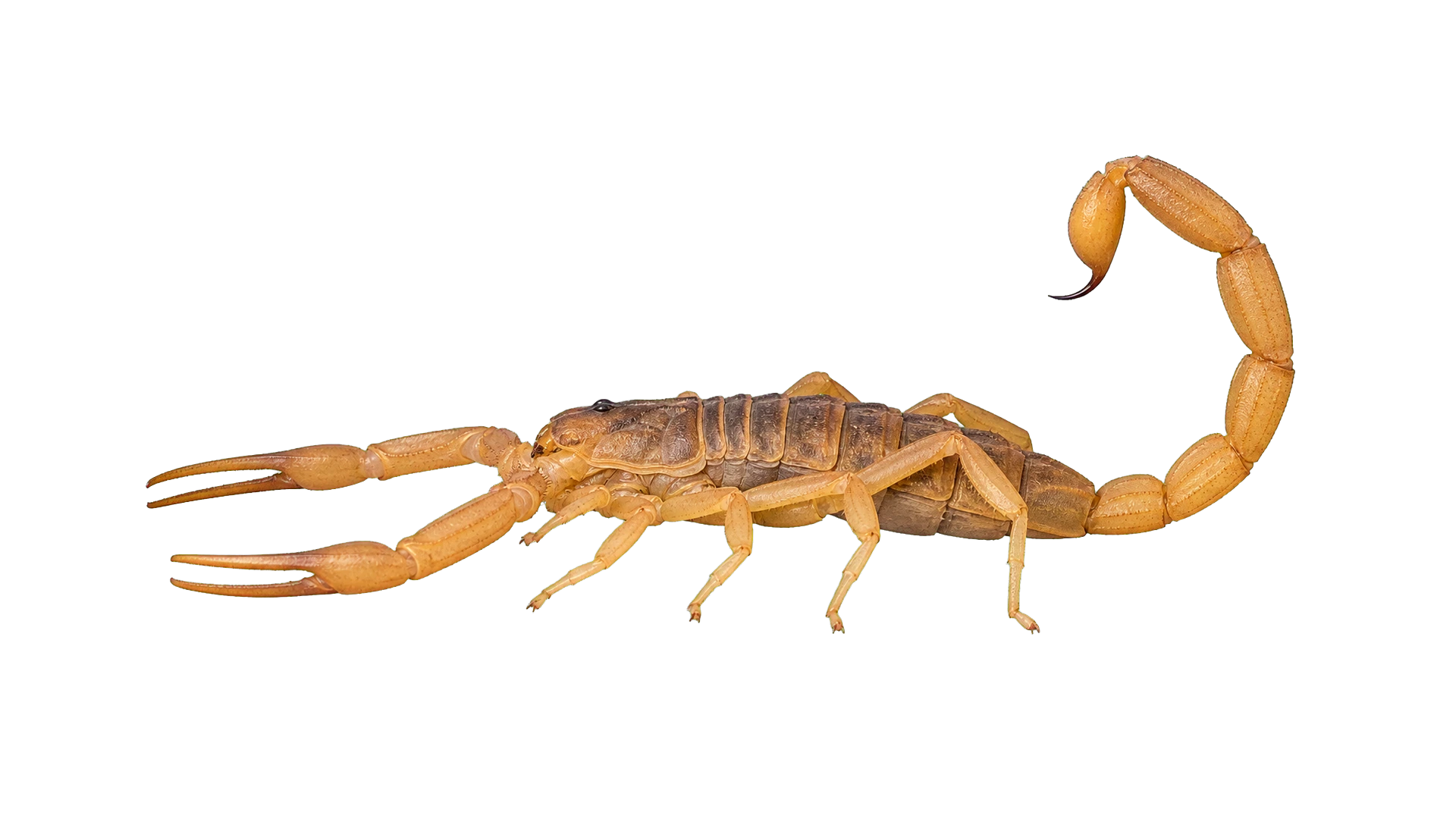
  • Arizona bark scorpions: pale, slender, climbs walls and ceilings.
  • Striped tail scorpions: common Southwest ground-dweller with mild sting.
  • Hairy desert scorpions: 4 inches plus, intimidating but mild venom.
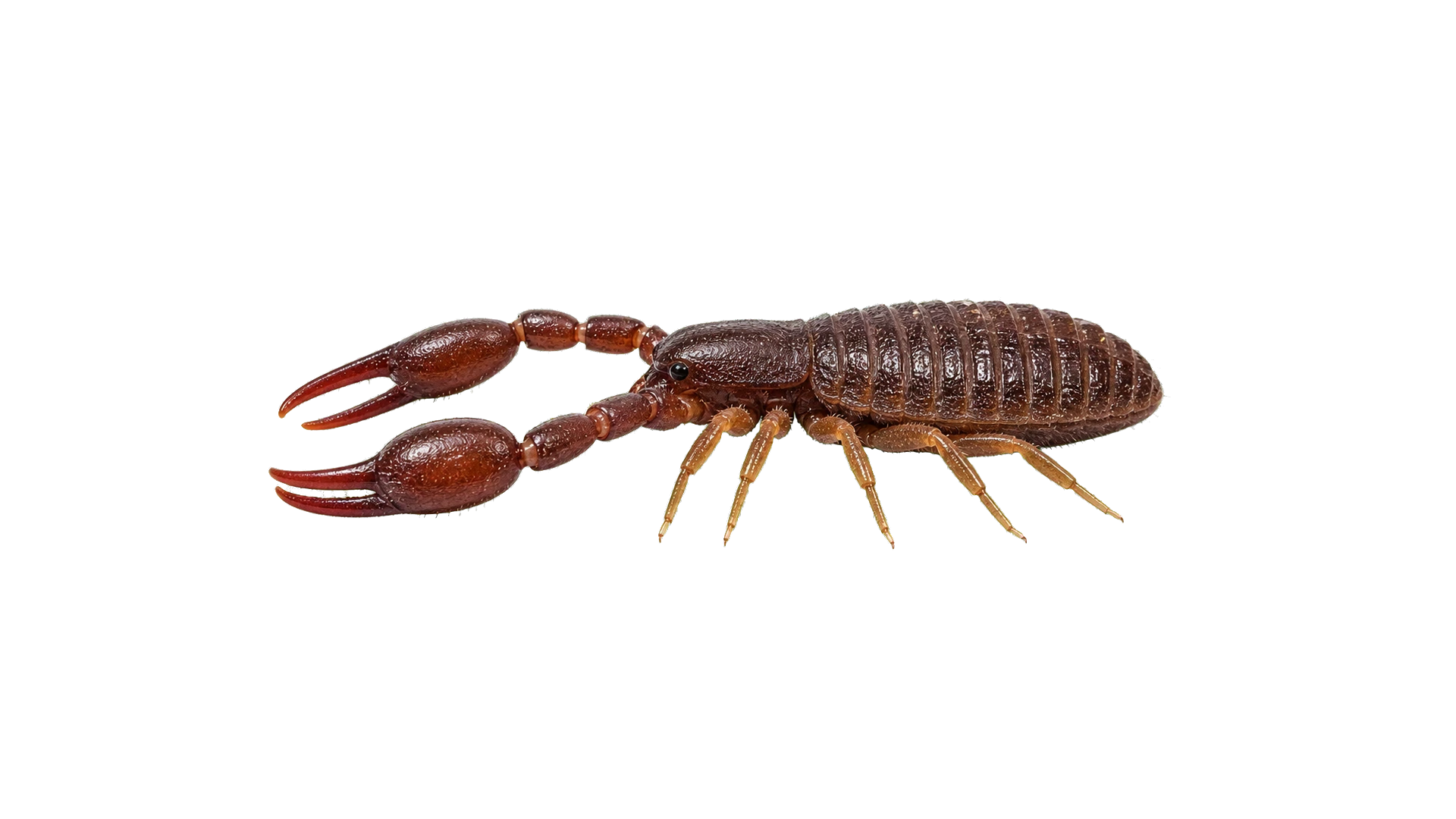
  • Pseudoscorpions: 1/4 inch, harmless, beneficial against book mites.

Scorpions by the Numbers

Roughly 90 scorpion species occur in the United States, concentrated in the Southwest. Arizona bark scorpions account for most medically significant scorpion stings and most envenomation hospitalizations in the US. A typical bark scorpion can fit through a gap as small as 1/16 of an inch, smaller than most weep hole and foundation crack standards. Scorpions can survive a year or more without food and several months without water in the right conditions.

  • 1-5 in Adult body length
  • 1/16 in Minimum gap
  • 12+ mo Time without food

Three Tells It's a Scorpion

Three checks that confirm the find is a scorpion (or a harmless pseudoscorpion) and narrow the medical risk.

Body shape icon

Pincers, segmented tail, eight legs

Two large pincers (pedipalps) extending forward, a segmented tail curled up and forward over the body ending in a stinger (telson), and eight legs. This silhouette is unmistakable and rules out every insect lookalike.

Size icon

Bark scorpions are small and pale

Arizona bark scorpions are notably small (1.5 to 3 inches including tail), slender, and pale yellow to tan. If a scorpion is dark brown, larger than 3 inches, or visibly stocky, it is not a bark scorpion and the medical risk is much lower.

Behavior icon

Climbing equals bark scorpion

Bark scorpions climb walls, ceilings, and across furniture. Other Southwest scorpions are ground-bound and almost never appear off the floor. A scorpion on a wall or ceiling indoors is statistically very likely to be the medically significant species.

Signs Scorpions Are on the Property

Most scorpion confirmations are direct sightings since the species cannot be inferred from droppings or damage. UV blacklight inspection at night dramatically increases detection.

How a Scorpion Issue Develops

Outdoor population Scorpions establish a population around foundations, woodpiles, and rock landscaping
Migration indoors Heat, drought, or seasonal pressure pushes scorpions through small foundation gaps and weep holes into the structure
Established interior activity Multiple sightings indoors over weeks indicates breeding or sustained migration; sting risk becomes routine

How Scorpions Behave Around Homes

Scorpions are nocturnal predators of insects, spiders, and other small invertebrates. They hunt by ambush, waiting motionless in cracks, under rocks, or in shaded cover for prey to pass within reach. Most scorpions are entirely outdoor creatures that occasionally wander indoors when seeking moisture during heat or drought, when foundation cracks open up, or when prey populations move inside (cricket and cockroach populations indoors essentially become scorpion bait stations).

Bark scorpions are different and more concerning. They actively climb vertical surfaces, including stucco walls, block walls, and tree trunks, and routinely enter homes through second-story openings or by climbing exterior walls into roof voids and attics. They hide in shoes, bedding, and stored clothing during the day. Most serious bark scorpion stings occur when a person puts on a shoe, climbs into bed, or grabs a stored item without inspecting it first. Children and elderly adults face elevated risk from bark scorpion envenomation; healthy adult stings are intensely painful but rarely life-threatening.

Scorpion control is a structural and landscape problem more than a chemical one. The single highest-impact action is sealing the home envelope to gaps smaller than 1/16 of an inch, including weep holes, garage door corners, and foundation cracks. The second is reducing harborage within 20 to 30 feet of the foundation by removing rock features, woodpiles, leaf litter, and dense ornamental cover. Targeted residual treatments along foundations and around entry points add a third layer. UV blacklight inspection at night maps the actual scorpion population, which is the only way to know whether prevention efforts are working.

Scorpion Anatomy at a Glance

Six features that define a scorpion. The anatomy itself is unmistakable; species-level details narrow the medical risk.

1 2 3 4 5 6
  1. Pincers (pedipalps)

    The two large claw-like pincers are modified mouthparts that grasp prey while the stinger delivers venom. Bark scorpions have slender pincers; burrowing scorpions have stout ones.

  2. Eight legs (arachnid)

    Scorpions are arachnids, with four pairs of walking legs. Rules out insect IDs. Bark scorpions can grip vertical surfaces; ground-dwelling species cannot.

  3. Segmented body

    Divided into the cephalothorax (front, with eyes, pincers, legs) and the segmented mesosoma and metasoma (middle and curled tail). Segments help scorpions detect substrate vibration.

  4. Tail and stinger (telson)

    The curled tail ends in the venom bulb and sharp injection tip. Scorpions strike forward over the head. Thick-tailed Buthidae (bark scorpions) generally have more potent venom.

  5. Book lungs

    Ventral plates with paired openings serve as respiratory organs, shared structurally with spiders. They are also why scorpions dehydrate easily and prefer humid microclimates.

  6. Eyes on top of the head

    A pair of median eyes on top of the cephalothorax plus 2 to 5 pairs of smaller lateral eyes. Vision is poor; scorpions rely on vibration and air-current sensors. Eyes also glow under UV.

What Are You Actually Seeing?

Match the species below to figure out the medical risk and the right next step.

What Are You Actually Seeing?

What You're Seeing

  • A small (1.5 to 3 inch) pale yellow to tan scorpion on an interior wall, ceiling, in a shower, or in stored clothing
  • Slender pincers and a thin tail; not stocky
  • Active at night and into early morning; hides during the day in dark crevices, behind picture frames, in shoes

What's Likely Happening

Arizona bark scorpions are the only North American scorpion with medically significant venom for healthy adults. They climb vertical surfaces, enter homes through 1/16 inch gaps, and hide in shoes, bedding, and stored items during the day. Most serious sting incidents involve children or elderly adults stung in unfortunate locations.

What To Do Now

  • Inspect shoes, bedding, and clothing before use; never put on a shoe stored on the floor without checking it.
  • Pro structural sealing of the entire home envelope is the highest-impact response. Bark scorpions exploit gaps smaller than typical caulking standards.
  • Pro residual treatment along the foundation and at known entry points, paired with UV blacklight inspection at night to map the actual population.

What You're Seeing

  • A larger (3 to 5 inch) stocky scorpion under a rock, in a woodpile, or near landscape features
  • Heavy stout pincers and a thicker body than a bark scorpion
  • Stays on the ground; does not climb walls or vertical surfaces

What's Likely Happening

Most large Southwest scorpions (striped tail, hairy desert) are ground-dwelling species with mild stings roughly equivalent to a bee sting. Indoor incursions are occasional rather than chronic, usually happening during heat or drought. Pseudoscorpions, despite the name, are not real scorpions and are entirely harmless.

What To Do Now

  • Reduce harborage within 30 feet of the foundation: remove woodpiles, rock features, and dense ornamental cover, especially on the side of the home where sightings concentrate.
  • Pro residual treatment along the foundation and at potential entry points reduces inbound migration.
  • Sealing weep holes, garage door corners, and foundation cracks reduces indoor incursions; ground scorpions cannot climb so most entries are at floor level.

What You're Seeing

  • A tiny (under 1/4 inch) brown or tan creature with pincers but no tail, in old books, basements, or attics
  • Walks slowly, often holding still for long periods
  • No sighting of an actual stinger or curled tail

What's Likely Happening

Pseudoscorpions are tiny harmless arachnids, often confused with real scorpions because of the pincers. They lack a tail and stinger entirely and cannot harm humans. They are net-positive predators of book mites, dust mites, and book lice in storage areas. No treatment is needed; they indicate the substrate they are found in (books, paper, stored linens) has supporting prey populations.

What To Do Now

  • No treatment necessary. Pseudoscorpions are beneficial and self-resolve as their prey populations decline.
  • If reduction is wanted, address the underlying moisture or paper-mite issue: dehumidify storage areas, declutter old books and paper, and improve air circulation in attics and basements.
  • Confirm the find is actually a pseudoscorpion (no tail) before assuming the home has a scorpion problem; the visual similarity is striking.

What You're Seeing

  • Multiple scorpions glowing bright green under a UV blacklight at night, on stucco walls, in rock landscaping, around the foundation
  • Concentrated in shaded areas, near woodpiles, under rock features, in irrigation valve boxes
  • Surprise factor: visual count is much higher than daylight sightings would suggest

What's Likely Happening

Scorpions naturally fluoresce bright green under UV light because of compounds in their cuticle. UV blacklight inspection at night reveals the actual population, which is typically 10 to 50 times larger than daytime sightings indicate. This is the most accurate way to know what you are dealing with and whether prevention efforts are working.

What To Do Now

  • Pro structural and landscape inspection that includes UV night assessment is the standard for serious scorpion properties.
  • Combine harborage reduction (rock and wood removal), structural sealing, and residual treatment as a multi-layer response.
  • Re-inspect with UV blacklight at 30 and 90 day intervals to confirm population reduction; this is the only reliable feedback loop for scorpion control.

How Urgent Is This Really?

Scorpion urgency depends heavily on species and household. Bark scorpions (Arizona, parts of New Mexico, Nevada, and Texas) are medically significant for children, elderly, and people with allergies. The timeline below maps both species and exposure.

  1. 0 to 1 month
    Monitor

    Outdoor sightings on the patio, in the yard, or under landscape rocks. No indoor activity yet. Most desert species (striped tail, hairy desert) have low venom toxicity comparable to a bee sting, not a true medical emergency.

    • Identify species: bark scorpions are pale yellow, slender, climb walls. Others are bulkier and ground-bound
    • Walk the foundation at night with a UV blacklight. Scorpions fluoresce bright blue-green
    • Clear yard debris, woodpiles, and landscape rocks from within 10 feet of the foundation
  2. 1 to 3 months
    Act soon

    Single indoor sighting in a shoe, on a wall, or in a sink. Bark scorpions enter through 1/16-inch gaps. Risk to children jumps significantly the first time one shows up indoors because nighttime barefoot encounters become possible.

    • Seal every gap over 1/16 inch: door sweeps, weatherstripping, expanding foam at utility penetrations
    • Shake out shoes, towels, and bedding before use, especially in homes with young children
    • Schedule a perimeter treatment timed with scorpion peak activity (March through October)
  3. 3 months and beyond, multiple sightings
    Urgent

    Recurring indoor activity, scorpions found in multiple rooms, or scorpions seen during the day. Indoor breeding is unlikely but harborage in walls and attic is possible. Children and elderly household members face elevated medical risk from any sting.

    • Treat the entire perimeter, attic, and crawlspace. Scorpions hide deeply during daylight hours
    • Place sticky traps along baseboards in bedrooms and bathrooms to monitor population trends
    • Keep an EpiPen accessible if anyone in the household has a known scorpion or insect sting allergy
  4. Bark scorpion sting or heavy indoor
    Medical

    A bark scorpion sting on a child, elderly person, or anyone with a strong reaction (severe pain, numbness, trouble breathing). Or heavy indoor presence over 10 scorpions per month under UV. Emergency medical care and immediate professional pest control needed.

    • For any sting on a child under 6: call Poison Control (1-800-222-1222) or go directly to the ER
    • Schedule weekly UV inspections of bedrooms until the population is verified closed out
    • Plan for ongoing seasonal treatment because scorpion harborage in surrounding desert is permanent

Scorpions are predators of crickets and small insects. If you have a heavy scorpion population, you almost always have a heavy cricket and insect population fueling them.

Pest Control Pros serving the city of the state of your city and nearby areas

Local pros bring UV blacklight inspection, structural sealing, and the residual treatments scorpion control actually requires.

Available 24/7
(888) 495-1510

What Sustains a Scorpion Population

Scorpions do not pick yards at random. They follow signals: a steady cricket or cockroach population that supplies prey, a rock wall or wood pile within 20 feet of the foundation, exterior lights that pull prey insects to the wall after dark. A single block wall with unsealed weep holes can serve as a 40 foot stretch of climbing harborage for bark scorpions, which is why some Arizona yards see 5 plus scorpions per UV scan while a block away sees none.

Different scorpion species chase different rewards, which is why ID matters. Arizona bark scorpions (Centruroides sculpturatus) climb stucco and block walls, enter through weep holes and worn weather stripping, and carry the only medically significant US venom. Striped bark scorpions dominate Texas and Oklahoma yards. Desert hairy scorpions stay on the ground in landscape rock. Pseudoscorpions are tiny harmless cousins that ride into bathrooms on damp towels and books. Knowing the species changes whether you need a UV-night perimeter audit or just a wipe-and-release.

Most affected properties have two or three of these conditions running at once, and prey removal plus exclusion beats indoor spray every time. Start with the highest-leverage source: address the cricket and cockroach populations that feed them, then seal exterior weep holes with stainless wool, repair worn door sweeps, and pull rock and wood piles 20 feet from the wall. Switch porch bulbs to yellow LED to cut prey attraction. Even partial wins help: a UV blacklight walk at 10 PM identifying and removing 8 to 15 scorpions per visit drops nightly counts within 2 weeks, especially in bark scorpion country.

Where Scorpions Hide

Woodpiles and stacked materials

Stacked firewood, lumber, and stored materials are prime scorpion harborage. Move stacks at least 30 feet from the foundation and store firewood off the ground on a rack.

Rock landscaping and decorative boulders

Rock features create the cool humid microclimates scorpions prefer during hot Southwest days. Removing rock features within 20 feet of the foundation is the single biggest landscape change for scorpion reduction.

Foundation cracks and weep holes

Bark scorpions exploit gaps as small as 1/16 inch. Weep holes in brick veneer, foundation cracks, and garage door corner gaps are typical entry points and require focused sealing.

Garages and storage areas

Cluttered garages with stored boxes, holiday decorations, and infrequently moved items create indoor harborage. Reduce clutter and inspect stored items annually.

Showers, sinks, and bathroom drains

Bark scorpions are attracted to moisture and frequently appear in bathtubs, showers, and around sinks. Drain covers and overnight drain plugs reduce easy access from drain pipes.

Attics and roof voids

Bark scorpions climb exterior walls into roof voids and attics through soffit gaps. They drop down through ceiling fixtures and recessed lighting into living spaces, surprising homeowners.

How Scorpion Populations Grow

Scorpions are slow-growing and long-lived. Populations build slowly but persist for years once established.

  1. Birth

    Live birth, 25 to 35 young

    Scorpions give live birth, not eggs. Newborns ride on the mother's back for the first 1 to 2 weeks while their cuticle hardens against air.

  2. Juvenile (instars)

    1 to 3 years

    Young scorpions cycle through 5 to 7 molts before adulthood. Each molt is a vulnerable window. Bark scorpions reach maturity in 1 to 3 years.

  3. Subadult

    Final pre-mating molts

    Late instars are near adult-sized but not yet mature. Subadults disperse from the parent's territory and establish their own hunting ranges.

  4. Adult

    3 to 8 years

    Adults mate, produce broods, and hunt for years. Long lifespan plus low reproduction means stable populations slow to rebuild after control.

Scorpion control benefits from this slow lifecycle: aggressive structural sealing and harborage reduction can reduce a population substantially over 6 to 18 months without needing the chemical intensity insect populations require. The trade-off is patience; results show gradually rather than immediately, and UV blacklight inspection is the only reliable way to confirm progress.

IMPORTANT

UV Blacklight Reveals 10x What You Can See in Daylight

Scorpions fluoresce bright blue-green under UV light. Walk the foundation, walls, and rock features at night with a UV flashlight (under $20 online) and you will see a population 10 to 50 times larger than daylight sightings suggested. This is the single biggest diagnostic upgrade in scorpion work. Properties that thought they had two or three scorpions discover they have forty. Once you can count the population, the response writes itself: seal every gap over 1/16 of an inch on the exterior envelope (weep holes, garage door corners, foundation cracks, soffit gaps), strip harborage within 30 feet of the foundation (rock features, woodpiles, leaf litter), and apply residual along the foundation where scorpions cross while hunting. Indoor sprays accomplish almost nothing because scorpions hide in wall voids, picture frame backs, and stored shoes during the day, not on baseboards where the spray sits. Re-walk with the UV light at 30 and 90 days. The fluorescence count is the only reliable feedback loop. Households with bark scorpions and young children or elderly residents should default to professional sealing; bark scorpion stings hospitalize roughly 200 children in Arizona alone each year.

Which Scorpion Species Do You Have?

Scorpion species range from harmless to medically significant. Match what you're seeing to identify which one.

Species Severity Key Sign Where You'll Find Them
Bark Scorpions Medical Found on walls and ceilings at night, glows under blacklight, painful sting under bark, rock crevices, inside shoes
Pseudoscorpions Nuisance Found in old books, leaf litter, and bathrooms; harmless to humans bathrooms, basements, under bark
Bark Scorpions
Severity Medical
Key Sign Found on walls and ceilings at night, glows under blacklight, painful sting
Where You'll Find Them under bark, rock crevices, inside shoes
Pseudoscorpions
Severity Nuisance
Key Sign Found in old books, leaf litter, and bathrooms; harmless to humans
Where You'll Find Them bathrooms, basements, under bark

Severity reflects typical impact, not your specific case. If unsure, treat at the higher tier.

What Actually Reduces Scorpions

Honest read on common DIY methods. Scorpion control rewards structural and landscape work much more than chemical intensity.

Can work icon

What can work

Aggressive structural sealing

  • Caulk every gap larger than 1/16 inch on the exterior envelope
  • Install weep hole covers and door sweeps with no gap at the corners
  • Seal soffit gaps, attic vent gaps, and any roof penetration; bark scorpions enter through second-story openings

Harborage reduction within 20 to 30 feet of foundation

  • Remove rock features, woodpiles, leaf litter, and dense ornamental cover near the foundation
  • Replace mulch with gravel or bare soil immediately against the foundation
  • Trim tree branches away from roof contact; scorpions use branches as entry routes

Pro residual plus UV blacklight monitoring

  • Targeted residual application along foundation and at known entry points
  • Quarterly re-treatment on serious scorpion properties
  • UV blacklight inspections at 30 and 90 day intervals to confirm population reduction
Falls short icon

What reliably falls short

Indoor baseboard sprays

  • Scorpions hide in voids the spray cannot reach
  • Most indoor sightings are migrating individuals, not residents
  • Misses the actual outdoor population driving the issue

Generic perimeter sprays without sealing

  • Scorpions push through 1/16 inch gaps the spray does not block
  • New individuals replace treated ones from the outdoor population
  • Provides false confidence while real risk persists

Bug bombs and indoor foggers

  • Foggers cannot penetrate wall voids or stored items where scorpions hide
  • Pesticide exposure with no progress on the actual driver
  • Almost never the right tool for scorpion situations

How to Reduce Scorpion Activity

Six prevention moves sorted by effort. Stack three or four for meaningful reduction over 6 to 18 months.

  • Shoes icon
    Easy Daily

    Inspect shoes and bedding

    Shake out shoes left on the floor before putting them on, and check inside boots, gloves, and stored clothing in scorpion regions. Most bark scorpion stings happen during exactly this oversight.

  • Door sweep icon
    Easy Continuous

    Install tight door sweeps

    Door sweeps with no corner gap on every exterior door, including garage and basement doors. Bark scorpions exploit door corner gaps that exceed 1/16 inch.

  • Caulk icon
    Moderate Annual

    Seal weep holes and foundation gaps

    Apply weep hole covers (stainless steel mesh) and caulk every gap larger than 1/16 inch on the exterior envelope. The most important single project for scorpion-prone homes.

  • Landscape icon
    Moderate Annual

    Remove harborage within 20 feet

    Move woodpiles to at least 30 feet from the foundation. Remove rock features, leaf litter, and dense ornamental cover within 20 feet of the home.

  • Perimeter treatment icon
    Advanced Quarterly

    Pro quarterly perimeter treatment

    Pro residual application on the foundation and at entry points every 90 days, scaled up to monthly during peak summer activity for serious scorpion properties.

  • UV light icon
    Advanced Quarterly

    UV blacklight night inspection

    Quarterly UV blacklight inspections at night map the actual population and confirm whether prevention is working. Without UV mapping, scorpion control is essentially unmonitored.

When Scorpion Activity Peaks

Scorpion activity tracks Southwest temperature and monsoon patterns. Most indoor sightings cluster in two specific seasonal windows.

  • Spring

    Activity resumes as overnight temperatures climb above 60 degrees Fahrenheit. Indoor sightings increase as scorpions migrate from winter harborage. Mating activity peaks for many species.

  • Summer

    Peak activity through the hot months. Bark scorpions are highly active at night, hunting in cooler outdoor temperatures and entering homes through any available gap. Peak sting incidents.

  • Fall

    Activity persists as overnight temperatures stay warm. Indoor migration peaks during October and November as scorpions seek winter harborage. Sting incidents often shift indoors.

  • Winter

    Outdoor activity drops as temperatures fall. Scorpions enter brumation in protected harborage. Indoor populations remain active in conditioned spaces; bark scorpions inside warm homes are essentially active year-round.

What a Pro Scorpion Visit Looks Like

Four steps from arrival to a multi-layer plan. Initial visits typically run 60 to 120 minutes including UV blacklight assessment.

UV mapping, structural sealing, harborage reduction, residual treatment. Real scorpion work is multi-layered and patient. Spray-only approaches rarely solve serious situations.

Bark scorpions inside the home? (888) 495-1510
  1. UV blacklight night inspection

    After dark survey of foundation, walls, woodpiles, rock features, and accessible roof areas to map the actual scorpion population. This usually reveals 10 to 50 times more scorpions than daylight inspection.

  2. Structural envelope assessment

    Identify and document every gap larger than 1/16 inch on the exterior, including weep holes, garage door corners, foundation cracks, and soffit gaps. The sealing list typically runs 20 to 80 specific locations on a Southwest home.

  3. Targeted treatment and recommendations

    Residual application along foundation and at known entry points. Harborage reduction recommendations for the property within 20 to 30 feet of the home. Sealing recommendations or scope of work for structural work.

  4. Follow-up UV monitoring

    Re-inspection at 30 and 90 days to confirm population reduction and adjust the plan as needed. Quarterly residual maintenance on serious properties. UV-confirmed feedback is the only reliable way to know whether the work is succeeding.

What Homeowners Say After Scorpion Treatment

Stories from Southwest households who connected with pros for bark scorpion incursions, structural sealing, and UV-monitored ongoing control.

Tiana U.
Tiana U.
St. George, UT

"No more scorpions in the garage."

We kept finding bark scorpions near the garage door. The tech sealed every gap along the foundation and sprayed a barrier around the perimeter. Haven't seen one since.

Tiana U.
Tiana U.
St. George, UT

"No more scorpions in the garage."

We kept finding bark scorpions near the garage door. The tech sealed every gap along the foundation and sprayed a barrier around the perimeter. Haven't seen one since.

Joelle C.
Joelle C.
Las Vegas, NV

"Indoor scorpion sightings finally stopped."

Finding a scorpion in the bathroom was alarming. The provider treated the perimeter and interior and explained how desert landscaping near the foundation attracts them. After treatment, we stopped seeing them inside.

Jackson F.
Jackson F.
Albuquerque, NM

"Garage sealed off against scorpions."

We found scorpions inside multiple times during summer. The provider sealed gaps around the garage door and foundation and treated the perimeter. They explained how desert landscaping against the house attracts them.

Tom G.
Tom G.
Norman, OK

"Displaced scorpions sealed out of the house."

After new construction disturbed the land near our neighborhood, scorpions started showing up in our home. The provider sealed entry points and treated the perimeter. They explained how land disturbance displaces scorpions into nearby homes.

Hikari M.
Hikari M.
Scottsdale, AZ

"Bathroom scorpion sightings ended."

Finding scorpions in the bathroom at night was terrifying. The tech treated the interior and exterior and explained how Arizona bark scorpions enter through tiny cracks. After sealing and treating, we stopped finding them inside.

Saul Z.
Saul Z.
Junction City, KS

"Basement scorpions sealed out."

We found a scorpion in the basement laundry room and panicked. The provider treated the basement and exterior and explained that striped bark scorpions occasionally appear in central Kansas. Sealing foundation cracks reduced the risk significantly.

Guillermo V.
Guillermo V.
North Las Vegas, NV

"Foundation cracks sealed and scorpions gone."

Bark scorpions appeared in the garage, bathrooms, and even the baby's room. The provider did a thorough treatment and sealed all foundation cracks. The scorpion activity dropped to zero within weeks.

Marilyn U.
Marilyn U.
Roswell, NM

"Indoor scorpion sightings dropped to zero."

Walked into the bathroom barefoot at two in the morning and felt something move. Turned the light on and a bark scorpion was an inch from my foot. I have never put shoes on so fast. The tech sealed every foundation crack with a UV light to find the entry points, treated the interior and exterior, and we went from two or three sightings a week to nothing.

Riley X.
Riley X.
Duncan, OK

"Foundation sealed and scorpions cleared."

Saw one skitter across the bathroom tile when I flipped on the light to brush my teeth. Then another one in the hall the next night. The tech walked the foundation with a black light, which made them glow, and found three cracks I had walked past for years. Sealed them, treated the perimeter inside and out. Zero sightings since.

Florence J.
Florence J.
El Paso, TX

"Foundation cracks sealed and scorpions gone."

Bark scorpions appeared in the bathroom and kitchen. The provider sealed foundation cracks and treated the interior. Scorpion sightings dropped to zero.

Common Questions About Scorpions

Direct answers to the questions Southwest homeowners ask most about scorpion identification, sting risk, and control.

  • How do I know if I'm seeing an Arizona bark scorpion? Toggle answer for: How do I know if I'm seeing an Arizona bark scorpion?

    Three quick checks. Size: bark scorpions are small, 1.5 to 3 inches including the tail. If a scorpion is larger than 3 inches, it is almost certainly not a bark scorpion. Color: bark scorpions are pale yellow to tan, almost translucent in some lighting. Darker brown scorpions are different species with much milder venom. Behavior: bark scorpions climb. They are the only US scorpion that routinely walks up vertical walls, across ceilings, and across furniture. If you find a scorpion on a wall, in a shower, or on stored clothing above the floor, it is statistically very likely to be a bark scorpion. The species ID matters because bark scorpions carry medically significant venom for healthy adults and especially for children and elderly residents. Other Southwest scorpions deliver stings roughly comparable to a bee or wasp sting and are not a real medical concern in healthy adults.

  • Why do scorpions glow under a UV blacklight? Toggle answer for: Why do scorpions glow under a UV blacklight?

    Scorpions have compounds in the outer layer of their cuticle (the exoskeleton) that fluoresce bright green under ultraviolet light. The exact biological purpose is still debated, but the phenomenon is consistent across species and ages, including newborn scorpions and freshly molted ones briefly. The practical implication for homeowners and pros is huge: a UV blacklight inspection at night reveals 10 to 50 times more scorpions than daytime visual inspection finds. Scorpions that are nearly invisible against stucco, gravel, or wood become unmistakable green points of light at 10 to 20 feet of distance. UV inspection is the standard for serious scorpion properties because it is the only reliable way to map the actual population, identify harborage hotspots, and confirm whether prevention efforts are reducing numbers. Inexpensive 365 nm UV flashlights from hardware stores work; pros use brighter dedicated units that cover larger areas faster.

  • Can scorpions really get through a 1/16 inch gap? Toggle answer for: Can scorpions really get through a 1/16 inch gap?

    Yes, especially bark scorpions, which are remarkably slender and flexible. Adult bark scorpions push through gaps as small as 1/16 of an inch (about the thickness of a credit card). This is smaller than typical caulking standards, smaller than most weep hole gaps in brick veneer, and smaller than the gaps that often remain at garage door corners after door sweeps are installed. The 1/16 inch threshold is why scorpion structural sealing is more demanding than rodent or insect exclusion. Effective scorpion sealing requires careful inspection of the entire exterior envelope: every weep hole gets a stainless steel mesh cover, every foundation crack is caulked or filled, every door has a tight sweep with no corner gap, every soffit gap is closed, and every roof penetration (vents, plumbing stacks, antenna mounts) is sealed. The work is typically a long single-day project on a Southwest home, and it is the single highest-impact scorpion control intervention available.

  • Are pseudoscorpions actually scorpions? Toggle answer for: Are pseudoscorpions actually scorpions?

    No, despite the name and the visual similarity. Pseudoscorpions are tiny (under 1/4 inch) arachnids with the same forward-facing pincers (pedipalps) that real scorpions have, but they completely lack the segmented tail and stinger that define a true scorpion. They are entirely harmless to humans, do not sting, and do not bite. Pseudoscorpions are actually beneficial: they prey on book lice, dust mites, fungus gnat larvae, and similar tiny indoor pests. They show up in bookcases, basements, attics, and stored linens because their preferred prey lives there. If you find one, you almost certainly have a small population of book mites or similar prey species in the same area, but neither pseudoscorpions nor their prey require treatment in most cases. The find is essentially cosmetic. The name confusion is the only real downside; many homeowners panic before realizing the tiny pincered creature has no tail and cannot harm them.

  • What should I do if I'm stung by a scorpion? Toggle answer for: What should I do if I'm stung by a scorpion?

    First, identify the species if you can do so safely. A photograph helps medical providers determine treatment urgency. For striped tail and hairy desert scorpion stings (most US species), the response is the same as a bee or wasp sting: ice the area, take an antihistamine, monitor for allergic reaction, and seek care if symptoms escalate. For Arizona bark scorpion stings, the response is more serious: pain, numbness, tingling, muscle twitching, and difficulty breathing or swallowing can develop within minutes to hours. Children, elderly adults, and people with cardiovascular conditions are at elevated risk. For confirmed bark scorpion stings on these populations, seek emergency medical care immediately; an antivenom (Anascorp) exists and is administered for serious cases. Healthy adults stung by bark scorpions usually experience intense localized pain and tingling without systemic symptoms, but emergency evaluation is still warranted if symptoms include muscle spasms or breathing difficulty. Calling poison control (1-800-222-1222 in the US) gets immediate guidance specific to your symptoms and species.

  • Why don't indoor sprays work for scorpions? Toggle answer for: Why don't indoor sprays work for scorpions?

    Two reasons. First, scorpions hide in voids and crevices that interior sprays cannot reach: wall voids, attic spaces, picture frame backings, stored shoe interiors, behind appliances, in closet corners. The scorpion is not running across the spray zone; it is sitting motionless somewhere the spray never penetrated. Second, most indoor scorpion sightings are migrating individuals from an outdoor population, not residents. Even if an indoor spray killed every scorpion currently inside, new individuals continue migrating in through structural gaps as long as the outdoor population and the gaps both exist. Effective scorpion control addresses three things in order: aggressive structural sealing of every exterior gap larger than 1/16 inch, removal of harborage (woodpiles, rock features, leaf litter) within 20 to 30 feet of the foundation, and targeted residual treatment along the exterior foundation and at known entry points. Indoor sprays might be a small supplement after those three but are essentially useless on their own. UV blacklight monitoring confirms whether the actual approach is working.

  • How long does it take to get a scorpion population under control? Toggle answer for: How long does it take to get a scorpion population under control?

    Realistic timeline is 6 to 18 months for serious bark scorpion properties, with progress visible at the 90 day mark and substantial reduction by 6 months. The reason it takes longer than insect control is the slow scorpion lifecycle: scorpions live 3 to 8 years as adults and reproduce slowly compared to insects, so populations build slowly but also recede slowly when prevention works. The fastest results come from doing all three layers at once: aggressive structural sealing, harborage reduction, and pro residual treatment. Properties that do only one or two layers see slower or partial progress. UV blacklight monitoring at 30, 90, and 180 days confirms the trajectory; without it, homeowners often abandon prevention prematurely because they cannot see the population reduction that is actually happening. Patience plus the multi-layer approach plus UV-monitored feedback is what gets scorpion-prone homes back to occasional sightings rather than chronic indoor incursions.

Pest Control Pros serving the city of the state of your city and nearby areas

Map the population with UV at night, seal every gap above 1/16 inch, reduce harborage near the home. Local pros bring all three to scorpion work.

Available 24/7
(888) 495-1510

The Scorpion Species You're Likely Dealing With

Click through to species pages for bark scorpions, striped tail scorpions, hairy desert scorpions, and harmless pseudoscorpions.

Bark Scorpions

The most venomous scorpion in North America, common in the Southwest.

Arizona bark scorpions are slender, straw-colored scorpions that climb walls, ceilings, and trees, unlike most ground-dwelling species. Their sting causes intense pain, numbness, and in severe cases, breathing difficulty and muscle convulsions that require emergency medical treatment. They are commonly found inside homes, hiding in shoes, clothing piles, and sink cabinets.

Quick ID:

  • Scorpion sightings on walls or ceilings
  • Glow under blacklight at night
  • Found inside shoes or clothing

Why it matters:

  • Stings can cause life-threatening reactions in children and elderly
  • They climb walls and ceilings, dropping onto beds and into living areas
  • Populations cluster, finding one usually means many more are nearby
Learn more about Bark Scorpions

Pseudoscorpions

Tiny, pincer-bearing arachnids found in damp indoor spaces.

Pseudoscorpions look like miniature scorpions, complete with oversized pincers, but lack a tail and stinger and are completely harmless to humans. They prey on booklice, mites, carpet beetle larvae, and other tiny arthropods in leaf litter, bathrooms, basements, and old books. Their presence indoors typically indicates elevated humidity and an underlying population of tiny prey insects.

Quick ID:

  • Tiny scorpion-like creatures in bathroom or basement
  • Found in old books or papers
  • Presence indicates other small pest prey

Why it matters:

  • Their presence signals a hidden population of prey pests like booklice or mites
  • High indoor humidity they require also promotes mold and wood decay
  • Often mistaken for ticks, causing unnecessary alarm
Learn more about Pseudoscorpions