Local pest control help is one call away.

Pseudoscorpion: Identification, Treatment & Prevention

Pseudoscorpions are tiny arachnids, just 2 to 8 millimeters long, smaller than a fingernail clipping. They have a flat oval body, eight legs, and two large pinchers on the front legs that look exactly like a miniature scorpion's claws. That resemblance is where the name comes from, and it's also why most people who find one immediately think they have a scorpion problem. They don't. Pseudoscorpions have no stinger and no tail at all, which is the single fastest way to tell them apart from a true scorpion. They cannot bite or sting humans or pets, and their venom (which is real, but tucked inside the pinchers) only works on the tiny prey they hunt.

If you've found a small brown or reddish-brown creature with crab-like pinchers tucked into an old book, a box of papers in the basement, or under bark in the yard, you're almost certainly looking at a pseudoscorpion. The right response is usually no response at all. They are beneficial predators that eat book lice, dust mites, carpet beetle larvae, and springtails, the small pests homeowners actually do want gone. This guide covers identification, why they often appear seemingly from nowhere, and the rare situations where professional consultation is genuinely useful.

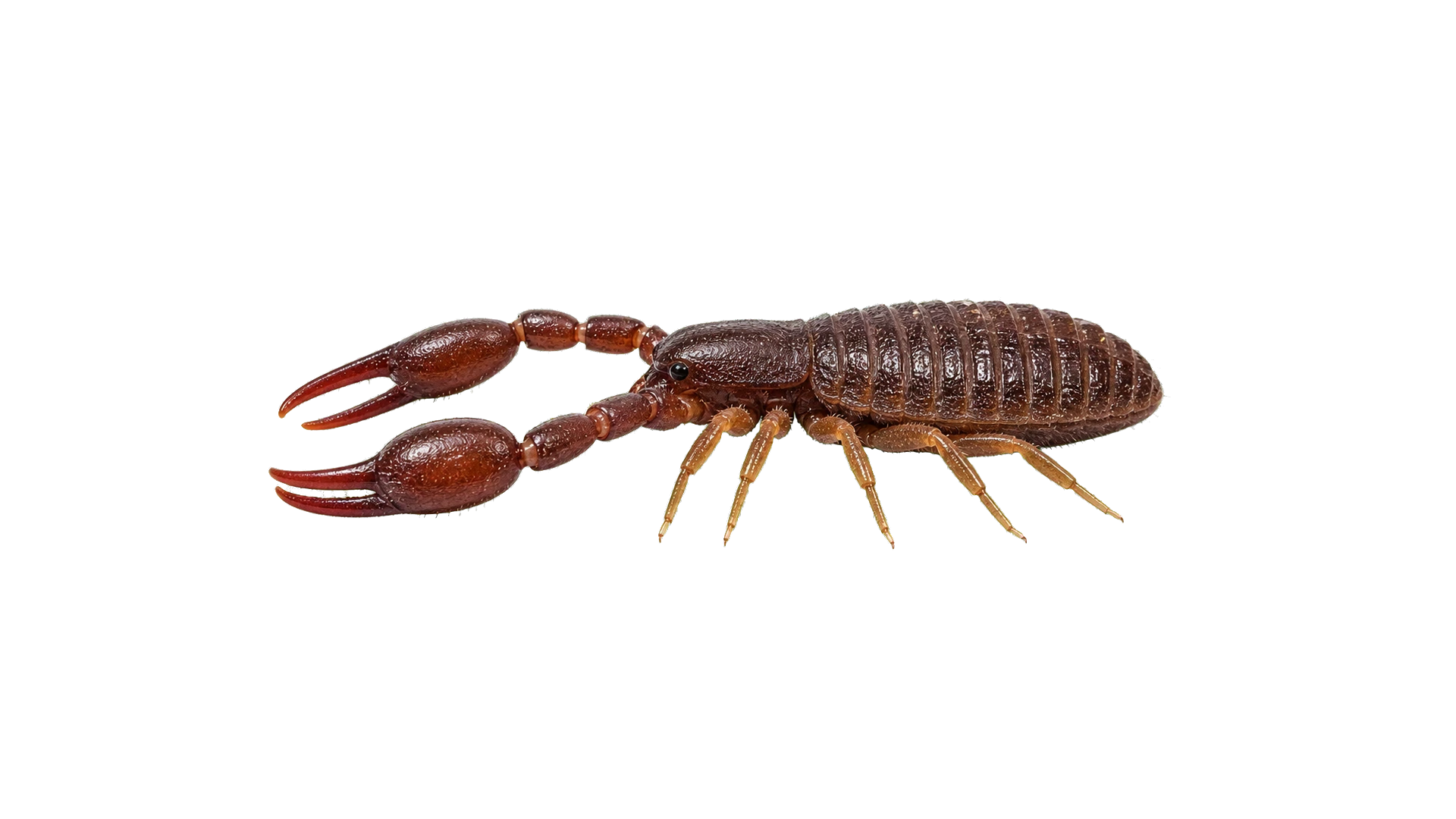
Close-up illustration of a pseudoscorpion showing tiny body and large pincher-like pedipalps with no tail or stinger

ID Card: Pseudoscorpion

Scientific name
Pseudoscorpiones
Color
Dark brown to mahogany
Size
1/16 to 1/8 inch
Body shape
Tiny, flat body with large pincers, no tail stinger (not a true scorpion)
Key evidence
Found in old books, leaf litter, and bathrooms; harmless to humans
Also known as
False scorpions, Book scorpions

Related Species

Call to get matched with a local pest control pro.

Available 24/7
(888) 495-1510
  • Specialists trained on arachnid identification and beneficial-species assessment
  • Inspection focused on the prey species that actually drive the population
  • Education and reassurance for households alarmed by the appearance

Where to Find Pseudoscorpions

Cross-section illustration showing pseudoscorpion habitat zones inside old books, paper storage, crawl spaces, and outdoor leaf litter

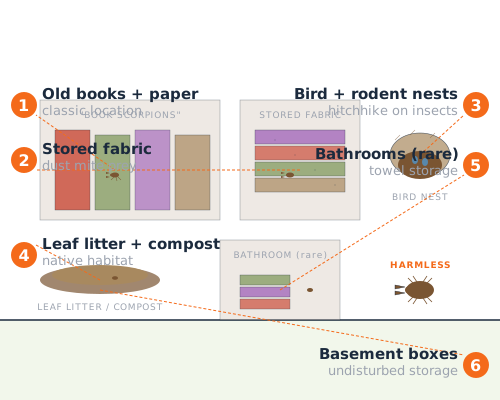
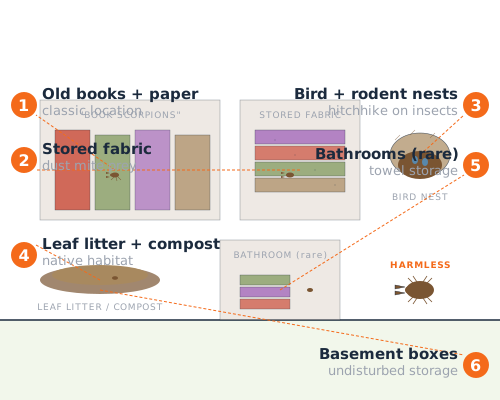
Pseudoscorpions tuck into undisturbed spots where their prey concentrates. They are so small (2 to 8 millimeters) that they're easy to miss without a flashlight, and they move slowly. Walk these specific zones if you want to see one, or to figure out what the population is feeding on:

  • Old books and paper storage, This is the classic location. The house pseudoscorpion (Chelifer cancroides) is so reliably found in old books that it has been called the book scorpion for centuries. The pseudoscorpions are there because book lice are there, eating the paste that holds the bindings together.
  • Boxes of old papers, magazines, and cardboard, Attics, basements, and garage storage with stacked paper materials usually carry both book lice and the pseudoscorpions that hunt them. Pull a box out and look along the inside edges with a flashlight.
  • Leaf litter, mulch beds, and under loose bark outdoors, This is the native outdoor habitat. Lift a layer of damp leaves or pull a strip of bark and you'll often find pseudoscorpions alongside springtails, mites, and small beetles.
  • Crawl spaces, basements, and humid storage areas, Higher humidity supports the small arthropods pseudoscorpions feed on. Look in undisturbed corners, behind stored items, and along sill plates.
  • Around houseplant pots and bagged potting soil, Pseudoscorpions sometimes appear here following springtails and fungus gnats. Check the saucers and the soil surface.
  • Inside storage boxes of old clothing, blankets, and woolens, Dust mites and carpet beetle larvae draw pseudoscorpions to fabric storage that has gone undisturbed for months or years.
  • Bathrooms with poor ventilation, Less common, but high humidity around towel storage and under-sink areas sometimes supports the small arthropod prey pseudoscorpions follow.

If you're finding pseudoscorpions repeatedly in the same area, that tells you something useful. It almost always means a population of small pests, book lice, dust mites, springtails, or carpet beetle larvae, is established there too. The pseudoscorpions are doing free pest control work on those species. The right move is to inspect the storage for those underlying pests rather than to worry about the pseudoscorpions themselves.

Cross-section illustration showing pseudoscorpion habitat zones inside old books, paper storage, crawl spaces, and outdoor leaf litter
Illustration showing how pseudoscorpions reach indoor spaces via phoresy, hitchhiking on larger insects, and through stored materials brought in from outside

Why Do I Have Pseudoscorpions?

Identifying a pseudoscorpion is step one. Understanding why it showed up tells you whether anything needs to be done at all. Pseudoscorpions don't seek out homes for warmth, food residue, or shelter the way ants and roaches do. They follow their prey, and their prey is the small arthropod community that builds up in undisturbed paper, fabric, and damp organic material. Where the prey populations are healthy, pseudoscorpions show up too. Where the prey is gone, the pseudoscorpions leave or starve out on their own.

What actually brought them in:

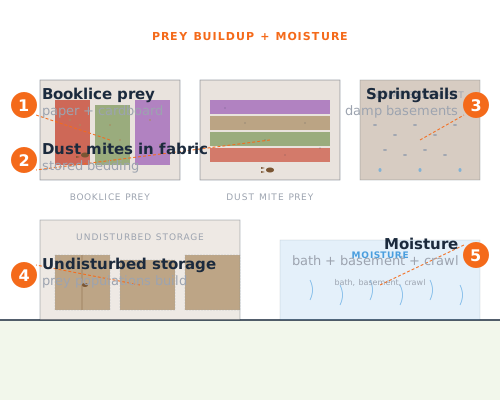
  • Book lice in old books and paper storage, the single most common reason house pseudoscorpions appear indoors, book lice eat the starchy paste in book bindings and pseudoscorpions hunt them
  • Dust mites in stored bedding, woolens, and undisturbed fabric, especially in humid storage areas where mite populations build over months
  • Springtails and small flies in damp basements, crawl spaces, and around houseplants where moisture supports a small arthropod community
  • Carpet beetle larvae in long-stored clothing and natural fibers, another reliable prey source that draws pseudoscorpions into closets and dressers
  • Phoresy, hitchhiking on larger insects like flies, beetles, and dragonflies, this is the unusual dispersal trick that explains the from-nowhere appearance, a pseudoscorpion grips a host's leg with its pincher and rides to a new habitat

Phoresy is worth understanding because it answers the question most homeowners actually have: how did this thing get into my house? The answer is that a fly or beetle carried it in, sometimes from outdoor leaf litter, sometimes from a neighboring structure. The pseudoscorpion let go when the host landed somewhere with good prey, your book shelf, your basement, your closet, and started hunting. That's also why a single sighting often turns into more sightings later: where one arrived, the prey conditions to support it were already in place.

How Serious Is Your Pseudoscorpion Situation?

Find your scenario below. Each row reflects how to actually think about pseudoscorpion sightings, not a generic pest timeline. Most of the time the answer is leave them alone.

What You're Seeing Severity If Untreated Next Step
Single pseudoscorpion in a book or stack of papers None Beneficial predator doing free pest control on book lice or other small arthropods, no harm to anything in the home Leave it alone. Take a photo if you want, but no treatment is needed and nothing is at risk.
Several pseudoscorpions plus visible book lice or dust mite signs Low The pseudoscorpions will stay as long as the prey stays, but the underlying book lice or dust mite population may keep growing if storage conditions don't change Address the food source, not the predator. Sort and dry out storage, fix humidity, and the pseudoscorpions will leave on their own.
Pseudoscorpion in the living space with family members alarmed by the appearance Reassurance No physical risk at any point, the concern is comfort and quality of life rather than safety Identify the specimen, explain it cannot bite or sting, and capture and release it outdoors if anyone wants it out of the room.
Repeated sightings plus a family member with severe arachnophobia Comfort Family stress and avoidance behaviors can compound even without any real physical risk from the species itself Schedule a professional inspection focused on the underlying prey species, plus minimal residual treatment if reduction is the goal.
Single pseudoscorpion in a book or stack of papers
Severity None
If Untreated Beneficial predator doing free pest control on book lice or other small arthropods, no harm to anything in the home
Next Step Leave it alone. Take a photo if you want, but no treatment is needed and nothing is at risk.
Several pseudoscorpions plus visible book lice or dust mite signs
Severity Low
If Untreated The pseudoscorpions will stay as long as the prey stays, but the underlying book lice or dust mite population may keep growing if storage conditions don't change
Next Step Address the food source, not the predator. Sort and dry out storage, fix humidity, and the pseudoscorpions will leave on their own.
Pseudoscorpion in the living space with family members alarmed by the appearance
Severity Reassurance
If Untreated No physical risk at any point, the concern is comfort and quality of life rather than safety
Next Step Identify the specimen, explain it cannot bite or sting, and capture and release it outdoors if anyone wants it out of the room.
Repeated sightings plus a family member with severe arachnophobia
Severity Comfort
If Untreated Family stress and avoidance behaviors can compound even without any real physical risk from the species itself
Next Step Schedule a professional inspection focused on the underlying prey species, plus minimal residual treatment if reduction is the goal.

Pseudoscorpions are one of the few household arthropods where leave alone is the right answer in most situations. If you're between two rows, treat the higher one as your situation.

How Pseudoscorpions Develop

Pseudoscorpions reproduce slowly and live longer than most arachnids, which is part of why their populations stay small and steady rather than exploding the way insects do. They also do something unusual for arachnids: the female spins a silk cocoon during egg laying. The cycle below is what keeps the population stable, and it's also why direct treatment is rarely the right answer.

  1. Eggs in a silk cocoon

    Carried in a brood pouch attached to the mother

    The female spins a silk shelter and lays a small clutch of eggs into a brood pouch on the underside of her body. She carries them with her, which is unusual among arachnids and is the reason populations stay small even in good prey conditions.

  2. Nymph

    Several instars over many months

    Nymphs stay close to the mother through the first instar and feed on tiny arthropods like the smallest book lice and mites. They molt through three to four instar stages before reaching adult form, with each molt taking weeks or longer depending on temperature and food availability.

  3. Adult

    Live 1 to 2 years

    Adults continue predating on book lice, dust mites, carpet beetle larvae, springtails, and small flies. The long lifespan combined with slow reproduction is exactly why pseudoscorpion populations are usually steady rather than swarming, you may see the same individuals in the same general area for months.

Long-lived predators with slow reproduction don't behave like household pests. Their populations track the prey species, not the building, which is why the right intervention is almost always aimed at the small pests feeding the pseudoscorpions rather than the pseudoscorpions themselves.

When Pseudoscorpions Are Most Active

Indoor pseudoscorpions stay active year-round in heated homes because the prey species they hunt (book lice, dust mites, carpet beetle larvae) are also active year-round indoors. Outdoor populations follow a more typical seasonal pattern in leaf litter and under bark, with spring and summer being the peak window for phoresy events that introduce pseudoscorpions to new indoor habitats.

  • Spring

    Outdoor populations come back to surface activity as soil warms and leaf litter retains moisture. Phoresy events (pseudoscorpions hitchhiking on flies, beetles, and dragonflies for dispersal) pick up as those host insects become more active, which is when new sightings indoors typically start.

  • Summer

    Outdoor activity peaks in mulch, leaf litter, and under loose bark. Indoor populations stay steady in book storage, basements, and crawl spaces. This is also when phoresy is most common, so unexpected indoor sightings are most likely to show up this quarter.

  • Fall

    Outdoor populations consolidate into deeper leaf litter and protected harborage. Indoor sightings often increase slightly as homeowners pull out fall storage, sort through old boxes, and disturb undisturbed habitat where pseudoscorpions have been hunting all year.

  • Winter

    Outdoor activity drops sharply as temperatures fall, but indoor populations are unaffected. Heated storage areas, basements, and crawl spaces stay at conditions pseudoscorpions tolerate well, so winter sightings indoors are common and normal as homeowners pull holiday storage and old boxes out of long-undisturbed corners.

When Pseudoscorpions Actually Warrant a Pro

Pseudoscorpions themselves almost never warrant professional treatment. They are tiny (2 to 8 millimeters), they cannot bite, they cannot sting, and they spend their lives quietly hunting the small pests homeowners already want gone. Spraying them accomplishes nothing useful and actually removes a beneficial predator from the home.

What sometimes does warrant a pro is the underlying prey population. If pseudoscorpions are showing up in multiple rooms or in heavy numbers, that's a reliable signal that book lice, dust mites, carpet beetle larvae, or springtails have a meaningful foothold in storage. A specialist can identify which prey species is driving the situation and recommend targeted treatment for that species, not the pseudoscorpion.

The other case where a call is genuinely useful is reassurance. The pincher-and-body silhouette of a pseudoscorpion looks alarming, especially to anyone with a fear of arachnids or scorpions. A pro who can walk through the no-tail no-stinger anatomy in person often resolves household stress that articles and photos online didn't quite settle.

Beyond those two cases, pseudoscorpions are one of the few household arthropods where the honest answer is leave them alone. They are a sign that the home has the kinds of small undisturbed habitats where biodiversity persists, and removing the predator just lets the actual pests grow unchecked.

What Changes When a Pro Shows Up

Pseudoscorpion work is unlike most pest visits because the pseudoscorpions themselves rarely need treatment. The job is identification, education, and figuring out what the population is actually feeding on. Here's what changes when a specialist shows up:

Pest control technicians completing a pseudoscorpion inspection and prey assessment visit
  • Local Pest Control
  • 24/7 Availability
  • Quality Workmanship
  • Eco‑Friendly Options
  • Trusted by Homeowners
  • They Confirm the Species, Not Just the Family

    Pseudoscorpions look like a few other small arthropods at first glance, and the most important first job is ruling out anything that could actually bite or sting. A pro confirms it's a pseudoscorpion, explains the no-tail and no-stinger anatomy, and removes the immediate worry.

  • They Inspect for the Real Pests

    Where there are pseudoscorpions, there are usually book lice, dust mites, springtails, or carpet beetle larvae. The inspection focuses on those underlying species in storage, books, fabric, and humid zones, because addressing them is the actual lever.

  • They Treat the Prey, Not the Predator

    If the prey population needs to come down, treatment focuses on the book lice, dust mites, or carpet beetle larvae directly. The pseudoscorpions leave on their own once the food source is gone, and there is no benefit to spraying them.

  • They Recommend Storage and Humidity Fixes

    Most pseudoscorpion sightings track back to humid, undisturbed storage. The visit usually ends with practical recommendations on dehumidification, sorting old paper and fabric, and improving ventilation in basements and crawl spaces.

  • Local Pest Control
  • 24/7 Availability
  • Quality Workmanship
  • Eco‑Friendly Options
  • Trusted by Homeowners
NoToPests home

One call connects you with a local specialist who knows pseudoscorpions and your area.

Be Ready When You Call

Pest control technician arriving for pseudoscorpion identification and prey assessment visit
Junho L.
Daisuke P.
Kirk Q.
Marion K.

Trusted by homeowners nationwide

Call for Pest Control Help (888) 495-1510

Can You Handle This or Do You Need Help?

Pseudoscorpions are one of the few household arachnids where DIY can fully solve the situation, because most of the time there isn't a situation to solve. The decision tree is short.

What DIY Can Do

DIY is more than enough for nearly every pseudoscorpion sighting. The work is identification and storage cleanup, not chemical treatment:

  • Identify with a photo, the four-leg-pair-plus-pinchers shape with no tail and no stinger is unmistakable once you've seen one
  • Leave the pseudoscorpion alone or capture and release it outdoors if anyone wants it out of the room, both options are valid
  • Inspect the storage area for book lice in paper, dust mites in fabric, or carpet beetle larvae in stored woolens, addressing those is what actually reduces the population
  • Reduce humidity in basements and crawl spaces, sort old paper and fabric, and improve ventilation in undisturbed storage zones
  • What DIY cannot reliably do: accurately diagnose which prey species is driving a heavier population if multiple small pests are present at the same time.

What a Pro Does Differently

Professional pseudoscorpion work is identification, prey assessment, and education. The pro doesn't try to spray the pseudoscorpions, they figure out what the pseudoscorpions are eating:

  • Confirms species and rules out anything that could actually bite or sting, which removes the immediate worry
  • Inspects books, paper storage, fabric storage, and humid zones for book lice, dust mites, carpet beetle larvae, and springtails
  • Treats the underlying prey species when it's warranted, not the pseudoscorpions themselves
  • Provides storage and humidity recommendations that keep the small-pest community from rebuilding
  • Education for family members alarmed by the appearance, which often resolves more household stress than any product application could.

Suspect Pseudoscorpions? Don't Panic.

Pseudoscorpions cannot bite or sting, and they are quietly hunting the small pests you actually want gone. Connect with a local specialist for identification, reassurance, and an inspection focused on what the population is feeding on.

Available 24/7
(888) 495-1510

What Homeowners Say After Getting Help

Real results from people who had the same problem and solved it.

Tiana U.
Tiana U.
St. George, UT

"No more scorpions in the garage."

We kept finding bark scorpions near the garage door. The tech sealed every gap along the foundation and sprayed a barrier around the perimeter. Haven't seen one since.

Tiana U.
Tiana U.
St. George, UT

"No more scorpions in the garage."

We kept finding bark scorpions near the garage door. The tech sealed every gap along the foundation and sprayed a barrier around the perimeter. Haven't seen one since.

Joelle C.
Joelle C.
Las Vegas, NV

"Indoor scorpion sightings finally stopped."

Finding a scorpion in the bathroom was alarming. The provider treated the perimeter and interior and explained how desert landscaping near the foundation attracts them. After treatment, we stopped seeing them inside.

Jackson F.
Jackson F.
Albuquerque, NM

"Garage sealed off against scorpions."

We found scorpions inside multiple times during summer. The provider sealed gaps around the garage door and foundation and treated the perimeter. They explained how desert landscaping against the house attracts them.

Tom G.
Tom G.
Norman, OK

"Displaced scorpions sealed out of the house."

After new construction disturbed the land near our neighborhood, scorpions started showing up in our home. The provider sealed entry points and treated the perimeter. They explained how land disturbance displaces scorpions into nearby homes.

Hikari M.
Hikari M.
Scottsdale, AZ

"Bathroom scorpion sightings ended."

Finding scorpions in the bathroom at night was terrifying. The tech treated the interior and exterior and explained how Arizona bark scorpions enter through tiny cracks. After sealing and treating, we stopped finding them inside.

Saul Z.
Saul Z.
Junction City, KS

"Basement scorpions sealed out."

We found a scorpion in the basement laundry room and panicked. The provider treated the basement and exterior and explained that striped bark scorpions occasionally appear in central Kansas. Sealing foundation cracks reduced the risk significantly.

Guillermo V.
Guillermo V.
North Las Vegas, NV

"Foundation cracks sealed and scorpions gone."

Bark scorpions appeared in the garage, bathrooms, and even the baby's room. The provider did a thorough treatment and sealed all foundation cracks. The scorpion activity dropped to zero within weeks.

Marilyn U.
Marilyn U.
Roswell, NM

"Indoor scorpion sightings dropped to zero."

Walked into the bathroom barefoot at two in the morning and felt something move. Turned the light on and a bark scorpion was an inch from my foot. I have never put shoes on so fast. The tech sealed every foundation crack with a UV light to find the entry points, treated the interior and exterior, and we went from two or three sightings a week to nothing.

Riley X.
Riley X.
Duncan, OK

"Foundation sealed and scorpions cleared."

Saw one skitter across the bathroom tile when I flipped on the light to brush my teeth. Then another one in the hall the next night. The tech walked the foundation with a black light, which made them glow, and found three cracks I had walked past for years. Sealed them, treated the perimeter inside and out. Zero sightings since.

Florence J.
Florence J.
El Paso, TX

"Foundation cracks sealed and scorpions gone."

Bark scorpions appeared in the bathroom and kitchen. The provider sealed foundation cracks and treated the interior. Scorpion sightings dropped to zero.

Common Questions About Pseudoscorpions

Direct answers to what homeowners ask most about identification, the no-tail no-stinger anatomy, phoresy, and whether treatment is ever the right call.

  • What are pseudoscorpions and should I be concerned about them? Toggle answer for: What are pseudoscorpions and should I be concerned about them?

    Pseudoscorpions are tiny (1/16 to 1/8 inch) arachnids that look like miniature scorpions, complete with a pair of oversized pincers (pedipalps), butlack a tail and stinger entirely. They are completely harmless to humans and cannot bite or sting. They are beneficial predators that feed on booklice, mites, carpet beetle larvae, clothes moth larvae, and other small arthropods. Pseudoscorpions are commonly found in leaf litter, under bark, and in compost, and they occasionally enter homes in potted plants, firewood, or through cracks in the foundation. Their presence indoors usually indicates a healthy population of the small arthropod prey they feed on, and they require no control measures whatsoever.

  • Why am I finding pseudoscorpions in my home? Toggle answer for: Why am I finding pseudoscorpions in my home?

    Pseudoscorpions are found indoors when conditions support their microscopic prey, booklice, dust mites, springtails, carpet beetle larvae, and small fly larvae. They are most common in damp areas like basements, bathrooms, laundry rooms, and beneath sinks where moisture supports populations of their prey organisms. They may also be introduced with firewood, potted plants, or mulch brought indoors. Pseudoscorpions are entirely beneficial and harmless, so finding them is more of a curiosity than a concern. If their presence bothers you, reducing indoor humidity and addressing the underlying moisture-dependent prey population (booklice, mold mites) will naturally reduce pseudoscorpion numbers as their food supply diminishes.

  • Why do scorpions keep getting inside my house? Toggle answer for: Why do scorpions keep getting inside my house?

    Scorpions enter homes seeking moisture, prey insects, and shelter from extreme heat. They squeeze through gaps as narrow as a credit card, under doors, around pipe penetrations, through weep holes in brick, and via cracks in the foundation. Homes with irrigated landscaping close to the foundation or heavy ground cover near exterior walls see the most scorpion intrusion.

  • Are scorpion stings dangerous? Toggle answer for: Are scorpion stings dangerous?

    Most scorpion stings in the U.S. Are painful but not medically dangerous, comparable to a bee sting. The exception is the Arizona bark scorpion, which can cause numbness, muscle twitching, difficulty breathing, and requires medical attention, especially in children and elderly individuals. If you live in bark scorpion territory (Arizona, parts of Nevada, New Mexico, and southern California), identification is critical.

  • How quickly can a provider get to my home? Toggle answer for: How quickly can a provider get to my home?

    Most providers in our network can schedule an inspection within 24-48 hours. For urgent situations, likeactive structural damage or large colonies, same-week emergency service is often available. Response times depend on your location and the provider's current schedule.

  • What happens during the first visit? Toggle answer for: What happens during the first visit?

    Your provider inspects the property to identify the pest, locate nesting or entry points, and assess the scope of the problem. You get a clear explanation of what they found, what they recommend, and a written scope before any work begins.

  • Is treatment safe for kids and pets? Toggle answer for: Is treatment safe for kids and pets?

    Modern pest control products are designed to break down quickly after application and pose minimal risk to people and pets when applied correctly. Most providers ask you to keep kids and pets out of treated areas for 1 to 2 hours while the product dries, after which the area is generally safe again. Always confirm specific re-entry times with your provider, and let them know about pet birds, fish, or reptiles, since some treatments require extra precautions for those species.

Pest Control Pros serving the city of the state of your city and nearby areas

Local providers who handle arachnid identification and prey assessment are ready to walk your storage areas, identify the underlying small pests, and answer family questions in person, no obligation.

Available 24/7
(888) 495-1510