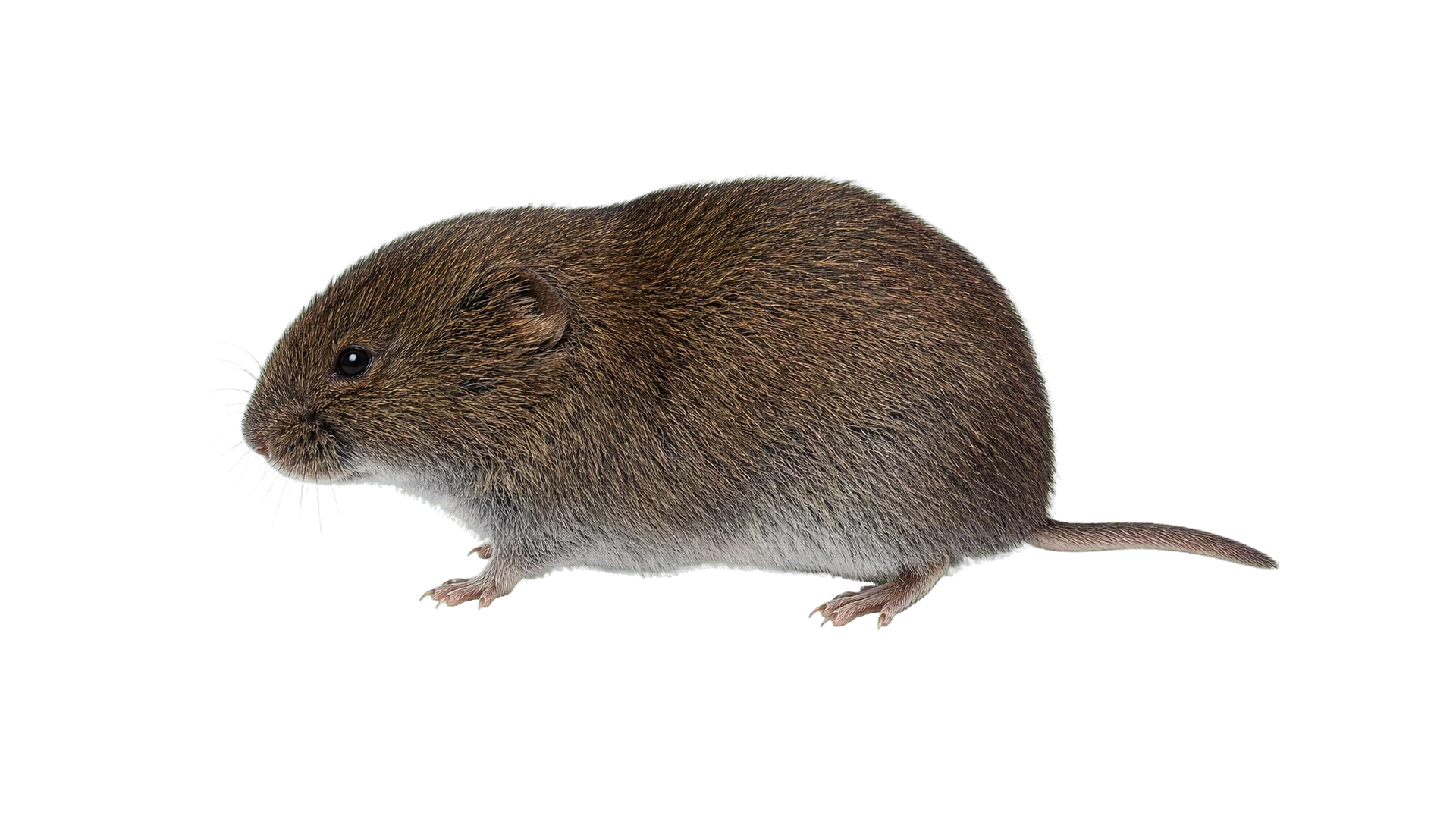
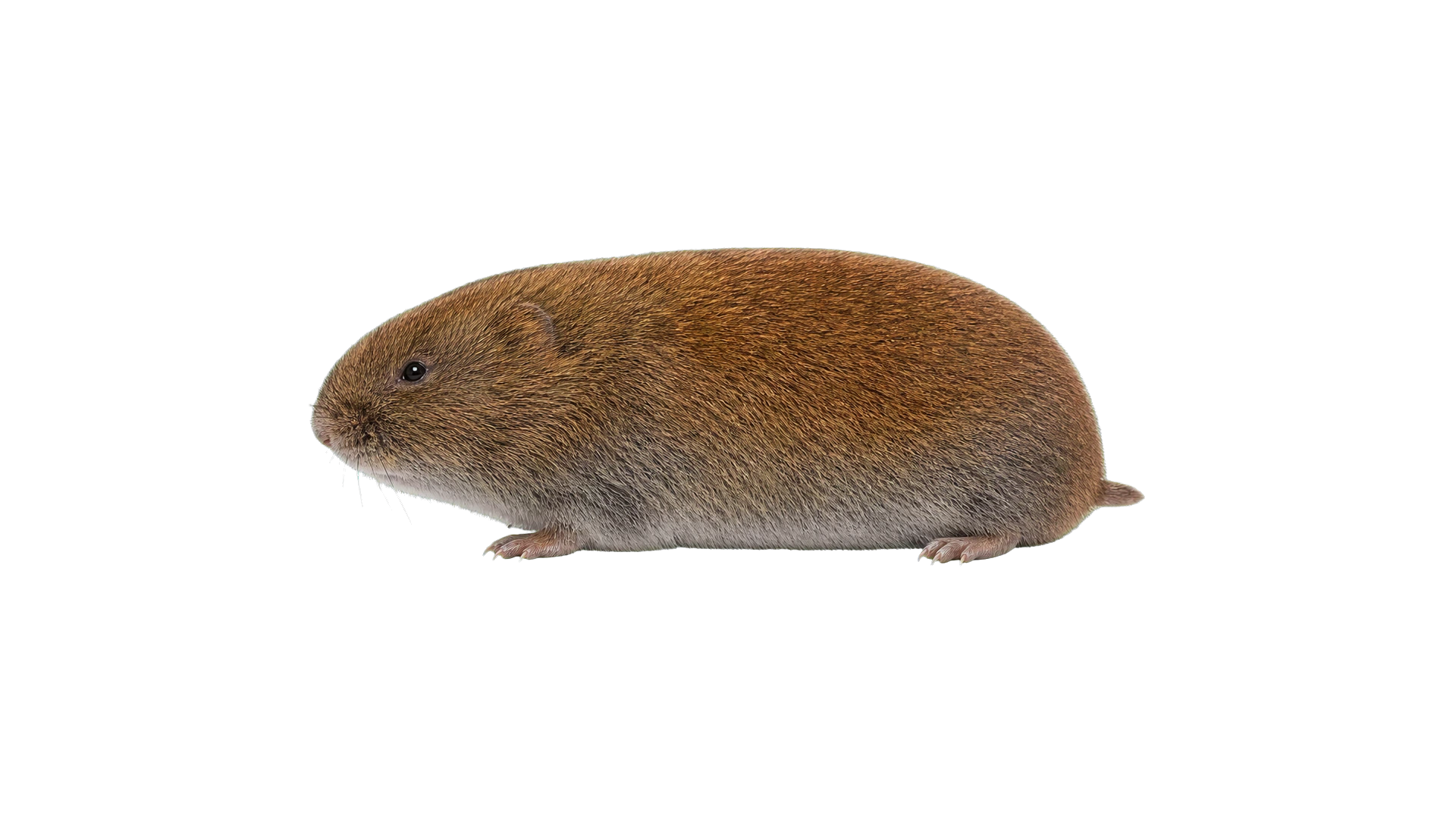
Tail much shorter than body
Vole tails run 1 to 2 inches, less than half the body length. Mouse tails roughly equal body length. Tail-to-body ratio is the fastest visual ID between voles and mice.
Local pest control help is one call away.
 Pest Control Services Nationwide Pest Control Services Nationwide
 Voles are small herbivorous rodents that look like fat short-tailed mice and live at the ground surface in lawns, garden beds, and ornamental plantings. Homeowners confuse them with mice (longer tails, larger ears) and with moles (tunneling insectivores). Voles eat plants and travel above ground in clipped grass runways. Moles eat insects and tunnel below ground. The two animals require completely different treatments and are routinely treated for the wrong species.
Voles are obligate herbivores. They eat grass, roots, bulbs, and inner bark of young trees and shrubs. Most plant damage occurs during winter and early spring when other food sources are scarce and snow cover hides voles from raptors while they girdle accessible plant material under the white.
A single vole population can girdle a young apple tree or kill a juniper hedge in one winter. Damage stays invisible until snow melts in March, by which point the tree is already past recovery. Fall prevention dramatically outperforms spring reaction because females produce 5 to 10 litters per year.
Three things every vole population needs:
Adult voles measure 4 to 6 inches body length with a 1 to 2 inch tail (less than half the mouse-tail ratio). Population irruptions produce densities exceeding 200 voles per acre during peak years, 10x background levels. Females produce 5 to 10 litters per year of 3 to 6 young each, with population doubling time as short as 21 days. US nursery and orchard losses to vole damage run into tens of millions annually.
Three checks distinguish voles from mice (longer tails, larger ears) and moles (tunneling, not surface). Identification matters because the treatments are completely different.
Vole tails run 1 to 2 inches, less than half the body length. Mouse tails roughly equal body length. Tail-to-body ratio is the fastest visual ID between voles and mice.

Vole ears are small and barely visible above the fur line. Mouse ears are large and prominent for the head size. Ear visibility separates the two species at 6 feet.
Voles have a blunt rounded snout and a stocky body that suggests a small guinea pig more than a mouse. Combined with short tail and small ears, the diagnosis is conclusive.
Vole signs are above-ground surface evidence: runways, clipped grass, gnawed bark at 3 to 6 inches from the soil line. Differentiating these signs from mole tunneling and mouse activity is the most important step in identification before any treatment plan is selected.
Runways are the clearest indicator. They appear as 1 to 2 inch wide paths cut through grass with the blades clipped flat from repeated traffic. Networks radiating from cover (woodpiles, shrub bases, deep mulch beds) indicate a sustained population. Isolated single tunnels almost always mean moles or mice, not voles.
Tree bark stripping confirms a population is feeding on woody plants. Tooth grooves run vertically, roughly 2 millimeters wide, at or just above the soil line on young trees and shrubs. Damage that wraps the entire trunk (girdling) kills the tree by severing nutrient transport and is usually fatal by spring.
How a Vole Issue Develops
Voles travel above ground in surface runways through grass, mulch, and ground cover. The runways are clearly visible as 1 to 2 inch wide paths with the grass blades cut flat from the animals running through repeatedly. Snow cover during winter allows the same activity to occur invisibly beneath the snow; the runways become visible at snowmelt and often surprise homeowners with the extent of activity that occurred during winter.
Plant damage during winter is the most consequential vole issue. Voles strip the inner bark from young trees and shrubs at or just above ground level, particularly when other food is scarce. Stripping that goes around the entire trunk circumference (girdling) kills the tree because nutrient transport from leaves to roots is severed. Apple trees, fruit trees, junipers, yews, and other ornamental shrubs are most commonly affected. Damage may not be visible until spring leaf-out fails to develop.
Effective vole control requires three coordinated elements: trapping in active runways, reducing protective cover habitat, and protecting valuable plantings during winter with hardware cloth trunk wraps. Single-element approaches produce partial results. Properties with chronic vole pressure benefit from comprehensive seasonal management starting in fall before winter feeding damage develops.
Six features that distinguish voles from look-alike mice, support effective species ID, and explain why control approaches differ from other small rodents.
Tail runs 1 to 2 inches, less than half the body length and much shorter than mouse tails. Single fastest visual ID separating voles from mice at any distance.
Ears are small, rounded, and partially hidden in head fur. Mouse ears are prominent and obvious. Reduced ear visibility is consistent across vole species.
Snout is rounded and blunt rather than pointed. Blunter face profile distinguishes voles from mice and shrews at moderate distance and supports the herbivore feeding niche.
Body shape is shorter and wider than a mouse, suggesting a small guinea pig. Stockier build supports burrowing behavior through ground cover and grass thatch.
Like all rodents, voles have continuously growing front teeth requiring constant gnawing. Tooth grooves on damaged tree bark are about 2 millimeters wide.
Feet are small with modest claws, suited for grass-level travel rather than digging or climbing. Voles rely on existing ground cover rather than tunnel excavation.
Pick the situation that fits what you have noticed. Each one points to a different stage of the vole population and a different control approach.
Voles look like mice but live entirely outdoors and eat plant roots. They reproduce constantly: a single female has 5 to 10 litters per year. The most damage happens under snow cover in winter, where voles girdle shrubs and young trees out of sight. The timeline below tracks the year-round cycle.
Surface runways visible in lawn (1 to 2 inch trails matted into grass) or chew damage at base of small trees and shrubs. Population is small but active, most visible right after spring snowmelt.
Multiple runways across the lawn, fresh chew damage on shrubs, or visible burrow entries (1 to 2 inches wide). Population is now likely 5 to 15 voles and breeding actively every 21 days.
Significant lawn damage, multiple shrubs or young trees girdled, or visible vole population in dense ground cover. Females breed at 5 to 6 weeks of age and produce a litter every 21 days.
Major landscape damage: dead shrubs, girdled fruit trees, severe lawn destruction. Population is established at 200+ voles per acre during irruption years. Replacement costs run hundreds to thousands per damaged tree.
Voles do most of their damage between November and March, hidden under snow or dense cover. By the time you see the damage in spring, the next breeding cycle is already underway. Plan vole control as a fall task, not a spring response.
Local pest pros distinguish voles from moles correctly, place traps in active runways, and coordinate cover-habitat reduction so populations decline durably.
Voles do not pick yards at random. They follow signals: dense lawn thatch deeper than 1 inch, mulch banked 3 inches deep against tree trunks and shrubs, ground covers like pachysandra or English ivy that hide a 4 inch wide surface highway. Once protected cover exists, a small population of 2 to 4 voles can build to 50 plus animals in one breeding season because females produce 5 to 10 litters per year.
Different vole species chase different rewards, which is why ID matters. Meadow voles (Microtus pennsylvanicus) work surface runways through lawn and pasture, girdle tree bark above the soil line, and dominate Northeast and Upper Midwest yards. Pine voles (Microtus pinetorum) burrow underground in mulched gardens and ornamental beds, chew bulbs and root systems, and prefer the Southeast and Mid-Atlantic. Prairie voles concentrate in Plains states with grassland edge. Meadow voles cause visible surface damage; pine voles cause invisible root damage that only shows when shrubs fail.
Most affected yards have two or three of these conditions running at once, and habitat trimming plus tree guards beat trapping. Start with the highest-leverage barrier: pull mulch back 4 inches from every tree trunk and shrub base, mow lawn margins to 3 inches, and install 1/4 inch hardware cloth guards 18 inches tall around young trees through winter. Check state wildlife rules before lethal control; voles are protected non-game species in some jurisdictions. Even partial wins help: pulling mulch off tree trunks before winter can cut girdling damage on 20 to 40 young trees by 80 percent in a single dormant season.
Lawn with substantial thatch (over 1 inch) provides ideal vole cover. Annual dethatching reduces vole habitat as a side benefit beyond lawn health goals.
Mulch piled deeper than 2 inches around shrubs, trees, and garden beds is preferred vole travel territory. Pulling mulch back exposes voles to predators and reduces population support.
Dense vegetation, deep mulch, or accumulated leaf litter at tree and shrub bases creates the localized cover that supports winter bark damage. Clear bases of cover during fall.
Woodpiles, brush piles, and rock piles host vole populations and provide staging areas for damage to surrounding plantings. Move 30+ feet from valued plantings.
Perennial beds with continuous winter cover (mulch, snow, plant litter) support vole populations through cold months. Annual fall cleanup reduces overwinter habitat support.
Foundation shrub plantings with deep mulch and dense canopy create connected vole travel routes against the structure. The location supports both lawn travel and structural-edge habitat.
Why vole pressure can go from background to irruption within a single season under favorable conditions.
0 to 3 weeks
Born blind and hairless in a grass-lined nest. Litter size 3 to 6 typically. Females produce 5 to 10 litters per year.
3 to 5 weeks
Eyes open at week 2; weaning by week 3 is fast. Young begin eating solid plant material rapidly, supporting the rapid reproductive cycle.
5 to 6 weeks
Voles reach sexual maturity at 5 to 6 weeks, faster than most rodents. Population doubling time runs 21 to 28 days under favorable cover and food conditions.
Lives 3 to 6 months
Adults live 3 to 6 months in the wild due to heavy predation. Short lifespan offset by rapid breeding. Ten voles become 100 within one growing season.
Vole populations cycle between low background years and irruption years where densities exceed 200 voles per acre. Irruption years correlate with abundant winter cover (heavy mulch, deep snow) and reduced predation. Year-to-year variability is significant; properties with chronic favorable conditions support consistently higher populations.
Vole species damage lawns and gardens differently. Match what you're seeing to identify which one.
| Species | Severity | Key Sign | Where You'll Find Them |
|---|---|---|---|
| Meadow Voles | Persistent | Surface runways through grass, 1-2 inch burrow holes, gnawed grass stems | lawns, meadows, fields |
| Pine Voles | Persistent | Underground tunnels near roots, wilting plants with chewed roots, collapsed bulb plantings | underground tunnels, orchards, gardens |
Severity reflects typical impact, not your specific case. If unsure, treat at the higher tier.
Honest read on common methods. The right approach combines runway trapping, cover reduction, and plant protection; either alone produces partial results.

 Snap traps placed in active runways under plywood cover boards Cover board creates sheltered tunnel the vole continues using Bait with peanut butter, oatmeal, or apple slices; reset and rebait daily Annual lawn dethatching reducing thatch below 1 inch Pull mulch back from shrub bases, tree trunks, and garden bed edges Move woodpiles, brush piles, and rock piles 30+ feet from valued plantings Hardware cloth wraps installed in fall around all young trees and valuable shrubs Wraps extend from soil grade to 18+ inches above expected snow line Bulb planting in hardware cloth cages constructed at planting time
  Bait acceptance is poor; voles prefer fresh plant material Non-target risk to ground-feeding birds, pets, and predator wildlife Specialty vole-formulated baits exist but produce inconsistent results Mole traps are designed for subsurface tunnels; voles travel above ground Wrong tool entirely for surface vole runways Frequent confusion stems from misidentification of vole damage as mole damage Animals adapt quickly during typical outdoor exposure cycles Spray products dilute and dissipate with weather over short periods No durable effect on populations already established
 Six prevention actions sorted by effort. Cover reduction plus winter plant protection addresses most vole pressure on most properties.

Mulch deeper than 2 inches against shrubs and trees creates winter vole cover. Pull back to 1 inch or expose soil entirely at bases of valued plantings before October.

Lawn thatch over 1 inch thick supports vole populations through winter. Annual dethatching produces a healthier lawn and removes the cover habitat that protects voles from raptors.

Install hardware cloth wraps around young trees every fall before snow. Extend from soil grade to 18 inches above expected snow line. One fall task prevents winter girdling.

Move woodpiles, brush piles, and rock piles 30 feet from valued plantings. Reduces property vole population and removes staging areas for winter damage to nearby trees.
Plant tulips, crocuses, and other valuable bulbs in 1/4-inch hardware cloth cages built at planting time. Mesh on all sides plus top prevents vole access while allowing bloom.

Annual fall cleanup of perennial beds reduces winter cover that supports overwintering populations. Cut ground cover, remove plant debris, expose soil to hawks and owls.
Vole pressure runs through winter feeding damage cycles. Fall preparation prevents most winter damage; spring assessment reveals what got through.
Snowmelt reveals winter damage: bark stripping on trees, missing bulbs, runways across lawn. Population breeds heavily during spring; damage assessment and replacement plantings occur during this window.
Lower visible activity as predator pressure is high and natural food is abundant. Population continues breeding but damage is less visible. Good window for cover-habitat reduction and lawn maintenance.
Population peaks of the year typically occur in fall before winter mortality. Critical preparation window: install tree wraps, reduce winter cover, complete cleanup work before first snow. Trapping during this window reduces overwinter population.
Heaviest damage window: snow cover or dense ground cover protects voles from predators while they feed on accessible plant material. Winter trapping under snow is impractical; prevention work done in fall determines winter outcomes.
Four steps from arrival to a control plan addressing population, habitat, and plant protection together.
Trap, reduce cover, protect plantings. Vole control is multi-element; pros who address only one element produce partial results.
Distinguish vole damage from mole and mouse damage. Map active runways and identify the cover habitat features supporting the population. Assess plant damage already requiring protection.
Snap traps placed in active runways under plywood cover boards. Bait with peanut butter, oatmeal, or apple slices. Reset and rebait daily for 2 to 3 weeks.
Coordinate with property owner on cover reduction: dethatching, mulch reduction, pile relocation, ornamental bed cleanup. Some changes during the visit, others require follow-up project work.
Hardware cloth tree wraps on young trees if the season warrants. Recommendations for bulb cage construction and winter protection of high-value plantings before first snowfall.
Real stories from households who connected with pros to address vole populations and prevent winter plant damage through coordinated control.

"Garden beds saved from vole damage."
Voles had tunneled through our yard and garden. The inspector explained how to address the tunneling and treated the perimeter. The damage stopped and we were able to replant without losing everything again.
"Garden beds saved from vole damage."
Voles had tunneled through our yard and garden. The inspector explained how to address the tunneling and treated the perimeter. The damage stopped and we were able to replant without losing everything again.

"Lawn recovered after voles cleared out."
Our lawn was riddled with vole tunnels and they were damaging garden roots. The tech set up a targeted removal plan and explained how to make the yard less hospitable. The lawn recovered within a few weeks once the voles were gone.

"Garden protected from vole tunneling."
When the snow melted, we found vole tunnels crisscrossing the entire lawn and garden. The tech set up a removal plan and recommended gravel barriers around garden beds. The following winter showed almost no new tunnel activity.

"Lawn recovered after vole removal."
Vole tunnels crisscrossed the lawn. The provider set up a removal plan and recommended gravel barriers around garden beds. The lawn recovered once the voles were gone.

"Lawn recovered after vole removal."
Snow melted last April and the lawn looked like someone had carved a maze into it. Vole runways crisscrossed everywhere, especially along the garden beds. The tech set up a removal plan and recommended a gravel barrier around the vegetable garden to discourage them from returning. The lawn grew back in by midsummer and the garden has stayed clear.
Direct answers to what homeowners ask most about vole runways, plant damage, and management.
Tail length is the fastest tell. Vole tails are 1 to 2 inches, much shorter than the body. Mouse tails are roughly equal to body length. Body shape differs: voles are stocky and compact, more like a small guinea pig than a mouse. Mice are slim and elongated. Ear visibility differs substantially. Vole ears are small, rounded, partially hidden in the fur. Mouse ears are large and prominent. Snout shape differs: voles have a blunt rounded snout; mice have a pointed snout. Habitat differs entirely. Voles live outdoors in lawns and gardens, traveling above ground in surface runways. Mice live indoors (commensal species) or in woodlands and field edges. Damage differs: vole damage is plant-focused (clipped grass, stripped bark, eaten bulbs). Mouse damage is structural (gnawed wires, contaminated food, droppings along baseboards). Treatments do not cross over.
Three different animals. Voles are rodents (order Rodentia) with continuously growing incisors. They eat plants and travel in above-ground surface runways. Body length 4 to 6 inches, short tail, small ears, blunt snout. Damage: clipped grass paths, missing bulbs, stripped tree bark. Moles are insectivores (order Eulipotyphla) with many small pointed teeth. They live entirely in subsurface tunnels, eating earthworms and grubs. Cylindrical body, paddle-shaped front feet, tiny eyes, no external ears. Damage: raised tunnel ridges and conical hills. Shrews are also insectivores but smaller (2 to 3 inches), with pointed snouts. They eat insects, spiders, and worms in ground cover and leaf litter. Shrews produce no visible damage and are beneficial. Walking the lawn identifies the species: flat clipped grass paths are vole runways, raised collapsing ridges are mole tunnels. Treatments do not cross over.
Voles do not hibernate. They remain active through winter, feeding daily under snow cover that protects them from raptors and other predators. With other food scarce, tree and shrub bark becomes primary food. The phloem layer (inner bark) of young trees provides sugars and nutrients. Voles strip outer bark to access it. Young trees with smooth thin bark (under 5 years) are most vulnerable. Apple, pear, cherry, plum, crabapple, and lilac all suffer. Junipers, yews, and arborvitae experience damage at branch bases. Feeding occurs at and just above the snow line, which moves up as snow accumulates. Damage extending 12 to 24 inches up the trunk reflects deep snow accumulation. Girdling all the way around kills the tree. Wrap young trunks with 1/4 inch hardware cloth from soil grade to at least 18 inches above expected snow line. Pull mulch back from tree bases at fall maintenance.
Yes, those are some of the highest-leverage interventions. Voles need protective cover to survive predation from raptors, foxes, snakes, and cats. Lawn thatch over 1 inch thick provides ideal habitat where voles travel and feed hidden from predators. Annual dethatching that drops thatch below 1 inch typically reduces vole pressure over 1 to 2 seasons. Mowing at 3 inches or shorter reduces cover compared to higher mowing. Maintain short mowed strips along property edges, fence lines, and structural perimeters to break population connectivity. Pull mulch back from tree bases, shrub bases, and garden beds to under 1 inch. Reduce ornamental ground cover (pachysandra, English ivy, certain junipers) in pressure zones. Combine maintenance with targeted trapping and hardware cloth wraps on valuable plantings. During irruption years (every 3 to 5 years in many regions), maintenance alone may be insufficient.
Minimal direct risk. Disease transmission is low. Voles carry various pathogens but transmission to humans is uncommon in residential settings. Some hantavirus strains and tularemia are documented but rare. The most concerning indirect risk is tick transmission. Voles host ticks including species that carry Lyme disease, and properties with substantial vole populations may have higher tick populations affecting pets and humans. Pets investigating voles may experience minor bites with wound infections. Cats often bring captured voles indoors (gloves and double-bagging handle disposal). Plague (Yersinia pestis) is associated with various rodents including voles in specific western US regions but at low residential transmission rates. Reducing vole populations also reduces ticks they support. Pets benefit from routine tick prevention products and veterinary care.
Fall and spring. Fall trapping (September through early November) reduces the overwinter population, lowering winter feeding damage on trees and bulbs. Spring trapping (March through May) addresses post-winter survivors before peak breeding. Active runways are visible in both windows when ground cover is reduced. Summer growth obscures runways and natural food competition lowers catch rates. Place snap traps at active runway intersections, perpendicular to runway direction, with both ends facing into the runway. Cover boards (plywood over runways) create sheltered tunnels that improve catch rates. Pre-bait for 2 to 3 days without setting the trap so voles develop a feeding habit. Use peanut butter, apple slices, oatmeal, or sunflower seeds. Inspect daily and move ineffective placements after 5 to 7 days. Light pressure responds to 2 to 3 weeks. Heavy pressure may require 4 to 6 weeks combined with habitat reduction.
Yes, often. Regional populations persist across parks, woodlands, fields, and adjacent properties. Single-property removal does not eliminate the regional source, and reinvasion typically occurs within months to years through dispersing animals. Habitat conditions determine reinvasion speed. Properties with heavy thatch, deep mulch, dense ground cover, and woodpiles experience faster reinvasion than those with reduced cover. Properties combining removal with cover reduction see longer durations between population events. Vole populations cycle dramatically with irruption years every 3 to 5 years in many regions, during which property-level work alone may be insufficient. Effective long-term management combines initial trapping with ongoing habitat reduction, hardware cloth wraps on valuable plantings (often kept in place year-round), and periodic monitoring rather than expecting permanent single-event resolution. Damage prevention is more achievable than zero presence.
Trap in active runways, reduce cover, protect plantings. Local pros coordinate the three elements that durable vole control requires.
Click through to species pages for behavior, regional patterns, and treatment specific to that vole.
Surface-tunneling rodents that destroy lawns and girdle young trees.
Meadow voles create extensive runway systems through grass just above the soil surface, killing turf in wide swaths that become visible when snow melts in spring. They gnaw bark from the base of young trees and shrubs during winter, often girdling and killing them. Populations cycle dramatically, during peak years, densities can reach hundreds per acre, causing severe landscape damage.
Quick ID:
Why it matters:
Underground voles that destroy plant roots and bulbs from below.
Pine voles live almost entirely underground, tunneling through the root zone to feed on roots, tubers, and bulbs. Their subsurface lifestyle makes them harder to detect than meadow voles, the first sign of damage is often wilting or dying plants with no visible surface activity. They are a serious pest in orchards, nurseries, and residential landscapes with established plantings.
Quick ID:
Why it matters: