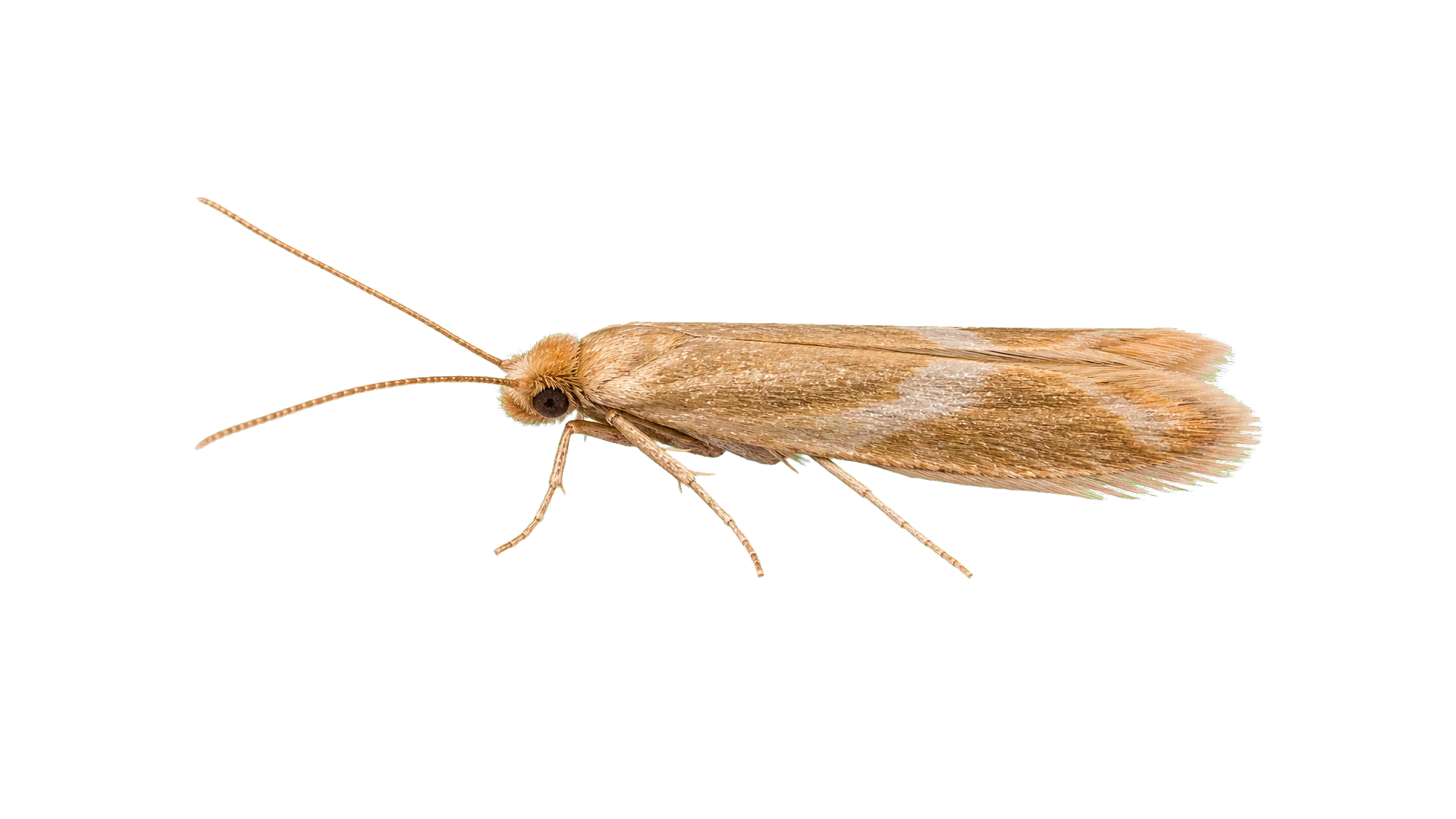
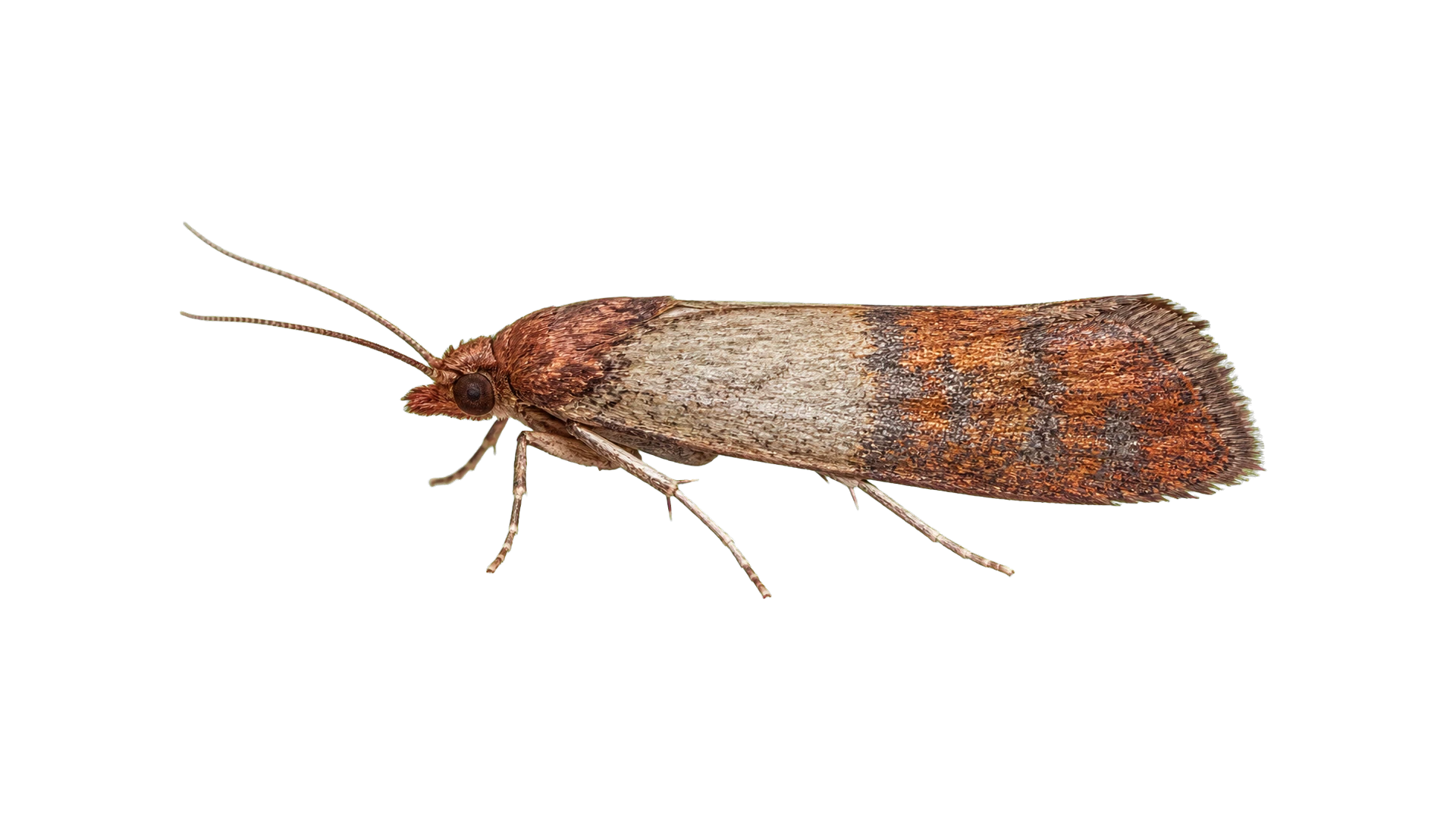
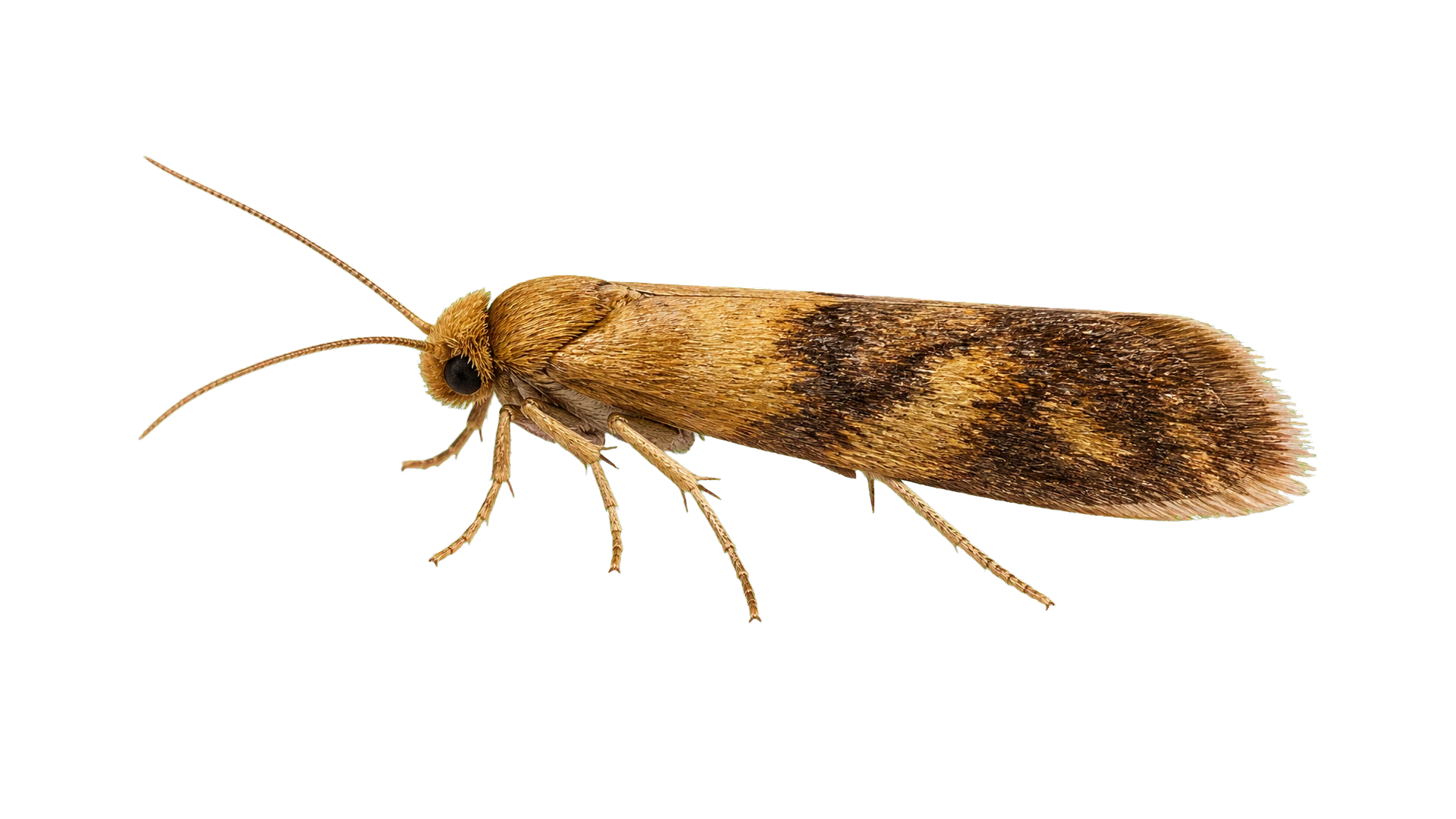
Stout fuzzy body
Moths carry notably stouter, fuzzier bodies than butterflies. The fuzz is actually overlapping scales (modified hairs). The chunky silhouette rules out flies, gnats, and slender lacewings on sight.
Local pest control help is one call away.
 Pest Control Services Nationwide Pest Control Services Nationwide
 The adults flying out of your closet or pantry are not the damage. The larvae are. By the time you see a moth, caterpillars have been chewing wool or cereal for 6 to 8 weeks. Identification (clothes vs pantry) tells you which substrate to attack; treatment lives at the food source.
Indoor moth pests split into two camps. Webbing and casemaking clothes moths (Tineidae) feed on keratin in wool, cashmere, silk, fur, and felt. Indianmeal moths and Mediterranean flour moths (Pyralidae) breed in cereal, flour, pet food, bird seed, and dried fruit.
Both need stored substrate that sits undisturbed for weeks. Find the substrate, treat or discard it, clean the storage zone, and the cycle ends. Skip that step and adults keep emerging from the same closet or pantry for months.
Three substrate categories every home has:
Webbing clothes moth larvae can chew one wool sweater for 3 to 4 months, leaving thousands of small holes before pupating. An Indianmeal moth infestation can spread from one contaminated cereal box to every cardboard package in the pantry inside 2 to 3 generations (roughly 12 weeks). Catching larvae in week one saves the item; catching them in week eight means discarding it.
Three checks that separate a moth from a butterfly, fly, or small flying beetle in under ten seconds.
Moths carry notably stouter, fuzzier bodies than butterflies. The fuzz is actually overlapping scales (modified hairs). The chunky silhouette rules out flies, gnats, and slender lacewings on sight.

Moths have four wings (two pairs) covered in tiny overlapping scales that rub off as fine powder when touched. Flies have one pair of transparent wings. The scaled-wing test is fast and reliable.
Moth antennae are thread-like or feathery, never clubbed at the tip. Butterflies have a clear knob at the antenna tip; moths do not. Antenna shape is the cleanest order-level distinction.
A single moth at the porch light is outdoor pressure. A real indoor infestation announces itself through the larvae and their physical evidence, almost always in storage zones homeowners don't routinely open. The damage is usually 6 to 8 weeks ahead of the first adult sighting.
Clothes moth damage hides in the back of closets, under furniture, and inside stored bins of out-of-season wool. Check the underarms, collars, and other body-oil zones of every wool sweater not worn in six months. The first generation almost always picks those exact spots before fanning out across the wardrobe.
Indianmeal moth damage hides in pantry corners and on cardboard box flaps where larvae spin silken webbing across the cereal, flour, or pet food. Mature larvae often crawl up walls and across ceilings looking for a pupation spot, which is why you'll see small caterpillars 10 feet from the actual food source.
How a Moth Infestation Develops
Clothes moths feed on keratin: wool, cashmere, silk, fur, feathers, taxidermy, even soiled cotton if it has body oils on it. Adults don't damage anything; they don't even feed (the proboscis is reduced). Larvae do all the damage during their 1 to 3 month feeding period. Damage often goes unnoticed for months because clothes moths prefer dark undisturbed storage and avoid frequently-worn items.
Pantry moths breed in stored grain, flour, cereal, pet food, bird seed, nuts, dried fruit, pasta, and similar products. Indianmeal moths are by far the most common indoor pantry pest. They almost always arrive in a single contaminated grocery item (most commonly cereal, flour, or pet food) and then spread to other cardboard or thin-plastic packages in the pantry over 2 to 3 generations.
Effective moth control is substrate-first. For clothes moths: locate the affected items, freeze or heat the items to kill all life stages, clean the closet thoroughly, and store remaining items in sealed containers with cedar or mothballs. For pantry moths: discard ALL infested and at-risk packages (everything in cardboard or thin plastic), clean the pantry shelves and corners, and re-store dry goods in glass or hard plastic containers. Pheromone traps catch adults but do not eliminate the source; they're useful as monitoring tools.
Six features that define a moth and distinguish it from butterflies and from other flying insects.
Four wings covered in microscopic scales (modified hairs) that detach as fine powder. The scales create the coloration and identify the species at the wing-pattern level.
Thread-like or feathery, especially in males who use them to detect female pheromones over long distances. Butterfly antennae carry a club tip; moths never do.
Adults sip nectar through a long proboscis that coils under the head at rest. Webbing clothes moth adults have a reduced proboscis and never feed.
Thick scaled body, much chunkier than a fly or butterfly profile. The fuzz insulates the moth for nighttime flight at lower temperatures than diurnal pollinators tolerate.
Three short pairs, partially tucked under the wings at rest. Larvae add fleshy prolegs along the abdomen for crawling across wool, grain, or pantry surfaces.
Large compound eyes wrap most of the head for low-light vision. Nocturnal species navigate by moonlight or starlight, which is why porch lights pull them in.
Choose the sign that matches; each one points to a different species and a different storage zone to address.
Indoor moths split into two groups with very different urgency curves: clothes moths damage wool, silk, and natural fibers; pantry moths contaminate stored food. The timeline below covers both, the species you have changes the protocol completely.
First moth spotted indoors, often near a window, light, closet, or pantry. Webbing clothes moths are gold-bronze; Indianmeal moths show two-toned banded wings. Location pinpoints the substrate within minutes.
Multiple moths in the same zone, larvae or silken webbing visible, or holes in wool and contaminated grain. Eggs may have spread to adjacent items. DIY can still close it if every at-risk item gets treated.
Multiple rooms or cabinets affected, recurring sightings after initial cleanup, or significant damage to wardrobe or pantry. Eggs are likely in storage zones you haven't yet inspected. DIY rarely closes infestations this size.
Multi-generational infestation: wool wardrobe destroyed, pantry-wide contamination, or moths active across HVAC vents in unrelated rooms. Multi-visit professional treatment plus item replacement is required for full closeout.
Moth problems almost always start with one item: a wool sweater pulled from a forgotten box, a bag of birdseed in the garage, or a sack of flour from the back of the pantry. Find that item first; treatment without source removal rarely holds.
Local pros identify the moth species, locate the actual source (closet or pantry), and coordinate the discard and storage protocols that prevent recurrence.
Indoor moth populations are entirely substrate-driven. Find the substrate, treat or discard it, and the cycle ends. Skip that step and pheromone traps thin the visible males while larvae keep chewing the source. This is the single most common reason DIY moth control drags on for months.
Webbing clothes moths target keratin: wool, cashmere, silk, fur, feathers, taxidermy. They prefer items with body oils, sweat, or food residue. A clean wool sweater in a sealed bag is dramatically less attractive than the same sweater hung dirty in a closet for six months.
Indianmeal moths target stored grain. The infestation almost always arrives in one contaminated grocery item, usually birdseed, cereal, flour, or pet food. From that single source, larvae spread through every cardboard or thin-plastic package within reach over 2 to 3 generations.
Webbing clothes moth ground zero. Wool and cashmere stored undisturbed for months are prime larval habitat. Pull out and inspect any garment not worn in 90 days first.
Indianmeal moth ground zero. Inspect every cereal box, flour bag, pasta package, pet food bag, and bird seed sack. Cardboard and thin plastic offer almost no barrier to larvae.
Long-term wool storage, off-season clothing bins, holiday decorations with felt components. Rarely inspected but supports persistent multi-year clothes moth populations.
Bird seed, dog food, chicken feed stored in garages or sheds frequently sustain Indianmeal moth populations that migrate into the kitchen on foot or by air.
Carpet edges along baseboards, under furniture, or at door thresholds rarely get a deep vacuum. Casemaking clothes moth larvae feed on wool fibers in these zones for months undetected.
Heritage items, antique upholstery, fur coats, mounted specimens, felt-lined instrument cases. All host webbing clothes moth populations unless regularly inspected and stored sealed.
Why a single contaminated grocery item becomes a full pantry infestation in 8 to 12 weeks.
4 to 10 days
Females lay 100 to 400 eggs directly on the substrate (wool or grain). Eggs are under 1 mm and almost impossible to spot. Hatch in 4 to 10 days at room temperature.
1 to 3 months
Caterpillar-like larvae feed continuously on wool or grain. The only stage that causes damage. Feeding can stretch past 3 months in cool storage or poor substrate.
1 to 4 weeks
Mature larvae spin silken cocoons in closet corners, shelf undersides, ceiling-wall joints, or inside the food itself. Pupae resist most consumer pesticides.
1 to 4 weeks
Adults emerge and mate within days. Females begin laying eggs immediately. Webbing clothes moth adults don't feed; pantry moth adults sip briefly.
Total egg-to-egg cycle runs 6 to 12 weeks at room temperature. Generations overlap when the substrate is rich enough, which is why pantry populations can multiply quickly. Source elimination breaks the cycle; adult-only treatment doesn't.
Moths range from pantry pests to fabric destroyers and wood borers. Match what you're seeing to identify which one.
| Species | Severity | Key Sign | Where You'll Find Them |
|---|---|---|---|
| Carpenter Worms | Structural | Large oval holes in hardwood trees, frass and sap oozing from trunk wounds | oak trees, elm trees, ash trees |
| Carpet Moths | Persistent | Bare patches in carpets and rugs, silken tubes at carpet edges | under furniture edges, carpet along baseboards, closet floors |
| Clothes Moths | Persistent | Irregular holes in wool and silk clothing, silken tubes or cases in closets | closets, storage areas, drawers |
| Indian Meal Moths | Persistent | Silken webbing in cereal, flour, and grain products; small moths flying near pantry | pantries, cupboards, pet food storage |
Severity reflects typical impact, not your specific case. If unsure, treat at the higher tier.
Honest read on common DIY methods. Substrate-first approaches work; adult-only tactics rarely do.

 Freeze affected items in plastic bags at zero degrees Fahrenheit for at least 72 hours Or heat treat in a dryer at high heat for 30 minutes (for items that tolerate it) Kills all life stages: adults, larvae, pupae, eggs Discard ALL grain products in cardboard or thin plastic, even those that look unaffected Vacuum and clean pantry shelves, walls, and corners; wipe with vinegar solution Re-store dry goods in glass or hard plastic with airtight seals Remove all stored items, vacuum the closet floor and shelves, wipe surfaces Inspect every item before returning; freeze or heat items that show evidence Store items in sealed containers (vacuum bags, sealed totes) with cedar blocks as preventive layer
  Kill contacted adults; do not penetrate stored items where larvae and eggs develop Pesticide residue exposure on clothing or food storage areas without addressing the source Provides quick visible knockdown but not real population suppression Catch males of specific species (separate traps for clothes moth vs pantry moth) Useful as monitoring tools to confirm species ID Insufficient as primary control because females and larvae continue developing Provide mild repellent effect against egg-laying females in stored clothing No effect on existing eggs, larvae, or pupae already in the items Useful as preventive layer in clean storage; not effective on active infestations
 Six prevention actions, sorted by effort. Moth control is mostly about how you store the substrate; clean storage habits prevent infestations from establishing.

Clean wool, cashmere, and silk before any long-term storage. Body oils and food residue attract egg-laying webbing clothes moth females. A clean garment in a sealed bag is the gold standard for off-season storage.

Pull out stored wool every 90 days and inspect for holes, larvae, or silken webbing. Catching damage at the start of a generation cycle saves the rest of the wardrobe and skips the freeze-treat protocol.

Move flour, cereal, rice, pasta, nuts, and pet food into glass jars or hard plastic containers with airtight seals. Cardboard and thin plastic are no barrier to Indianmeal moth larvae chewing through.

Empty the pantry every spring. Vacuum corners and shelves, wipe shelves with vinegar, inspect every item before it goes back. Eliminates pupal hideouts at the ceiling-wall junctions and shelf edges.

Move off-season clothing, holiday decorations with wool, and antique fabrics into vacuum bags or sealed totes. Eliminates moth access entirely. Best protection for cashmere sweaters, fur, and heritage pieces.

Look at cereal, flour, and bird seed packaging before it lands in the pantry. Indianmeal moth infestations almost always arrive in one contaminated grocery item. Five seconds at the kitchen counter prevents 8 weeks of work.
Indoor moth populations run year-round once established. Outdoor moth pressure cycles with temperature.
Outdoor moth activity resumes as temperatures warm. Indoor populations from winter establishment may produce visible adults as new generations emerge from stored items.
Peak outdoor moth activity. Lights at night attract dozens of moth species; some occasional indoor entry. Indoor pantry moth and clothes moth populations breed at maximum rate in warm conditions.
Outdoor activity declines. Wool sweaters and seasonal clothing return to closets, often introducing late-summer-acquired clothes moth eggs. Pantry moth pressure remains steady from indoor populations.
Outdoor populations crash. Indoor populations continue at slower pace; cold storage areas (basements, attics, garages) may slow indoor breeding. Winter is the cleanest treatment season because outdoor reinfestation is minimal.
Four steps from arrival to a household with moth populations under control. Initial visit runs 60 to 90 minutes; full clearance follows in 4 to 8 weeks.
Identify, locate, treat substrate, monitor. Real moth control is substrate-first. Plans that skip species ID rarely match the right treatment to the right storage zone.
Confirm webbing clothes moth, Indianmeal moth, or both. Each species sends the inspection toward a different storage zone with a different protocol.
Inspect every closet and clothing storage area for clothes moths; inspect every pantry, cabinet, and pet food bin for Indianmeal moth. Confirm the active source before treating.
Freeze or heat affected items at 0 degrees Fahrenheit for 72 hours, discard severely damaged or contaminated items, clean storage, transition to sealed containers.
Species-specific pheromone traps in closets and pantries. Activity should drop within 4 to 6 weeks; ongoing traps confirm closeout and catch any new introductions.
Real stories from households who connected with pros to find the substrate, treat the source, and protect remaining items.

"Fumigation cleared stored product pests from our pantry and walls."
Indian meal moths and beetles had infested our pantry and spread into the wall cavities behind the kitchen. Standard treatments were not reaching the source. The provider recommended fumigation to eliminate larvae and adults in every hidden space. We cleared the home, the crew tented and treated, and clearance testing confirmed a complete knockdown.
"Fumigation cleared stored product pests from our pantry and walls."
Indian meal moths and beetles had infested our pantry and spread into the wall cavities behind the kitchen. Standard treatments were not reaching the source. The provider recommended fumigation to eliminate larvae and adults in every hidden space. We cleared the home, the crew tented and treated, and clearance testing confirmed a complete knockdown.
Direct answers to what homeowners ask when moth damage shows up indoors.
No. Adult moths do not eat your food; the larvae do. By the time you see flying adults in the pantry, the larvae (small caterpillar-like worms) have already been feeding on stored grain, cereal, flour, pasta, pet food, or similar dry goods for weeks to months. The adults emerge from those food sources and start the next generation. To stop the cycle, you have to find and discard the infested food (look for silken webbing inside packages, larvae crawling on shelves, or rice-grain-sized worms in the food itself). Trapping or spraying adults without finding the source means new adults keep emerging from the contaminated food for as long as it remains in the pantry.
Clothes moth damage is irregular: holes scattered through the garment, often concentrated near underarms, collars, or other body-oil zones. You'll often find silken webbing or small cocoon-like cases inside the affected item. Carpet beetle damage tends to be more concentrated, often at one spot on the garment, with no webbing. Carpet beetle larvae (small fuzzy bristled worms) are also distinctive looking compared to the smooth caterpillar-like clothes moth larvae. Both pests respond to similar treatment (freeze or heat treatment, thorough closet cleaning, sealed storage), so misidentification rarely changes the response significantly. If you find adult moths inside the closet, it's almost certainly clothes moths; carpet beetles emerge as small dark beetles, not moths.
Mothballs (naphthalene or paradichlorobenzene) work but with significant caveats. They release a heavy vapor that's lethal to moth larvae and eggs in airtight storage; in non-airtight storage they're far less effective and the vapor exposure to humans is meaningful. Modern recommendation is to use them only in sealed containers (vacuum bags, sealed totes) and to avoid them in open closets where children, pets, or sensitive adults are exposed. Cedar blocks are a milder alternative; they repel adult egg-laying females but don't kill existing eggs or larvae. The most reliable approach for clothes moth-prone items is to clean the items thoroughly, freeze or heat treat any with potential infestation, and store in sealed containers regardless of whether you use additional repellents.
Discard any food package showing visible larvae, webbing, or grain clumping (these are signs of active infestation). Items in unbroken glass or hard plastic with airtight seals are usually safe; the seal prevents moth access. Items in cardboard or thin plastic, even if they look fine, may have early-stage infestation invisible from outside; the safest move is to discard them or to freeze the contents at zero degrees Fahrenheit for at least 72 hours before consuming. Sealed cans are unaffected. The economic loss is real but eliminating the source is essential to clearing the population. After discarding, vacuum and thoroughly clean the pantry shelves and corners before reintroducing food in airtight containers.
Pheromone traps are excellent monitoring tools but limited as primary control. The traps release a synthetic version of the female's mating pheromone, attracting males. They work for one species at a time (you need different traps for clothes moths vs Indianmeal pantry moths). Captured males cannot reproduce, so traps incrementally suppress populations over weeks. However, eggs and larvae already in the substrate continue developing, and unmated females remain. The right way to use pheromone traps is for species ID (confirming what you have), monitoring (tracking population over weeks), and confirming clearance after substrate treatment. For active infestations, source elimination remains the primary control; traps are the supplemental layer.
Pantry moths (most commonly Indianmeal moths) arrive in grocery products that were already infested when packaged. Adult moths or eggs are introduced during processing, packaging, or warehouse storage; they can chew through thin plastic and cardboard surprisingly easily, but they often don't need to because the eggs are already inside. Once one infested item enters your pantry, larvae can spread to adjacent products by chewing through cardboard or thin plastic packaging. This is why pantry moth populations seem to appear suddenly: you bring home one bag of bird seed or pet food with eggs in it, and 6 to 8 weeks later you have multiple items infested. Glass and hard plastic with airtight seals are the only reliable storage; cardboard is no protection.
For pantry moths, a thorough pantry purge (discarding infested items) plus deep clean plus sealed storage typically clears the population in 4 to 6 weeks. The lag is because pupae or eggs in hidden spots (cabinet corners, behind shelving) may continue producing adults during that window. For clothes moths, treatment of affected items (freeze or heat) plus closet cleaning plus sealed storage typically clears within 6 to 8 weeks. Pheromone traps placed during the treatment window confirm clearance: when traps go several weeks without catches, the population is considered eliminated. If activity persists past 8 weeks, a missed source remains; pro inspection is worth scheduling at that point to find what's been overlooked.
Find the substrate, treat the source, monitor with pheromone traps. Local pros handle the integrated plan rather than a single fogger event.
Click through to species pages for substrate location and treatment specific to that moth type.
Fabric-eating moths whose larvae destroy wool, silk, and stored garments.
Clothes moth larvae feed on natural fibers including wool, cashmere, silk, and fur, creating irregular holes in clothing, rugs, and upholstered furniture. Adults are small, golden-colored moths that avoid light and are rarely seen flying. Cedar alone is rarely sufficient, regular cleaning, proper garment storage, and professional treatment are needed to eliminate active infestations.
Quick ID:
Why it matters:
Common pantry moths whose larvae infest cereal, flour, nuts, and dried fruit.
Indian meal moth larvae produce silken webbing inside food packages as they feed, contaminating far more product than they consume. Adults are small moths with distinctive copper-and-gray wings often seen fluttering near kitchen ceilings at night. Eliminating all infested items, deep-cleaning pantry shelves, and storing goods in sealed containers are essential to breaking the cycle.
Quick ID:
Why it matters:
Wood-boring moth larvae that tunnel into hardwood trees and timber.
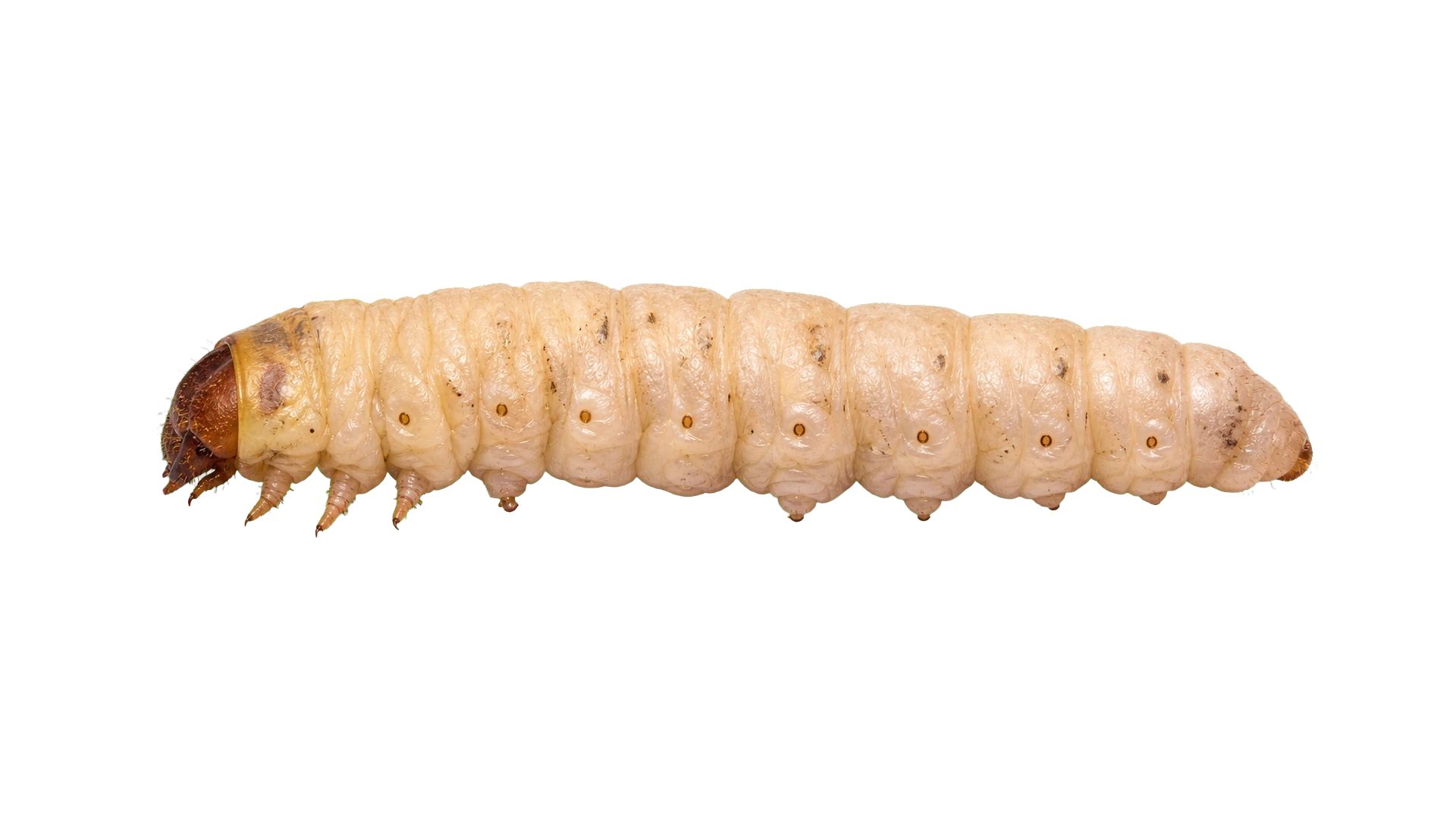
Carpenter worms are the large larvae of clearwing and leopard moths that bore deep into the heartwood of oaks, elms, ashes, and other hardwood trees. Their tunnels weaken trunks and branches over several years, creating entry points for decay fungi and other wood-destroying organisms. Sawdust-like frass and oval exit holes on bark are the primary signs of infestation.
Quick ID:
Why it matters:
Fabric-destroying moths whose larvae eat wool carpets and rugs.
Carpet moths are a type of clothes moth whose larvae specifically target wool carpets, area rugs, and upholstered furniture. They feed along baseboards, under heavy furniture, and in undisturbed corners where their damage goes unnoticed until bare patches appear. Adult moths are small and avoid light, making early detection difficult without deliberate inspection of carpet edges.
Quick ID:
Why it matters: