1 to 5 mm unfed
Unfed adults run 1 to 5 mm depending on species and life stage. Nymphs are 1 to 2 mm (poppyseed-sized). Engorged ticks balloon to 10+ mm. Anything larger than 1 cm without engorgement is not a tick.
Local pest control help is one call away.
 Pest Control Services Nationwide Pest Control Services Nationwide
 Tick exposure is a property-and-region problem. Different species carry different diseases. The right response to a bite depends entirely on which tick attached and for how long. Identification, fast removal, and regional disease awareness change a tick encounter from background noise to a real medical event.
Ticks need three things to sustain a yard population: hosts (deer, mice, birds, rabbits), humidity (leaf litter, dense ground cover, shaded edges), and undisturbed transition zones between woods and lawn. Properties bordering wooded edges or holding dense landscape ground cover carry the highest pressure.
Reduce host access and humid harborage and the population shrinks. Skip those layers and tick exposure stays high regardless of how often you spray, because the 24- to 72-hour attachment window for disease transmission keeps risk alive.
Three property conditions ticks rely on:
Roughly 90 tick species occur in the US, but a dozen drive most human disease transmission. The CDC models 476,000 new Lyme cases per year. Tick-borne illness rates have tripled since the 1990s, driven by expanding deer populations and suburban development at forest edges. The 24- to 72-hour attachment window is when bacterial transfer happens.
Three checks distinguish ticks from other small arachnids and biting insects in seconds.
Unfed adults run 1 to 5 mm depending on species and life stage. Nymphs are 1 to 2 mm (poppyseed-sized). Engorged ticks balloon to 10+ mm. Anything larger than 1 cm without engorgement is not a tick.

Ticks are arachnids: eight legs, no antennae, no obvious waist. Insects have six legs and three body segments. Leg count is the fastest single separator between ticks and biting insects.

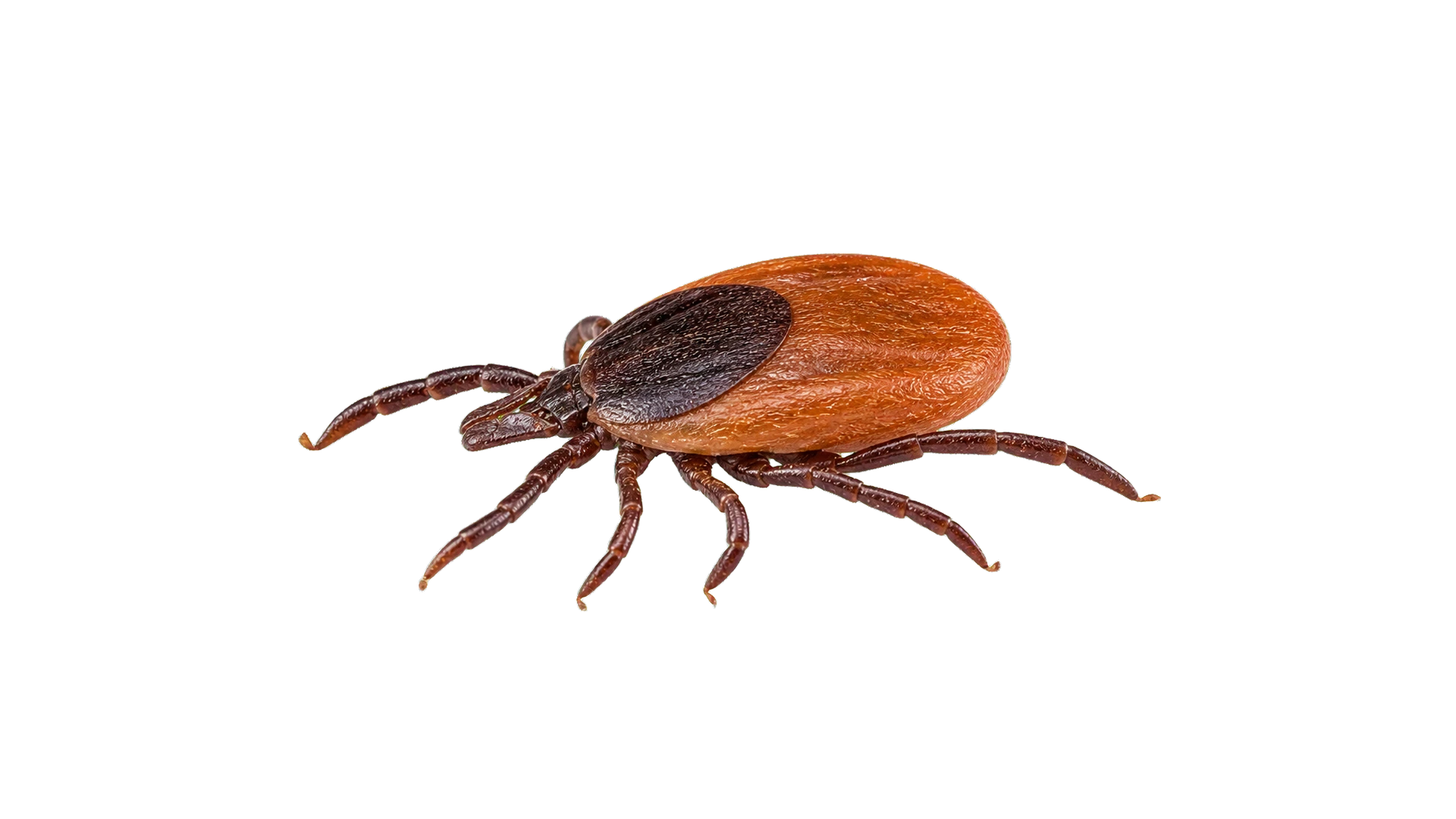
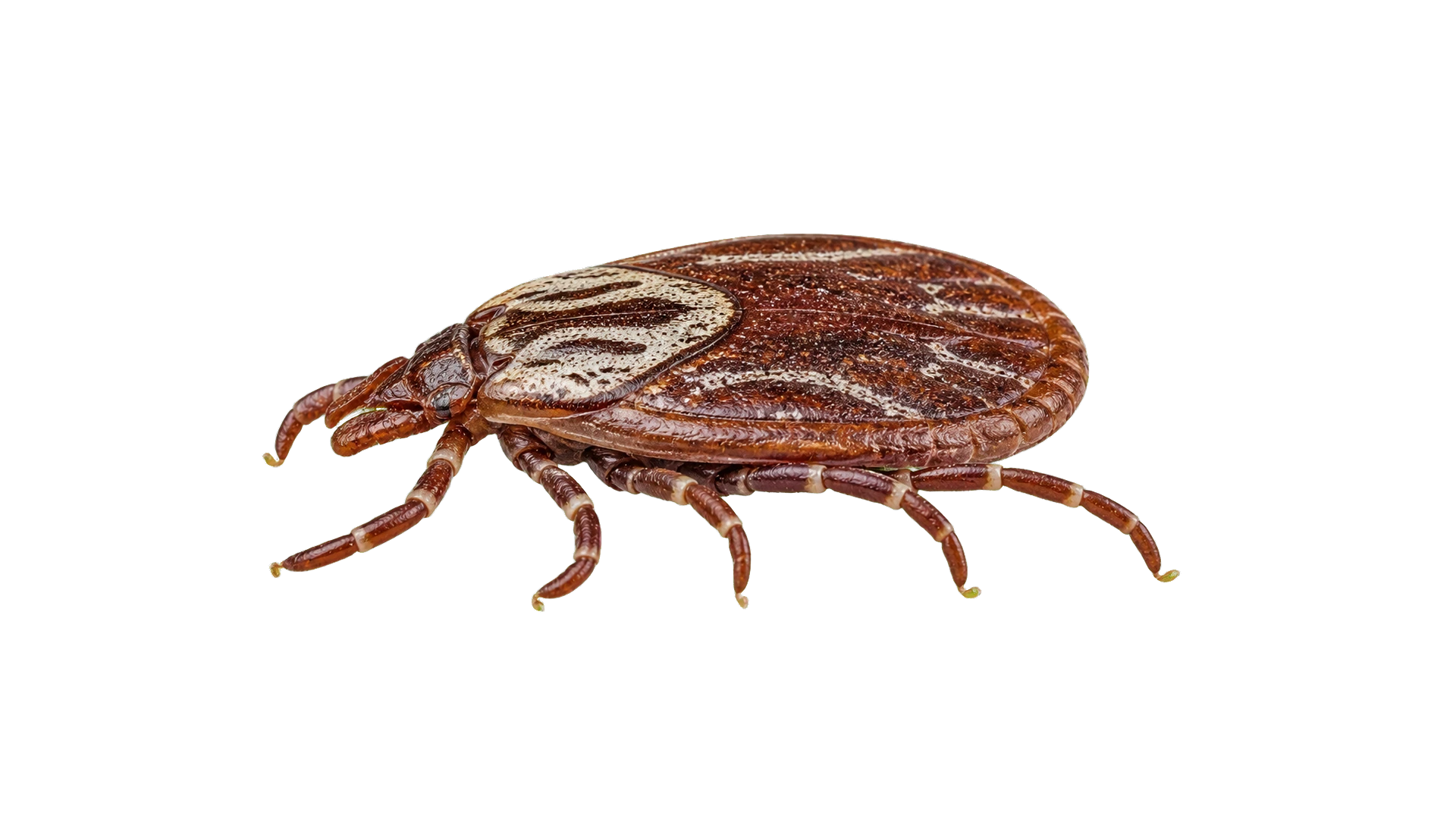
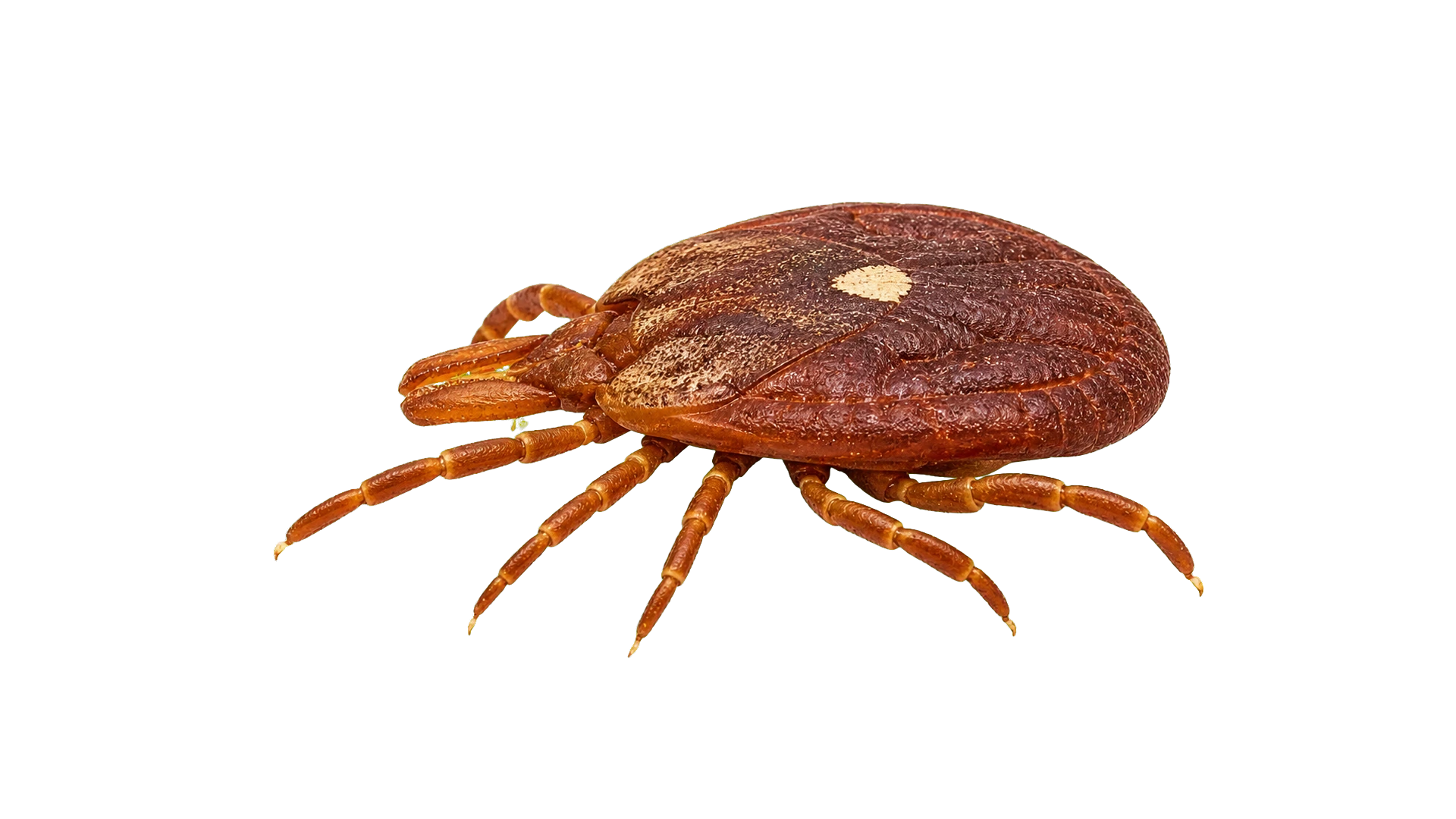
Most US ticks are reddish-brown, brown, or black. Lone star ticks show a white dorsal spot. American dog ticks display white-and-brown ornate patterns. Color combined with size narrows the species.
Tick encounters go unnoticed because the bite itself is painless and ticks anchor in spots homeowners rarely inspect. Most pathogen transmission happens after 24 to 48 hours of attachment. Daily tick checks during exposure season are the single most effective personal protection layer.
Three species drive nearly every reported case in the US. Deer ticks (black-legged ticks) carry Lyme disease, anaplasmosis, and babesiosis across the Northeast and Upper Midwest. Lone star ticks transmit ehrlichiosis and the alpha-gal red-meat allergy across the Southeast. American dog ticks transmit Rocky Mountain spotted fever across most of the country.
Knowing the species changes the disease watch period. Bull's-eye rash within 30 days points to Lyme from a deer tick. Sudden fever and headache within 14 days points to RMSF from a dog tick. The 24- to 72-hour attachment window is when prompt removal makes the most difference, so check daily and pull anything attached.
How a Tick Encounter Unfolds
Ticks are obligate blood feeders. They progress through four life stages (egg, larva, nymph, adult) and require a blood meal to molt between each stage. Larvae and nymphs feed on small mammals (mice, chipmunks, birds); adults feed on larger hosts (deer, dogs, humans). Each life stage takes one blood meal and then drops off to molt or lay eggs, which is why tick encounters are pulses across a season rather than continuous exposure.
The disease transmission concern centers on what diseases the host the tick previously fed on was carrying. Black-legged ticks (deer ticks) feed on white-footed mice as nymphs, which often carry the Lyme bacterium; the tick then transmits to humans during the adult feeding. Lone star ticks transmit ehrlichiosis and the alpha-gal allergy. American dog ticks transmit Rocky Mountain spotted fever. Identifying the species changes the disease watch significantly.
Effective tick control is a property-level program that addresses the wildlife hosts, the humid harborage, and the edge habitat where ticks transition from the woods to the lawn. Personal protection (repellent, covered clothing, daily checks) is the second layer. Yard treatment focused on edge zones and harborage is the third. None of these alone is enough in high-pressure regions; together they reduce exposure by 80+ percent.
Six features that define a hard tick (the family that includes most US disease-vector species).
Eight legs, attached near the front of the body. Primary diagnostic vs insects (six legs). Larvae have six legs; adults and nymphs have eight.
Capitulum (head and mouthparts) and idiosoma (body) connect without a waist. The whole organism looks like a single oval with mouthparts protruding.
Barbed feeding shaft that anchors the tick in skin. Backward-pointing barbs make removal difficult; pulling at the wrong angle leaves it embedded.
Hard plate on the front-top of the body. Covers the entire male dorsum; covers only the front in females, letting the abdomen expand during feeding.
Breathing pores beside the hind legs. Position and pattern serve as species-level diagnostic in close inspection under magnification.
Rectangular notches along the rear body edge in many hard tick species. Festoon pattern plus scutum shape distinguishes closely-related species.
Choose what you've found or noticed; each option points to a different stage of tick exposure.
Ticks split urgency between two clocks. A single bite can transmit Lyme, Rocky Mountain spotted fever, or alpha-gal in 24 to 72 hours of attachment. Yard infestations build across weeks of exposure. The timeline below covers both clocks separately.
A tick is found attached to skin or pulled off a pet. Disease transmission risk increases sharply after 36 hours of attachment. Removal technique and species ID matter more than panic right now.
Symptoms can appear 3 to 30 days after a bite. A bull's-eye rash, fever, joint pain, or extreme fatigue means medical care this week, not next month. Most tick-borne disease responds well to early antibiotics.
Multiple ticks found on family members or pets in one season. Wildlife traffic (deer, mice, rabbits) is bringing ticks to the property. DIY perimeter treatment helps but is rarely complete without habitat work.
Tick exposure recurs spring through fall, multiple family members pick up ticks, or you live in a high-Lyme region (Northeast, Upper Midwest). Prevention is now a yearly program, not a one-time treatment visit.
Tick urgency splits between the bite clock (hours to weeks) and the yard clock (months to years). Both matter, and each needs a different response. Treat them as separate problems running on separate timelines.
Local tick specialists know the regional species pressure, the disease risks, and where ticks concentrate on residential properties. Yard treatment that's actually targeted.
Ticks do not pick yards at random. They follow signals: a wooded edge within 50 feet of the lawn, leaf litter banked against fence lines, a bird feeder that draws the white-footed mice that feed nymph-stage ticks. A single mouse can host 50 to 100 larval ticks during a summer, and any property that lets mice nest within 10 feet of the lawn becomes a tick nursery.
Different tick species chase different hosts and signal different diseases, which is why ID matters. Deer ticks (Ixodes scapularis) carry Lyme, anaplasmosis, and babesiosis, and concentrate in Northeast and Upper Midwest yards with deer and mouse pressure. Dog ticks (Dermacentor variabilis) carry Rocky Mountain spotted fever and prefer tall grass and dogs across most of the eastern US. Lone star ticks (Amblyomma americanum) carry ehrlichiosis and the alpha-gal red meat allergy and dominate Southeast and South-Central yards with heavy deer pressure. Knowing the species tells you which test to ask for after a bite.
Most affected yards have two or three of these conditions running at once, and habitat trimming is the breeding-source fix that beats spray every time. Start with the highest-leverage barrier: rake leaf litter from a 10 foot perimeter strip around the lawn, install a 3 foot wood-chip or gravel barrier between woods and lawn, and pull bird feeders for 30 days during peak nymph activity in late May and June. Even partial wins help: a single 3 foot wood-chip barrier between woods and play area cuts tick crossings into the lawn by 50 to 80 percent, often within one season.
About 80 percent of yard tick exposure happens within 9 feet of wooded edges. Maintain a 3-foot bare-zone barrier and inspect this zone first.
Ivy, pachysandra, and other dense ground cover trap humidity and shelter ticks. Replace with low-water plants or maintain dryer alternatives where possible.
Accumulated leaves along fences, under decks, and at the foundation perimeter are prime tick harborage. Clear seasonally; don't let leaf litter overwinter against the house.
Mice and chipmunks (juvenile tick hosts) nest in stone walls and woodpiles. The mice carry tick larvae; the larvae mature in the surrounding leaf litter.
Shaded north-facing foundation zones with leaf litter and ground cover host significant populations. Targeted treatment along this zone has high ROI.
Any unmown zone is a tick reservoir. Maintain mowing on regular schedule; if a zone is intentionally unmown for ecological reasons, keep it well-separated from human-traffic areas.
Why a single deer crossing the yard can leave dozens of nymph ticks in your lawn the following spring.
Weeks to months
Females lay 1,500 to 3,000 eggs in leaf litter or soil after one blood meal, then die. Eggs hatch in spring or summer.
1 blood meal
Six-legged larvae feed once on a small host (mouse, bird, lizard) for 2 to 4 days, then drop off to molt.
1 blood meal
Eight-legged nymphs are the dangerous stage for human disease transmission. Tiny (1 to 2 mm) and responsible for most Lyme cases because they go undetected.
1 blood meal
Adults feed on large hosts (deer, dogs, livestock, humans). Females expand dramatically while feeding, then drop off to lay eggs. Males die after mating.
The full lifecycle from egg to next-generation egg takes 2 to 3 years for most species. The two-year timeline is why yard treatment compounds across seasons: each year of treatment suppresses the population entering the next year, and the cumulative effect across 2 to 3 years is dramatic.
Tick species carry different disease risks. Match what you're seeing to identify which one.
| Species | Severity | Key Sign | Where You'll Find Them |
|---|---|---|---|
| Deer Ticks | Medical | Bull's-eye rash after bite (Lyme disease indicator), found in wooded leaf litter | leaf litter, wooded areas, tall grass |
| Dog Ticks | Medical | Engorged ticks found on pets, common near trails and grassy areas | grassy areas, roadsides, trails |
| Lone Star Ticks | Medical | Aggressive biters, associated with alpha-gal syndrome (red meat allergy) | wooded areas, tall grass, brush |
Severity reflects typical impact, not your specific case. If unsure, treat at the higher tier.
Honest read on common tick prevention tactics. Effective tick control is layered (personal, pet, property); single-layer plans leave significant exposure.

 Maintain a 3-foot bare-zone barrier of mulch or gravel between lawn and wooded edges Mow lawn short, clear leaf litter, replace dense ground cover near lawn Reduce wildlife harborage: woodpiles, brush piles, bird feeders that draw rodents Permethrin treatment of outer clothing (NOT skin) lasts through 5 to 6 wash cycles Provides excellent protection during outdoor activity in tick-pressure zones Safer than DEET for sustained outdoor work; does not transfer to skin meaningfully Pro-grade yard treatment focused on edges and harborage zones, applied 2 to 3 times per season Year-round pet tick medication on every pet (modern oral or topical products) Combined approach reduces yard exposure by 80+ percent in high-pressure regions
  DEET on skin provides several hours of repellent effect against ticks already on you Does not address yard or pet population sources Useful as personal protection layer; not a control method Pyrethroid sprays kill questing ticks contacted directly Effect lasts 30 to 90 days; reapplication needed across the season Single-application without ongoing program leaves large windows of exposure Burning, smothering, twisting, or yanking the tick increases pathogen transmission risk by stressing the tick Tick-removal myths are responsible for many preventable disease cases Correct technique (fine-tipped tweezers, steady straight pull) takes 30 seconds
 Six prevention actions. Tick control layers personal, pet, and property protection; each one contributes meaningful reduction.

After every outdoor session in tick country, check the whole body within 2 hours. Most disease transmission requires 24 to 72 hours of attachment, so quick removal cuts Lyme risk to near zero.

Monthly oral or topical tick prevention dramatically reduces attached ticks on pets. Maintain through winter because tick activity continues at lower levels in heated regions year-round above 40 degrees Fahrenheit.

Bare zone of mulch or gravel between mowed lawn and wooded edges. Ticks rarely cross dry sun-exposed gaps. This single zone cuts yard penetration by an order of magnitude on most properties.

Annual spring cleanup of leaf litter along fence lines, foundation perimeter, and yard edges removes the humid harborage ticks rely on between feedings. Single highest-impact cultural change.

Move woodpiles 20+ feet from the house and elevate. Skirt under-deck spaces. Position bird feeders away from the main yard. Each step reduces the rodent population that sustains tick larvae.

Targeted edge-zone pyrethroid 2 to 3 times per active season. Worth it for properties with significant outdoor exposure or households inside high-Lyme regions of the Northeast and Upper Midwest.
Tick activity peaks twice per year for most species: spring (adults emerging) and late summer/fall (nymphs active). Different stages, different exposure profiles.
Adult ticks emerge from overwintering and begin questing. Adult bites are easier to spot because the ticks are larger. Spring is also nymph emergence season for many species; nymphs are tiny and harder to detect, accounting for most Lyme disease transmission.
Nymph activity peaks in mid-to-late summer. Adult populations decline as the spring cohort completes its blood meals. Summer is the highest-risk season for Lyme disease specifically because nymph attachments are often missed.
Adult tick activity resumes in many species. Lone star ticks, American dog ticks, and brown dog ticks remain active well into fall. Outdoor activity in tall grass or brushy areas continues to require precautions.
Activity drops in cold regions but doesn't stop entirely; ticks can quest on warm winter days when temperatures rise above 40 degrees Fahrenheit. Year-round pet tick medication is essential because any warm spell can produce active ticks.
Four steps from arrival to a yard with measurably lower tick pressure. Initial visit runs 60 to 90 minutes; results follow across 2 to 4 weeks.
Edges, harborage, hosts. Real tick control treats the lawn-to-woods edge, eliminates harborage, and addresses wildlife host pressure. Blanket spraying without that targeting is wasted product.
Walk the property to identify edge zones, harborage areas, and wildlife pressure. Map exposure zones so treatment targets the 9-foot edge band rather than blanket-applying yard-wide.
Pyrethroid or other pro-grade product applied to the lawn-to-woods transition, ground cover beds, and shaded foundation perimeter. Each application lasts 30 to 90 days against questing ticks.
Document the leaf litter, ground cover, woodpile, and bird feeder conditions sustaining population pressure. Property-owner action on these drives the long-term reduction.
Re-treatment 2 to 3 times across the active season (spring, mid-summer, early fall). Cumulative across-season effect cuts pressure 80 percent by year two.
Real stories from households who connected with tick specialists to reduce yard pressure and protect families and pets.

"Yard tick activity reduced all summer."
With Lyme disease common in Connecticut, we wanted our yard treated for ticks. The crew applied perimeter treatments and recommended reducing leaf litter where ticks thrive. The reduction in tick activity was noticeable all summer.
"Yard tick activity reduced all summer."
With Lyme disease common in Connecticut, we wanted our yard treated for ticks. The crew applied perimeter treatments and recommended reducing leaf litter where ticks thrive. The reduction in tick activity was noticeable all summer.

"Wooded yard cleared and tick habitat reduced."
Our property borders woods and tick exposure was a constant worry. The provider treated the yard perimeter and the leaf-litter transition zone. They recommended keeping the lawn trimmed short near the treeline to reduce tick habitat.

"Backyard tick activity cut sharply."
With Lyme disease common in Massachusetts, we needed yard tick control. The provider treated the perimeter and transition zones between lawn and woods. They recommended keeping leaf litter cleared and grass trimmed short.

"Wooded property tick activity brought down."
With wooded property, tick exposure was a daily worry. The provider treated the yard perimeter and transition zones. Keeping grass trimmed and leaf litter cleared near the house helped significantly.

"Wooded-yard tick habitat brought down."
Lyme disease is common in New Hampshire and ticks were a constant concern. The provider treated the yard perimeter and brush line. Keeping the lawn trimmed short near the woods helped reduce tick habitat.

"Wooded lot tick habitat reduced."
With Lyme disease concerns, tick control was a priority. The provider treated the yard perimeter and transition zones. Keeping the lawn trimmed and leaf litter cleared reduced tick habitat.

"Yard tick activity reduced significantly."
Pulled three deer ticks off the dog in one week last May and one off my son's neck. Adjacent state park land means tick pressure is no joke around here. The tech treated the yard perimeter and the woodline transition. He told me to bag and remove leaf litter near the house, which I had been raking right into the woods. Big difference this summer.

"Yard tick habitat reduced significantly."
Pulled an engorged tick off the dog's neck in May and that was the last straw. Two friends in town have had Lyme disease and I was not going to risk it with the kids. The tech treated the woodline transition and the yard perimeter. He told me to keep the grass trimmed short within ten feet of the woods, which I have been religious about. Tick checks have come up clean all summer.
Direct answers to what homeowners ask most about tick exposure and removal.
Use fine-tipped tweezers. Grasp the tick as close to the skin as possible, gripping the head or mouthparts (not the body). Pull straight up with steady, even pressure. Do not twist, jerk, or yank quickly; this can cause the mouthparts to break off. Do not use folk methods like burning the tick with a match, smothering with petroleum jelly or nail polish, or coating with hot oil; these stress the tick and increase the risk of pathogen transmission by causing it to regurgitate into the bite site. After removal, clean the bite site and your hands with rubbing alcohol or soap and water. Save the tick in a sealed bag with a damp cotton ball and refrigerate; if symptoms develop in the next 30 days, the tick can be tested. If the head breaks off and stays embedded, leave it; the body will work it out naturally.
Most research indicates Lyme disease transmission requires the tick to be attached for at least 24 hours, with risk increasing substantially after 36 to 48 hours of attachment. Other tick-borne diseases have different transmission timelines: anaplasmosis and ehrlichiosis can transmit in as little as 6 to 12 hours; Powassan virus can transmit in as little as 15 minutes. The practical takeaway: prompt removal matters significantly for Lyme prevention but is less protective for some other diseases. The most reliable protection is preventing attachment in the first place through repellent use, daily tick checks during exposure season, and yard exposure reduction. If you find an attached tick that may have been on for more than 24 hours, contact a healthcare provider; in some cases prophylactic antibiotic treatment is appropriate.
Routine testing is not generally recommended after a tick bite without symptoms. Most labs recommend waiting until symptoms emerge or 4 to 6 weeks after the bite, because tick-borne diseases require time to produce detectable antibodies and very early testing often returns false negatives. The exception is high-risk situations: tick attached for more than 36 hours, tick from a high-Lyme region, immunocompromised patient, or a pediatric or pregnant patient. In those cases, a healthcare provider may recommend prophylactic antibiotic treatment without waiting for testing. Watch for symptoms in the 30 days after a bite: bull's-eye rash, fever, fatigue, joint pain, or unusual headaches. Any of these in the post-bite window warrants a same-week medical visit.
Yes, in several ways. Pets contract Lyme disease (especially dogs), ehrlichiosis, anaplasmosis, and Rocky Mountain spotted fever from tick bites. Pets are also major tick transport into the home; a pet that walks through tick-pressure zones can bring multiple ticks indoors per outing. Veterinary-grade monthly tick prevention is the most reliable layer; modern oral and topical products dramatically reduce tick attachment. For dogs, regional Lyme vaccination is also worth discussing with your vet in high-pressure areas. Daily tick checks on pets after outdoor time should focus on ears (inside and at the base), between toes, around the muzzle, in armpits, and along the belly. Removing attached ticks within 24 hours dramatically reduces disease transmission risk for pets just as it does for humans.
Two approaches work in combination. On skin: DEET (20-30 percent concentration) or picaridin (20 percent) provide 4 to 8 hours of protection against tick attachment. Both have decades of safety data and are recommended by the CDC. On clothing: permethrin treatment of outer clothing (NOT skin) lasts through 5 to 6 wash cycles and provides excellent protection during outdoor work. Permethrin kills ticks on contact rather than just repelling, making it more effective for sustained outdoor activity. Combining permethrin-treated clothing with DEET or picaridin on exposed skin is the gold standard for high-pressure exposure (hiking, camping, yard work in tick country). Natural repellents like oil of lemon eucalyptus provide some protection but generally weaker than DEET; not recommended for known high-pressure exposure.
Five layered actions. First, mow lawn short and maintain a 3-foot bare-zone barrier of mulch or gravel between mowed lawn and any wooded edge or dense ground cover; ticks rarely cross dry sun-exposed gaps. Second, clear leaf litter along fences, foundations, and yard edges in spring and fall. Third, replace dense ground cover (ivy, pachysandra) along the lawn edge with low-water alternatives or maintain dryer alternatives. Fourth, reduce wildlife harborage: move woodpiles 20+ feet from the house and elevate, position bird feeders away from main yard, skirt under-deck spaces. Fifth, professional yard tick treatment 2 to 3 times per active season in high-pressure regions. Each layer alone provides modest reduction; combined, they reduce yard exposure by 80 percent or more.
Yes. Alpha-gal syndrome (AGS) is a delayed allergic reaction to red meat (beef, pork, lamb) caused by a sugar molecule called alpha-gal that's introduced into the body through bites from the lone star tick. After a sensitizing bite, the immune system can react severely 2 to 6 hours after eating red meat, with hives, gastrointestinal symptoms, or in severe cases anaphylaxis. The condition is most common in the southeastern and south-central US where lone star ticks are abundant, but cases have been documented across most of the eastern half of the country as the lone star tick's range expands. Diagnosis requires a specific blood test (alpha-gal IgE). Symptoms can persist for years; some patients recover gradually if they avoid further tick bites. Tick prevention is the only known way to avoid developing AGS.
Targeted edge-zone treatment, habitat modification recommendations, seasonal follow-up. Local tick specialists handle the integrated plan.
Click through to species pages for behavior, regional patterns, and disease vector specifics.
The primary carrier of Lyme disease in the northeastern and upper midwestern United States.
Deer ticks, also called blacklegged ticks, are the main vectors of Lyme disease, anaplasmosis, and babesiosis. Nymphs are as small as a poppy seed, making them extremely difficult to detect on skin and clothing. They are most active in spring and fall and are commonly found in leaf litter, tall grass, and along woodland edges near residential properties.
Quick ID:
Why it matters:
Brown ticks that attach to pets and can transmit Rocky Mountain spotted fever.
American dog ticks are among the most commonly encountered tick species and are the primary vector for Rocky Mountain spotted fever and tularemia. They are most active from April through August in grassy fields, roadsides, and recreational trails. Dogs are particularly vulnerable hosts, but these ticks readily attach to humans as well. Regular pet treatments and yard management help reduce exposure risk.
Quick ID:
Why it matters:
Aggressive ticks that can trigger a red meat allergy in bite victims.
Lone star ticks are aggressive, fast-moving ticks identified by the single white dot on the female's back. They are the primary vector for ehrlichiosis and STARI (Southern Tick-Associated Rash Illness), and their bites can trigger alpha-gal syndrome, an allergy to red meat and mammalian products that develops weeks after the bite. They are expanding their range northward from the southeastern United States.
Quick ID:
Why it matters: