Egg
About 30 to 60 days
Female adults lay 4,000 to 6,500 eggs in masses on the ground (or indoors for brown dog ticks) after their final blood meal. Eggs hatch into six-legged larvae that immediately seek small mammal hosts.
Local pest control help is one call away.
 Pest Control Services Nationwide Pest Control Services Nationwide
 American dog ticks (Dermacentor variabilis) are noticeably larger than deer ticks, 3 to 5 millimeters unfed and 10 to 15 millimeters engorged, with a brown body and the species' signature ornate pale-white markings on the male shield or pale-yellow markings on the female scutum. They're found across the entire US east of the Rocky Mountains plus parts of the Pacific Northwest and California. The single most important fact about this tick: it's the primary vector for Rocky Mountain spotted fever, which has a 5 to 10 percent fatality rate untreated, far deadlier than Lyme disease, which dog ticks do not transmit at all.
If you're finding large brown ticks with white or yellow shield markings on your dog, your kids, or yourself after time outdoors, you have American dog ticks rather than deer ticks. This guide covers identification, why this species carries different diseases, how the related brown dog tick can take over a house, and what professional treatment involves.
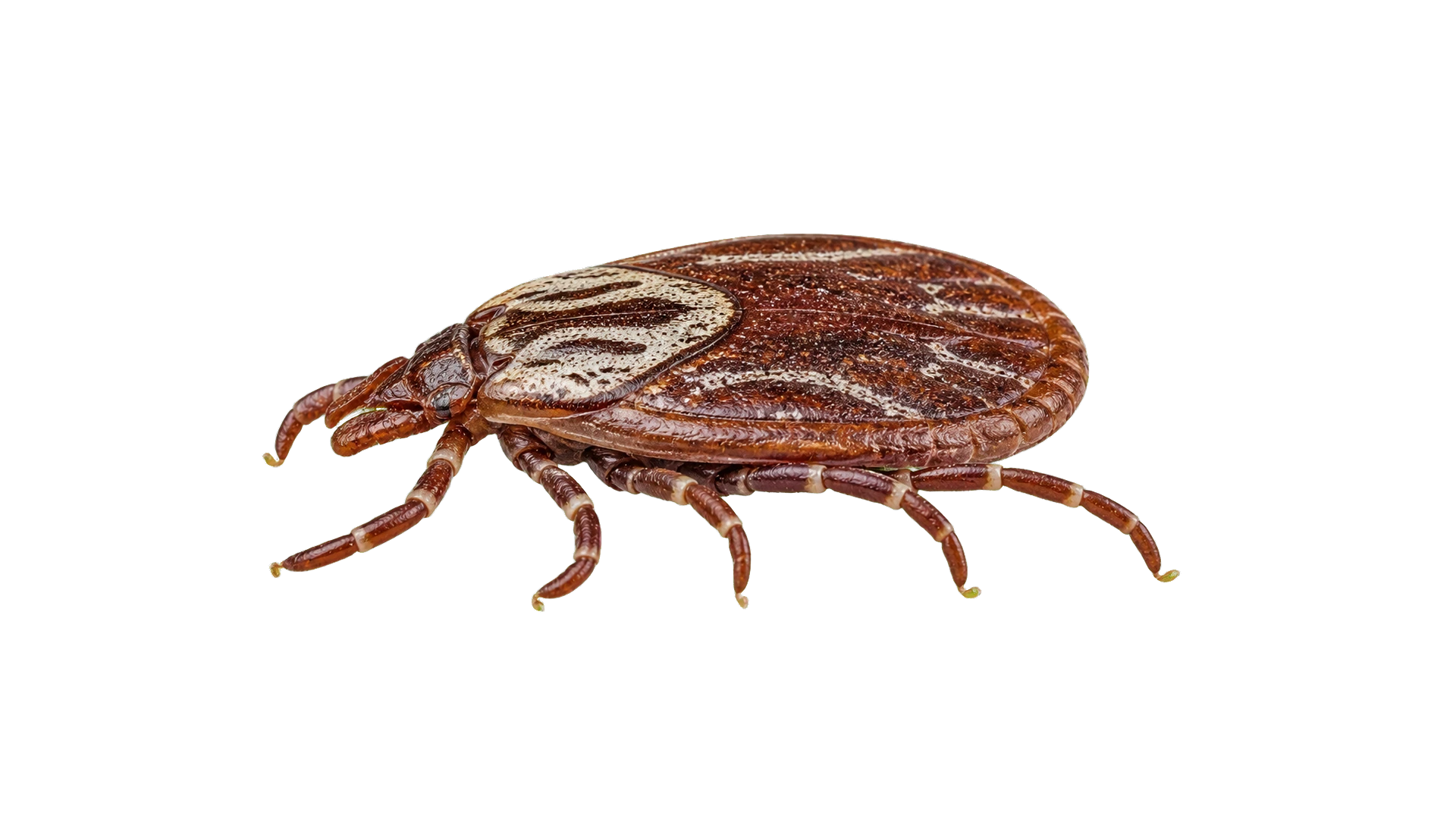
ID Card: American Dog Tick
Related Species
Call to get matched with a local pest control pro.
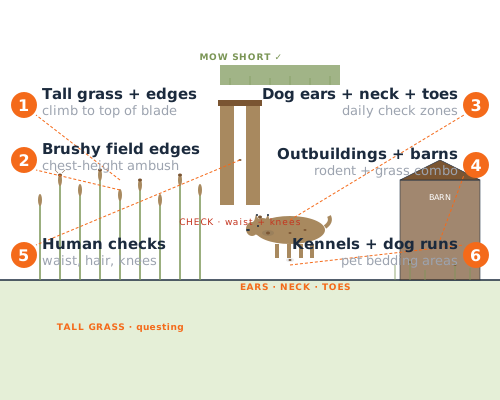
American dog ticks wait on grass blades and brush for passing hosts; the brown dog tick (a close relative) can live entirely indoors and is the only US tick that establishes year-round in homes and kennels. Knowing the difference between the two tells you whether the problem is outside, inside, or both:
Dog ticks transmit Rocky Mountain spotted fever (5 to 10 percent fatality untreated, 0.5 percent with prompt doxycycline), tularemia, ehrlichiosis, and occasionally tick paralysis. They do not transmit Lyme disease, that's the deer tick. Brown dog ticks indoors are a separate problem entirely, a single infested dog can seed thousands of ticks throughout a home, and the infestation can persist year-round in heated spaces. Yard treatment, indoor treatment when needed, vet-prescribed pet tick prevention, and personal protection together cut exposure dramatically.
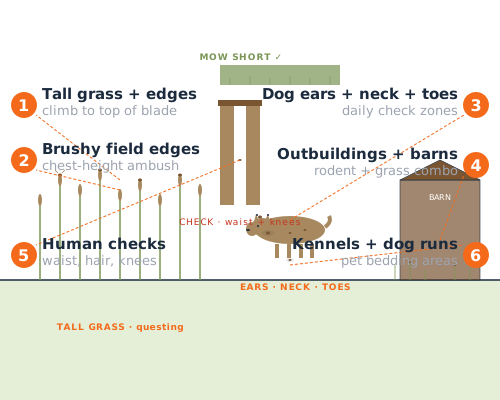
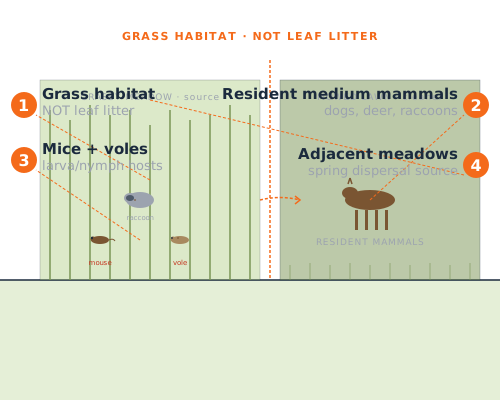
Spotting one is step one. Understanding what's bringing them to your property, or letting them establish inside your home, is what shapes a treatment plan that actually works. American dog ticks need outdoor grass habitat and host animals; brown dog ticks need a dog and a warm indoor space. Most properties produce ticks for one specific reason, and the fix depends on which species and which habitat.
What sustains dog ticks on your property:
American dog ticks have a 2-year, 3-host lifecycle: larvae feed on rodents, drop off, molt to nymphs that feed on small mammals, drop off, molt to adults that feed on dogs and humans. Brown dog ticks are different, they can complete the entire lifecycle indoors on a single dog, with no outdoor stage required. That's why a brown dog tick infestation in a heated home can grow year-round and is the only US tick capable of establishing persistent indoor populations.
Find your scenario below. Severity reflects exposure, time since attachment, and the difference between outdoor and indoor populations.
| What You're Seeing | Severity | If Untreated | Next Step |
|---|---|---|---|
| One tick spotted on a person or pet, found and removed quickly | Early | Risk is low if removed within 24 hours; save the tick in a sealed bag for ID if symptoms develop | Remove with fine-point tweezers at the head, monitor the bite site for 14 days, watch for fever or rash. |
| Tick attached over 24 hours after outdoor exposure in RMSF range | Moderate | Transmission risk rises with attachment time; RMSF symptoms typically appear 2 to 14 days after the bite | Call your physician about doxycycline prophylaxis. Save the tick for ID if possible. |
| Fever, headache, or spotted rash on wrists or ankles after recent tick exposure | Urgent | Possible Rocky Mountain spotted fever; untreated cases can be fatal within 8 days of symptom onset | Emergency medical evaluation today. Doxycycline started within 5 days has an excellent prognosis. |
| Multiple ticks in the house on baseboards, in dog bedding, or walking on walls | Urgent | Brown dog tick indoor infestation; population multiplies year-round in heated spaces and can reach the thousands | Call a professional today. Indoor treatment requires acaricide plus IGR plus thorough vacuum, vet tick control on every pet. |
RMSF doxycycline started within the first 5 days of symptoms has an excellent prognosis. If you're between two rows, treat the higher one as your situation.
American dog ticks have a 2-year, 3-host lifecycle in which each stage feeds on a different size of mammal. Brown dog ticks can complete the entire cycle indoors on a single dog, which is how an indoor infestation grows so fast in a heated home.
About 30 to 60 days
Female adults lay 4,000 to 6,500 eggs in masses on the ground (or indoors for brown dog ticks) after their final blood meal. Eggs hatch into six-legged larvae that immediately seek small mammal hosts.
Feeds for 3 to 4 days, then molts to nymph
Larvae feed primarily on white-footed mice, meadow voles, and other small rodents. They rarely contact humans at this stage. After feeding they drop off, molt, and become eight-legged nymphs.
Feeds for 5 to 8 days on small mammals
Nymphs feed on slightly larger mammals (rabbits, raccoons, opossums). After feeding they drop off the host and molt to adults. Like the larval stage, nymph bites on humans are uncommon, though indoor brown dog tick nymphs may feed on dogs.
Active spring through fall; can survive up to 2 years without a meal
Adults seek dog-sized hosts: dogs (preferred), humans, deer. Females mate on the host, drop off after feeding, and lay eggs to start the next cycle. Almost all human bites and disease transmission happen at this stage.
The American dog tick's 2-year lifecycle means yard treatment needs to be sustained across multiple seasons to reduce the population significantly. The brown dog tick can complete its entire indoor cycle in as little as 2 months in a warm home, which is why an indoor infestation can grow from a few visible ticks to thousands within a single season if untreated.
American dog tick activity peaks April through September outdoors. Brown dog ticks indoors stay active year-round in heated homes regardless of weather. Knowing both rhythms tells you when yard treatment matters most and when an indoor infestation can keep growing all winter.
Adult American dog ticks emerge from overwintering in March and April and start questing in tall grass for passing hosts. This is the peak activity window for the start of the disease-transmission season. Late April through May is the prime treatment window for outdoor yard work.
Continued adult activity through August. Dog walks, hiking, and yard work all carry the highest exposure now. Personal protection (DEET, permethrin-treated clothing, daily tick checks) carries the bulk of the load. Indoor brown dog tick populations grow fastest in summer heat.
Outdoor adult activity tapers through September and largely stops by October. Indoor brown dog tick populations continue growing in heated homes. Fall is the right time for habitat reduction work, mowing, brush clearing, leaf cleanup, because adults are less active.
Outdoor American dog ticks overwinter and there's no surface activity in cold weather. Indoor brown dog tick infestations stay fully active year-round in heated spaces and reproduce continuously. A visible tick indoors in winter almost always means an established indoor population.
American dog ticks transmit Rocky Mountain spotted fever (5 to 10 percent fatality untreated versus 0.5 percent with prompt doxycycline), tularemia, ehrlichiosis, and tick paralysis. They do not transmit Lyme disease, that's the deer tick. RMSF is concentrated in the eastern and central US, not the Rocky Mountains primarily despite the name, and a household with kids, outdoor dogs, hikers, or hunters in this range has a real medical reason to take dog ticks seriously.
Brown dog ticks are a separate problem with separate severity. They're the only US tick capable of completing the entire lifecycle indoors, which means a single infested dog returning from boarding, grooming, or a tick-heavy environment can seed an indoor infestation that grows to thousands of ticks within months. Treating brown dog ticks indoors requires a coordinated indoor pesticide program with an insect growth regulator, plus thorough vacuum work, plus pet tick prevention from the vet. Yard treatment alone does nothing for this scenario.
DIY tick control runs into two specific failures. First, homeowners treat the wrong zones, the lawn rather than the grass and brush edges where American dog ticks wait, or the yard rather than the baseboards where brown dog ticks hide. Second, they miss the pet tick prevention layer, which catches what makes it past yard treatment and stops the dog from carrying ticks back into the house. Hardware-store products applied without these adjustments produce limited results.
Professional yard treatment runs $250 to $600 per visit; indoor brown dog tick infestations cost $400 to $1,500 depending on severity and home size. Combined with vet-prescribed pet tick control, this can reduce tick exposure dramatically through the active season. The economics make sense when the alternative is a serious illness or a year-long indoor infestation.
Dog tick work splits into two very different jobs: outdoor yard treatment for American dog ticks, and indoor remediation when brown dog ticks have established inside a home. A specialist who works with both knows which is which and treats accordingly. Here's what that looks like:

 Identifies the Species First
 American dog tick or brown dog tick changes the whole approach. Ornate pale-white markings on the shield versus a plain brown body tells the technician where treatment needs to focus, outside or inside.
Treats the Grass and Brush Zones Granular and liquid acaricide applied to tall grass, weedy edges, and the first 10 to 15 feet of brushy property line. Open mowed lawn doesn't host dog ticks and needs minimal product.
Handles Indoor Brown Dog Tick Infestations Indoor treatment is specialized: acaricide along baseboards and cracks, IGR to break the lifecycle, and thorough vacuuming of bedding, carpet edges, and rest areas. Yard spray alone won't touch an indoor population.
Coordinates with Your Vet Pet tick prevention from the veterinarian is the layer that catches what makes it past yard treatment. The specialist surfaces this rather than leaving it as something you have to figure out separately.

Personal protection and prompt tick removal are genuinely DIY work and the most effective single layers of defense. Yard treatment and indoor brown dog tick remediation are professional work because both require correct timing, correct zones, and species-specific products.
Personal protection prevents the bite that transmits the disease. The work is a daily habit during tick season, not a single treatment:
A pro builds a treatment plan around the species, the habitat, and whether the problem is outdoor, indoor, or both:
American dog ticks transmit Rocky Mountain spotted fever and other serious diseases, and brown dog ticks can establish year-round indoor infestations. Connect with a local specialist who handles both yard work and indoor remediation.
Real results from people who had the same problem and solved it.

"Yard tick activity reduced all summer."
With Lyme disease common in Connecticut, we wanted our yard treated for ticks. The crew applied perimeter treatments and recommended reducing leaf litter where ticks thrive. The reduction in tick activity was noticeable all summer.
"Yard tick activity reduced all summer."
With Lyme disease common in Connecticut, we wanted our yard treated for ticks. The crew applied perimeter treatments and recommended reducing leaf litter where ticks thrive. The reduction in tick activity was noticeable all summer.

"Wooded yard cleared and tick habitat reduced."
Our property borders woods and tick exposure was a constant worry. The provider treated the yard perimeter and the leaf-litter transition zone. They recommended keeping the lawn trimmed short near the treeline to reduce tick habitat.

"Backyard tick activity cut sharply."
With Lyme disease common in Massachusetts, we needed yard tick control. The provider treated the perimeter and transition zones between lawn and woods. They recommended keeping leaf litter cleared and grass trimmed short.

"Wooded property tick activity brought down."
With wooded property, tick exposure was a daily worry. The provider treated the yard perimeter and transition zones. Keeping grass trimmed and leaf litter cleared near the house helped significantly.

"Wooded-yard tick habitat brought down."
Lyme disease is common in New Hampshire and ticks were a constant concern. The provider treated the yard perimeter and brush line. Keeping the lawn trimmed short near the woods helped reduce tick habitat.

"Wooded lot tick habitat reduced."
With Lyme disease concerns, tick control was a priority. The provider treated the yard perimeter and transition zones. Keeping the lawn trimmed and leaf litter cleared reduced tick habitat.

"Yard tick activity reduced significantly."
Pulled three deer ticks off the dog in one week last May and one off my son's neck. Adjacent state park land means tick pressure is no joke around here. The tech treated the yard perimeter and the woodline transition. He told me to bag and remove leaf litter near the house, which I had been raking right into the woods. Big difference this summer.

"Yard tick habitat reduced significantly."
Pulled an engorged tick off the dog's neck in May and that was the last straw. Two friends in town have had Lyme disease and I was not going to risk it with the kids. The tech treated the woodline transition and the yard perimeter. He told me to keep the grass trimmed short within ten feet of the woods, which I have been religious about. Tick checks have come up clean all summer.
Direct answers to what homeowners ask most about identification, Rocky Mountain spotted fever, brown dog tick indoor infestations, and treatment.
American dog ticks (Dermacentor variabilis) are relatively large ticks, unfed adults are about 3/16 inch long (roughly the size of a small watermelon seed), witha distinctive flat, oval body that becomes dramatically engorged (swelling to 1/2 inch or larger) after feeding. Males have mottled gray-brown and white coloring over their entire back, while females have a dark brown body with a lighter-colored, ornate shield (scutum) behind the head. Dog ticks are frequently found on dogs, particularly around the head, ears, and between toes, and attach to humans during outdoor activity in grassy and brushy areas. They are larger and more heavily patterned than the smaller, darker deer ticks.
American dog ticks are the primary vector for Rocky Mountain spotted fever (RMSF), aserious and potentially fatal tick-borne illness characterized by fever, headache, and a spotted rash that typically appears two to five days after symptom onset. They also transmit tularemia (rabbit fever) and can cause tick paralysis, a condition where a neurotoxin in the tick's saliva causes ascending paralysis that resolves once the tick is removed. Rocky Mountain spotted fever is treatable with antibiotics but can be fatal if treatment is delayed, so any fever or rash following a tick bite should prompt immediate medical attention. Dog ticks are most active from April through August across the eastern two-thirds of the United States.
Ticks thrive in shaded, humid environments with access to animal hosts. Properties bordering wooded areas, with tall grass, leaf litter, or stone walls that harbor mice are prime tick habitat. White-footed mice are the primary reservoir for Lyme disease, so high mouse populations directly correlate with high tick populations. Maintaining a clear, dry perimeter around your home reduces tick encounters significantly.
Ticks transmit more diseases than any other pest in the U.S. Blacklegged ticks (deer ticks) carry Lyme disease, anaplasmosis, and babesiosis. Lone star ticks can trigger alpha-gal syndrome (red meat allergy). American dog ticks carry Rocky Mountain spotted fever. Prompt removal within 24-36 hours significantly reduces transmission risk for most tick-borne illnesses, so daily tick checks after outdoor activity are essential.
Most providers in our network can schedule an inspection within 24-48 hours. For urgent situations, likeactive structural damage or large colonies, same-week emergency service is often available. Response times depend on your location and the provider's current schedule.
Your provider inspects the property to identify the pest, locate nesting or entry points, and assess the scope of the problem. You get a clear explanation of what they found, what they recommend, and a written scope before any work begins.
Modern pest control products are designed to break down quickly after application and pose minimal risk to people and pets when applied correctly. Most providers ask you to keep kids and pets out of treated areas for 1 to 2 hours while the product dries, after which the area is generally safe again. Always confirm specific re-entry times with your provider, and let them know about pet birds, fish, or reptiles, since some treatments require extra precautions for those species.

Deer ticks (blacklegged ticks) are the primary vector of Lyme disease, which can cause chronic joint pain, neurological problems, and heart complications if untreated. They are extremely small, nymphs are the size of a poppy seed, making them easy to miss.
Learn More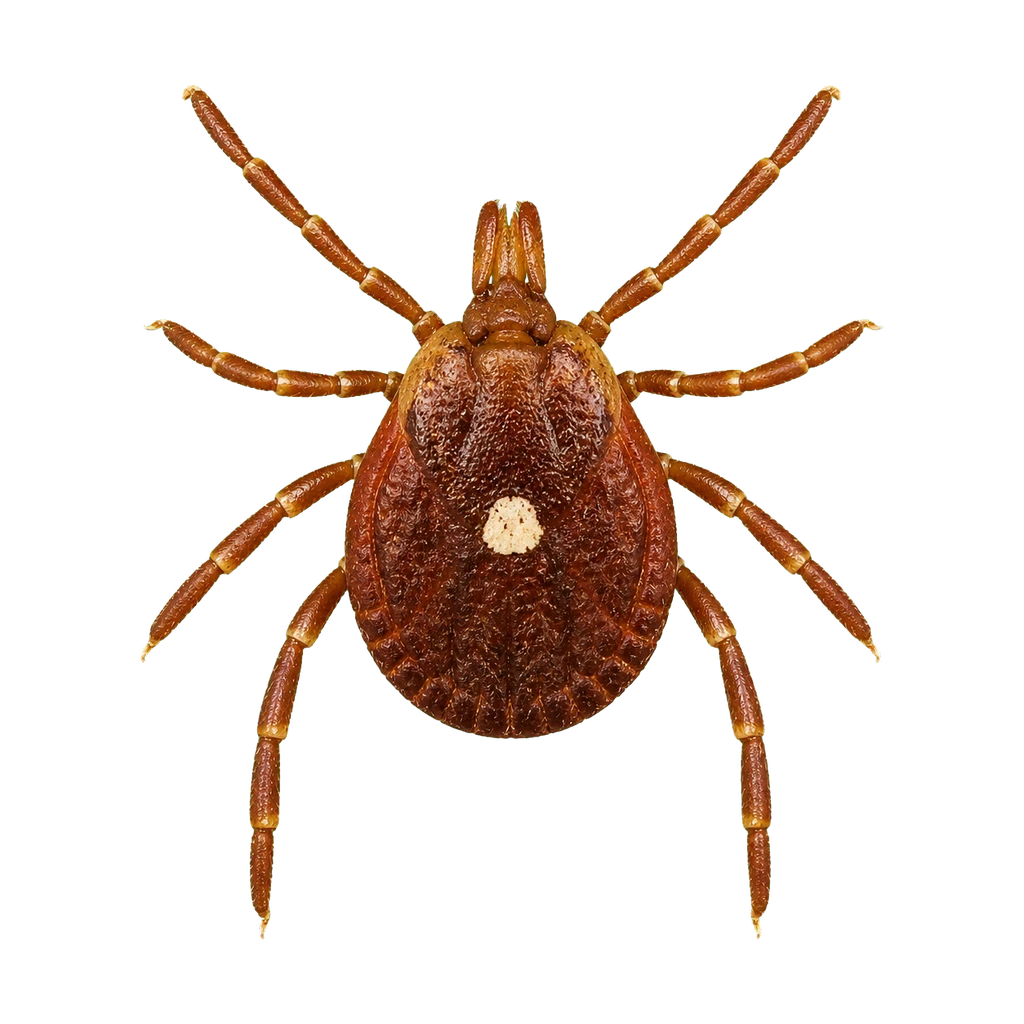
Lone star ticks are aggressive biters identified by the single white dot on the female's back, and their bites can trigger alpha-gal syndrome, an allergy to red meat. They are expanding their range northward and are active from spring through late fall.
Learn MoreLocal providers who handle American dog tick yard work and brown dog tick indoor infestations are ready to inspect, treat, and follow up, no obligation.