Local pest control help is one call away.

June Bug: Identification, Treatment & Prevention

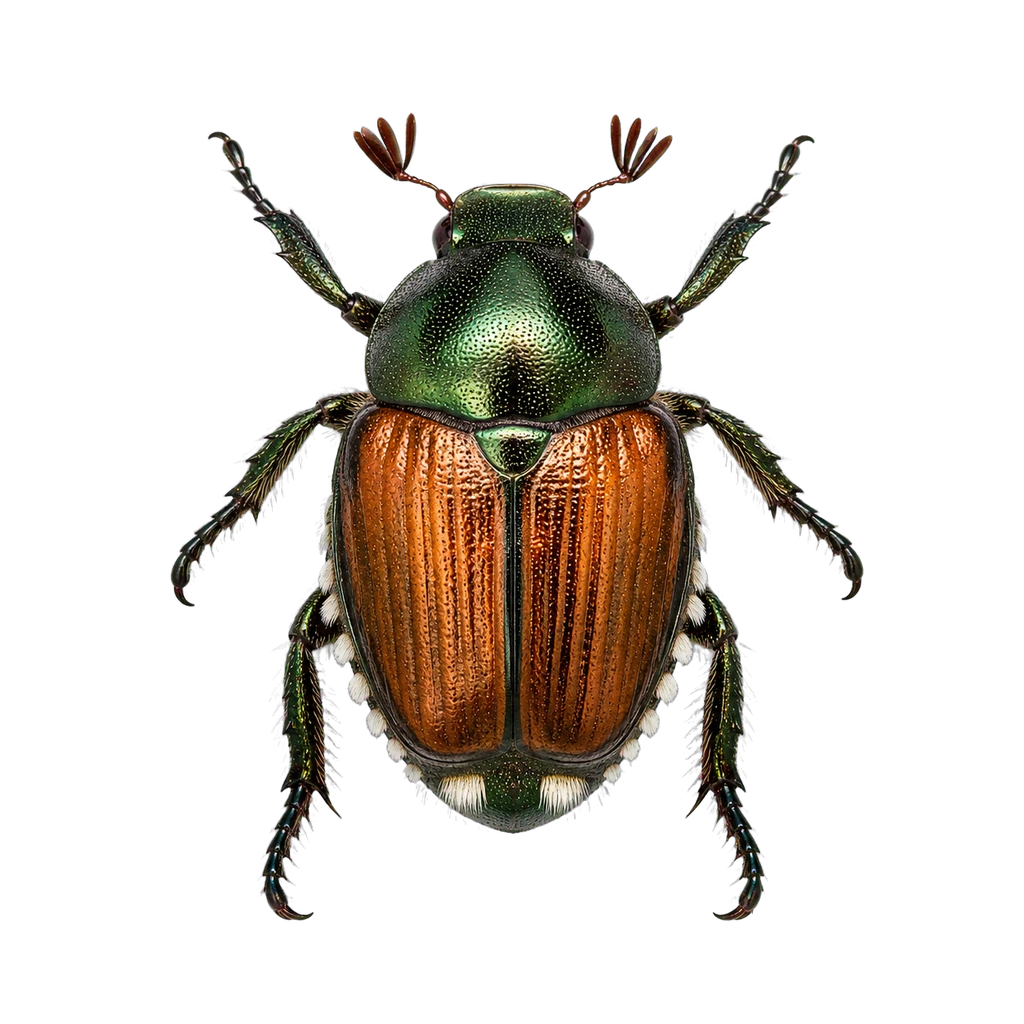
June bugs (also called May beetles) is the common name covering several large beetle species. True June beetles in the Phyllophaga genus are reddish-brown to dark brown and 10 to 25 millimeters long. The green June beetle (Cotinis nitida) has metallic green wings with tan-edged sides. All of them share the same field signature: large oval domed body, clumsy bumbling flight, and a nightly attraction to porch lights from May through August. Adults smack into windows and screens, collect at outdoor lights in dozens, and sometimes wander into the garage or house.

The damage from June bugs comes in two life stages. Adults cause a nightly nuisance plus minor leaf feeding on oak, walnut, ash, and fruit trees. The bigger problem is hidden underground: C-shaped white grubs that feed on grass roots for 2 to 3 years before becoming adults. This guide covers how to identify the species, what light modification does for adult nuisance, why grub treatment timing matters, and what professional service involves.

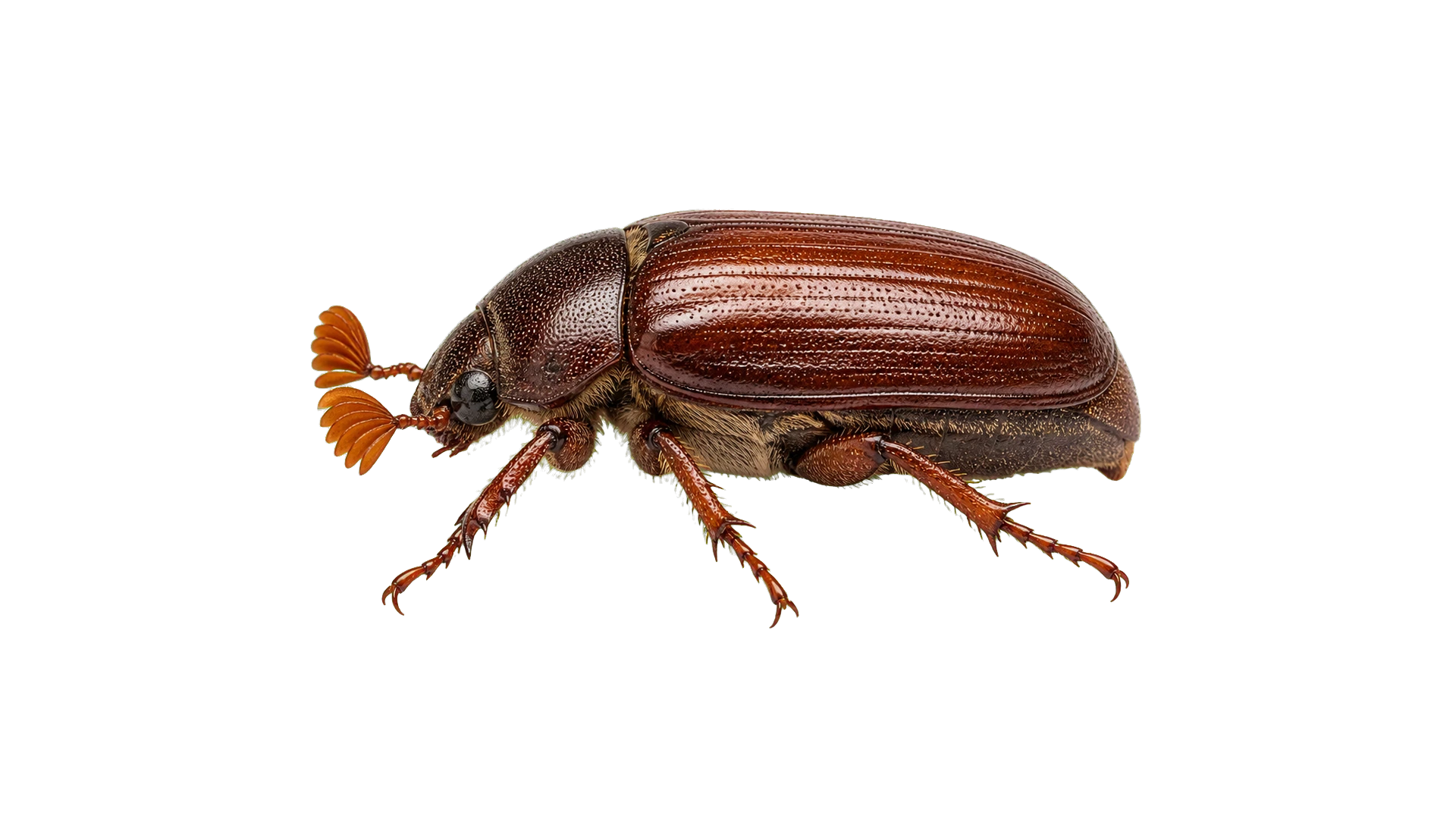
Close-up illustration of an adult June bug beetle and its C-shaped white grub larva, the form responsible for lawn damage

ID Card: June Bug

Scientific name
Phyllophaga spp.
Color
Reddish-brown, brown
Size
1/2 to 1 inch
Body shape
Oval, stout, shiny brown body
Antennae
Lamellate (fan-shaped club), 10 segments
Key evidence
Buzzing around porch lights at night in early summer, white grubs in lawn
Also known as
June beetles, May beetles, May bugs

Call to get matched with a local pest control pro.

Available 24/7
(888) 495-1510
  • Specialists trained on Phyllophaga and green June beetle identification
  • Soil-applied grub treatment that reaches larvae below the lawn surface
  • Lighting and entry modifications that reduce nightly adult invasion

Where to Inspect for June Bug Activity

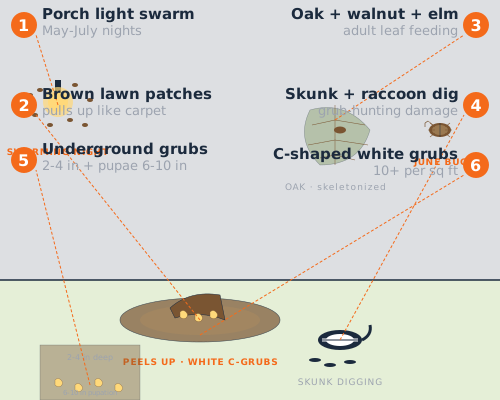
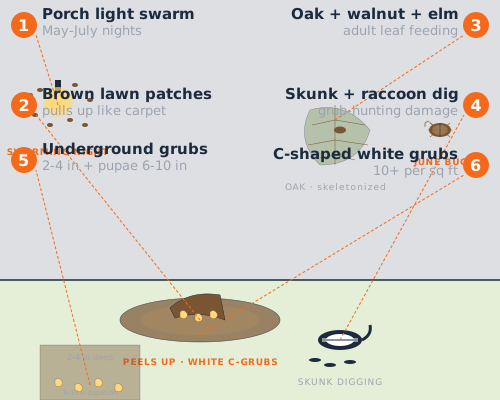
Cross-section illustration showing June bug damage zones, adult beetles at porch lights, white C-shaped grubs in lawn soil, and the brown lawn patches that pull up to reveal grub feeding

Adult June bugs and their grubs leave very different signs in very different places. The adults are obvious at night around lights. The grubs are invisible until you dig for them or until a skunk does it for you. Walking both zones is what tells you whether you have an adult-only nuisance or a full two-stage problem:

  • Outdoor lights from May through August, Porch lights, garage lights, and security lights are the primary adult evidence zone. Dozens of large beetles collected at the fixture, smacking into the glass, and bumbling into screens are the diagnostic signature.
  • Window screens and storm doors, Impact damage from clumsy flight shows up as dimpled screens, dented frames, and beetles wedged in the gap between screen and glass. The screen is usually the first thing homeowners notice getting beat up.
  • Sunny lawn areas with thatch buildup, This is where females lay eggs and where grubs feed on grass roots. Brown irregular patches appearing in late summer and fall that pull up like loose carpet are the diagnostic grub signature.
  • Lawn areas dug up by skunks, raccoons, or crows, Wildlife knows exactly where grubs are. Turf flipped over in chunks or torn up in strips means animals are feeding on grubs underneath, and the secondary damage often exceeds the grub feeding itself.
  • Around fruit trees, oak, walnut, and ash, Look for minor leaf chewing on accessible branches. Damage is cosmetic and rarely threatens tree health, but it confirms adult feeding activity on the property.
  • Garage interior near outdoor lights, Beetles drawn to garage lights wander inside and end up on the floor near the door. A handful of dead beetles on the garage slab each morning is a useful daily count of adult pressure.

The single most important June bug fact for treatment planning: this is two pests in one. The adult nuisance at outdoor lights is solved by lighting modification (yellow LED bulbs reduce attraction by 90 percent versus standard white LED or mercury vapor) plus screen and entry repair. The lawn grub problem is solved by soil treatment timed to the vulnerable grub stage. Treating one side of the problem without the other leaves the other half running, and most homeowners only notice the half they can see.

Cross-section illustration showing June bug damage zones, adult beetles at porch lights, white C-shaped grubs in lawn soil, and the brown lawn patches that pull up to reveal grub feeding
Illustration showing June bug lifecycle in lawn, adults at lights, eggs in soil, white C-shaped grubs feeding on grass roots, pupation chambers, and emergence of next-year adults

Why Do I Have June Bugs?

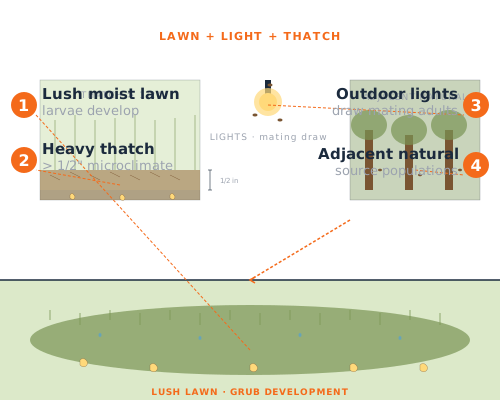
Spotting them is step one. Understanding why your property pulls them in explains why some yards get hit hard every year and others see almost nothing in the same neighborhood. June bugs are present across most of the United States, with different species dominant in different regions, but the local intensity comes down to a few conditions on the property itself.

What pulls June bugs onto your property:

  • Bright outdoor lighting, mercury vapor and standard white LED bulbs draw adults from a hundred yards away, concentrating beetles at the property and increasing the local egg-laying females
  • Large open lawn with heavy thatch, females prefer well-watered grass with thatch buildup for egg-laying because it gives larvae a soft humid layer to develop in
  • Mature oak, walnut, ash, or fruit trees, these are the tree species adults feed on at night, and their presence keeps adults staging on the property between flights
  • Agricultural area or large grass habitat nearby, golf courses, farm fields, and parks all act as source populations that disperse onto residential lawns during the summer flight window
  • Lack of natural biocontrol, properties with no birds, no parasitic wasps, and chemically suppressed soil microbes carry larger grub populations than properties with intact ecosystems

The lifecycle for true Phyllophaga June bugs takes 2 to 3 years from egg to adult, dramatically longer than the 1-year lifecycle of the Japanese beetle. That long larval stage means multiple year classes of grubs are present in the soil at the same time, and damage accumulates slowly and persistently rather than spiking and crashing year to year. It also means single-year treatment provides incomplete control: a multi-year program is more effective because it catches grubs across overlapping generations.

How Serious Is Your June Bug Problem?

Find your scenario below. Severity for June bugs has two dimensions: nightly adult pressure at lights and grub density in lawn soil. Both matter.

What You're Seeing Severity If Untreated Next Step
A few June bugs at porch lights nightly, no lawn damage visible Early Females laying eggs now; minor grub damage may appear next year and accumulate across the 2 to 3 year larval cycle Identify the species, switch to yellow LED bulbs, monitor lawn for early grub signs in late summer.
Dozens nightly, screen impact damage, a few entering the home Moderate Nightly nuisance will continue 8 to 12 weeks through peak summer; egg-laying load builds the next grub year class Lighting modification plus screen repair plus entry sealing. Cost typically $100 to $300.
Heavy nightly populations, lawn showing brown patches, animal-dug turf High Lawn damage will compound across multiple grub generations; wildlife digging adds secondary damage that often exceeds the grub feeding Call a professional this week. Combined adult deterrent plus grub treatment, typically $300 to $700.
Severe lawn damage, heavy nightly invasion, sleep disruption from beetles at windows Urgent Lawn may need full renovation; nightly impact damage continues until light source is modified Call today. Intensive program with long-term grub biocontrol plus comprehensive lighting and entry modifications.
A few June bugs at porch lights nightly, no lawn damage visible
Severity Early
If Untreated Females laying eggs now; minor grub damage may appear next year and accumulate across the 2 to 3 year larval cycle
Next Step Identify the species, switch to yellow LED bulbs, monitor lawn for early grub signs in late summer.
Dozens nightly, screen impact damage, a few entering the home
Severity Moderate
If Untreated Nightly nuisance will continue 8 to 12 weeks through peak summer; egg-laying load builds the next grub year class
Next Step Lighting modification plus screen repair plus entry sealing. Cost typically $100 to $300.
Heavy nightly populations, lawn showing brown patches, animal-dug turf
Severity High
If Untreated Lawn damage will compound across multiple grub generations; wildlife digging adds secondary damage that often exceeds the grub feeding
Next Step Call a professional this week. Combined adult deterrent plus grub treatment, typically $300 to $700.
Severe lawn damage, heavy nightly invasion, sleep disruption from beetles at windows
Severity Urgent
If Untreated Lawn may need full renovation; nightly impact damage continues until light source is modified
Next Step Call today. Intensive program with long-term grub biocontrol plus comprehensive lighting and entry modifications.

June bugs have a 2 to 3 year larval cycle, so single-year treatment misses overlapping generations. If you're between two rows, treat the higher one as your situation.

How June Bugs Develop

June bugs have an unusually long lifecycle for a common lawn pest. True Phyllophaga species take 2 to 3 years from egg to adult, roughly triple the 1-year lifecycle of the Japanese beetle. That long larval stage is exactly why grub damage builds slowly across overlapping generations and why multi-year treatment is more effective than a single seasonal application.

  1. Egg

    About 2 to 3 weeks

    Females lay eggs in lawn soil 2 to 5 inches deep, mostly in June, July, and August after mating at outdoor lights. Eggs hatch into small grubs within 2 to 3 weeks. This is the pre-feeding window when soil treatment intercepts the next generation before any root damage starts.

  2. Larva (white grub)

    2 to 3 years for true Phyllophaga

    The damage stage. Grubs are C-shaped and pale white with brown heads, larger than Japanese beetle grubs at 20 to 40 millimeters versus 18 to 22 millimeters. They feed on grass roots, rise toward the surface to feed in spring, descend deep in winter, and continue across multiple feeding seasons.

  3. Pupa

    About 1 to 2 weeks in late spring of final year

    Mature grubs migrate deeper in soil and form pupation cells. The transformation to adult happens over one to two weeks, and adults emerge directly from the soil shortly after.

  4. Adult

    Adults live 3 to 4 weeks above ground

    Adults emerge from late May into July, fly at night with a clumsy bumbling pattern, mate within days, and females lay the next generation of eggs in soil. Adults feed lightly on tree leaves and crash into porch lights nightly, but they don't damage lawn directly. Their eggs cause the next multi-year grub cycle.

Because the larval stage stretches across 2 to 3 years, multiple year classes are always present in the soil at the same time. That's why grub damage tends to build steadily rather than spike and crash, and why a single-year treatment leaves untouched grubs from other year classes. Effective long-term reduction means treating across multiple seasons.

When June Bugs Are Most Active

June bug activity follows a sharp annual pattern with the adult flight window squeezed into early summer and grub feeding stretched across the rest of the year. Each season requires a different focus.

  • Spring

    Grubs rise toward the surface to feed on grass roots after overwintering deep in soil. This is the second feeding window for grubs that hatched in previous years. Surface damage starts becoming visible in late spring on heavily infested lawns.

  • Summer

    Peak adult activity. Adults emerge from late May through July, fly at night, smack porch lights and screens, mate, and lay eggs in soil. This is also the prime treatment window for Phyllophaga grubs (June through August) and the loudest nightly nuisance window for homeowners.

  • Fall

    Grub damage to lawns becomes most visible as brown patches that pull up like carpet. Skunks, raccoons, and crows dig for grubs aggressively now, adding secondary damage that often exceeds the grub feeding itself. Treatment is still possible but increasingly difficult as grubs mature.

  • Winter

    Grubs descend 12 inches or deeper in soil and enter dormancy. No treatment is effective at this depth. The long larval stage continues underground; multi-year species spend most of the winter several feet down waiting for spring temperatures to rise.

Why June Bugs Need Professional Help

June bug service is more nuanced than most homeowners realize because it's actually two separate jobs on the same property. The adult nightly nuisance at outdoor lights is one problem, solved primarily by lighting modification rather than spraying. The lawn grub problem is a completely different job, solved by soil treatment timed to the vulnerable grub stage. Treating one without the other leaves the other half running, which is the most common mistake.

The single biggest win on the adult side costs very little: switching outdoor light bulbs from mercury vapor or standard white LED to yellow LED reduces beetle attraction by roughly 90 percent. The same fixture pulls a tenth as many beetles, and the change is permanent. Most homeowners discover this only after a pro flags it, because the typical hardware-store solution (spraying around the porch) does almost nothing for adult pressure.

On the grub side, timing is everything. True Phyllophaga grubs are most vulnerable from June through August, earlier than the July through August window for Japanese beetle. Treatment applied at the wrong stage can be 60 to 80 percent less effective than the same product applied during the vulnerable window. And because the larval cycle stretches across 2 to 3 years, single-year treatment misses grubs from overlapping generations. Multi-year programs with milky spore and beneficial nematodes provide long-term reduction.

Total cost for a combined adult deterrent and grub program typically runs $300 to $700 ($200 to $500 for lawn treatment, $100 to $300 for lighting and entry modification). That's much less than full lawn renovation after multiple years of grub damage plus skunk and raccoon digging, and dramatically more effective than DIY spraying that doesn't reach grubs in the soil zone.

What Changes When a Pro Shows Up

June bug service is two jobs on the same property: an adult deterrent program at outdoor lights and a grub program in the lawn. A specialist handles both at the right time for each. Here's what changes when a pro shows up:

Pest control technicians after completing a June bug grub treatment on a lawn
  • Local Pest Control
  • 24/7 Availability
  • Quality Workmanship
  • Eco‑Friendly Options
  • Trusted by Homeowners
  • Confirms the Species Before Recommending Anything

    Phyllophaga and green June beetle look different and act on different calendars. Phyllophaga grubs prefer June through August treatment; green June beetle grubs feed closer to the surface. Species ID is what aligns timing with the right life stage.

  • Times Grub Treatment to the Vulnerable Stage

    June through August catches Phyllophaga grubs at their most vulnerable, which is earlier than the July through August window for Japanese beetle. Wrong-month treatment can be dramatically less effective even with the same product.

  • Modifies Lighting to Cut Adult Attraction

    Switching to yellow LED bulbs at porch, garage, and security fixtures reduces adult attraction by roughly 90 percent versus mercury vapor or standard white LED. The change is permanent and dramatically more effective than spraying.

  • Plans for the 2 to 3 Year Larval Cycle

    Multiple year classes of grubs are present in the soil at the same time, so single-year treatment leaves the next generation untouched. A multi-year program with milky spore and beneficial nematodes provides long-term grub reduction across overlapping generations.

  • Local Pest Control
  • 24/7 Availability
  • Quality Workmanship
  • Eco‑Friendly Options
  • Trusted by Homeowners
NoToPests home

One call connects you with a local specialist who knows june bugs and your area.

Be Ready When You Call

Pest control technician arriving for a June bug grub treatment on a lawn
Junho L.
Daisuke P.
Kirk Q.
Marion K.

Trusted by homeowners nationwide

Call for Pest Control Help (888) 495-1510

Can You Handle This or Do You Need Help?

June bugs are one of the few pests where DIY actually handles a major part of the problem (the adult nightly nuisance) very well, while the grub side benefits from professional timing and multi-year planning.

What DIY Can Do

DIY work is genuinely effective for adult nuisance and partially effective for grubs over multiple seasons. Useful steps with honest limits:

  • Identify the species by size (large, 10 to 25 millimeters), clumsy bumbling flight, and nightly attraction to outdoor lights
  • Switch outdoor bulbs to yellow LED, this single change reduces adult attraction by roughly 90 percent
  • Repair impact damage to window screens and seal any gaps wider than a quarter inch
  • Apply milky spore and beneficial nematodes for long-term biological grub reduction across multiple years
  • Rake thatch from the lawn in fall to remove the egg-laying habitat that attracts females
  • What DIY cannot reliably do: time chemical grub treatment to the June-through-August window when Phyllophaga grubs are most vulnerable.

What a Pro Does Differently

A pro adds species-level timing and multi-year planning that DIY usually misses. Here's what changes when you call:

  • Species identification (Phyllophaga versus green June beetle) sets the right grub treatment timing
  • June through August chemical grub treatment catches Phyllophaga larvae at their most vulnerable stage
  • Multi-year program design accounts for the 2 to 3 year larval cycle and overlapping year classes
  • Lawn vigor management (deeper irrigation, thatch reduction) lowers the property's grub-carrying capacity over time
  • Recurring service for chronic high-population properties near agricultural areas or large grass habitat.

Suspect June Bugs? Don't Wait.

The Phyllophaga grub treatment window runs June through August, and adult nightly invasion ramps up across the same months. Connect with a local specialist who handles lighting modification, entry sealing, and properly timed grub treatment.

Available 24/7
(888) 495-1510

What Homeowners Say After Getting Help

Real results from people who had the same problem and solved it.

Kimberly I.
Kimberly I.
Kodiak, AK

"Stored clothing saved from carpet beetles."

We found holes in stored wool sweaters and discovered carpet beetles in the closet. The tech treated the closets and storage areas and explained how to store clothes to prevent reinfestation. The targeted approach worked perfectly.

Kimberly I.
Kimberly I.
Kodiak, AK

"Stored clothing saved from carpet beetles."

We found holes in stored wool sweaters and discovered carpet beetles in the closet. The tech treated the closets and storage areas and explained how to store clothes to prevent reinfestation. The targeted approach worked perfectly.

Veda J.
Veda J.
Indianapolis, IN

"Fumigation cleared stored product pests from our pantry and walls."

Indian meal moths and beetles had infested our pantry and spread into the wall cavities behind the kitchen. Standard treatments were not reaching the source. The provider recommended fumigation to eliminate larvae and adults in every hidden space. We cleared the home, the crew tented and treated, and clearance testing confirmed a complete knockdown.

Natalie Y.
Natalie Y.
Wichita, KS

"Fumigation eliminated carpet beetles throughout."

Carpet beetles had infested our wool rugs, closets, and even the HVAC ducts. Multiple targeted treatments only knocked them back temporarily. The provider recommended structural fumigation to reach larvae hiding in wall voids and ductwork. We followed the preparation checklist, cleared the home, and the crew handled the tenting and gas treatment. Clearance testing confirmed success and our belongings have been damage-free since.

Common Questions About June Bugs

Direct answers to what homeowners ask most about species identification, adult light attraction, grub damage diagnosis, and treatment timing.

  • How do I know if the beetles hitting my porch light are June bugs? Toggle answer for: How do I know if the beetles hitting my porch light are June bugs?

    June bugs (May/June beetles) are large, oval, reddish-brown to dark brown beetles, typically 1/2 to 1 inch long, with a distinctly clumsy, buzzing flight pattern that sends them crashing repeatedly into porch lights, windows, and screen doors on warm summer nights. They are noticeably larger and heavier-bodied than most other beetles attracted to lights, and their loud buzzing is distinctive. During the day they hide in soil or vegetation. Their larvae, large, C-shaped white grubs found in soil, areamong the most damaging turf-feeding grubs, and heavy adult flight activity near your home usually indicates a substantial grub population in nearby turf.

  • Do June bugs cause any damage as adults? Toggle answer for: Do June bugs cause any damage as adults?

    Adult June bugs cause relatively minor feeding damage compared to their destructive larval (grub) stage. Adults feed on foliage of deciduous trees and shrubs at night, but their feeding is generally superficial and rarely threatens plant health. The real damage comes from their larvae, which spend one to three years in the soil feeding on grass roots and can cause devastating turf damage, brown, dead patches where grass pulls up easily because the root system has been consumed. A heavy June bug flight season signals that egg-laying is occurring in your turf, and a preventive grub treatment in mid-summer can prevent larval damage the following year.

  • Why do beetles keep appearing inside my home? Toggle answer for: Why do beetles keep appearing inside my home?

    Beetles are the largest order of insects, and different species enter homes for different reasons. Carpet beetles feed on natural fibers, pet hair, and dead insects indoors. Powderpost beetles infest hardwood floors and furniture. Pantry beetles (drugstore and cigarette beetles) target stored food. Asian lady beetles and boxelder beetles invade in fall to overwinter. Identifying the species is the first step to solving the problem.

  • Are beetles harmful to my home? Toggle answer for: Are beetles harmful to my home?

    It depends on the species. Powderpost beetles can cause serious structural damage by boring into hardwood, leaving behind small round exit holes and fine powdery frass. Carpet beetles destroy wool rugs, clothing, and upholstery. Pantry beetles contaminate stored food. Other species like ladybugs and ground beetles are nuisance invaders that don't cause damage but are unpleasant in large numbers.

  • How quickly can a provider get to my home? Toggle answer for: How quickly can a provider get to my home?

    Most providers in our network can schedule an inspection within 24-48 hours. For urgent situations, likeactive structural damage or large colonies, same-week emergency service is often available. Response times depend on your location and the provider's current schedule.

  • What happens during the first visit? Toggle answer for: What happens during the first visit?

    Your provider inspects the property to identify the pest, locate nesting or entry points, and assess the scope of the problem. You get a clear explanation of what they found, what they recommend, and a written scope before any work begins.

  • Is treatment safe for kids and pets? Toggle answer for: Is treatment safe for kids and pets?

    Modern pest control products are designed to break down quickly after application and pose minimal risk to people and pets when applied correctly. Most providers ask you to keep kids and pets out of treated areas for 1 to 2 hours while the product dries, after which the area is generally safe again. Always confirm specific re-entry times with your provider, and let them know about pet birds, fish, or reptiles, since some treatments require extra precautions for those species.

Pest Control Pros serving the city of the state of your city and nearby areas

Local providers experienced with lighting modification, entry sealing, and timed grub treatment are ready to assess both sides of the June bug problem, no obligation.

Available 24/7
(888) 495-1510